
by Pippa Teague, Strength Coach | Oct 7, 2019 | Abdominals, Back Pain, Client Achievements, Conditioning, Exercise advice, lifts, Recovery, strength training, Uncategorized
Today we are highlighting Michelle who has been with us since August 2018 after dealing with severe lower back and hip pain.
“I was in constant pain in my lower back and afraid that I would have to accept this as a new standard of living for myself. On July 4, 2018, I went to bed with excruciating pain in my lower back and tingling in my leg. I never had this happen in my life and had no idea what to do. The pain came out of nowhere, but now I realize that it was probably building for some time and came to the surface then. I was in my 20s and felt like I was in my 90s because of what I was told by doctors about managing my lower back issues and overall pain levels.”
Upon meeting Michelle, I quickly realized that she was in need of reassurance and was really looking for someone to guide her. She was desperate for answers and did not know where to turn as her symptoms were not just resolving on their own. She was provided with conflicting advice and was not sure who she could trust. This is a major issue that I see in many of my clients and it is my job to help make sense of some of the things that they have been told.
“My struggle affected every part of my daily life. I was always thinking about the pain when I was at work or out with friends and family. I didn’t want it to come back and was afraid that everything I was doing was making it worse whether I was exercising or staying still. I felt out of control in my body. I had no idea what I should do. My doctor told me to wear a neck brace and to essentially stay still. My spine specialist told me that I had a disc herniation in my lower back, which was scary to hear. I was not in a car accident and have always been healthy, so I did not understand why this happened.”
Michelle was in a tough position coming into our office. Many of our patients experience pain that affects their daily life and it is sometimes extremely difficult to manage on their own.
“Loni helped me get to a place where I felt stronger and comfortable in my daily life. I got to a point where I stopped feeling the pain. I gained the confidence to exercise regularly and lift boxes, etc. without being scared to injure myself. I would not be where I am today without Loni and Infinite Potential.”
Michelle has been a pleasure to work with from day one. She has shown endless appreciation for what we have provided and is also very open to new ways of thinking about her pain, alternative approaches to treatment, and has shown willingness to trust the process. Michelle has made consistent progress since beginning with us and has sought care past her original injury committing to strength training since completing her time in physical therapy. Strength training was not a part of her regular routine but she has since adopted the practice as a regular weekly activity. She has made significant progress in the realm of strength, endurance and power achieving goals that she never thought were possible.
We asked Michelle what she wants others to know about her experience with Infinite Potential PT. Here is what she had to say:
“I want others to know that they should go to Infinite Potential (IP)! The business is different than the standard physical therapy at out-patient centers or hospitals, but this is what makes her special and one-of-a-kind. I had been in and out of PT at hospitals before being a client at IP. I was only there for a few weeks (6 at most) and then discharged and my issues would come back. I wasn’t given one-on-one treatment plan like I get here. Loni spends the time to really understand your needs and help you not just for a short time, but for your life. I wish everyone could discover what I’ve found in Infinite Potential. Loni has been life-changing and I will follow her wherever I go. I live closer to the North Shore now and commute to see her weekly! She’s the best!
Our passion at IPPTW is to empower people to realize their full potential. We strive to decrease their fears, help them understand what is going on and what can be done in the long and short term. We want to be YOUR resource for help and feel strongly that we can give you informed guidance to help you make decisions about your health.
If this story spoke to you, or speaks to someone you know, please pass it on. Can you relate to Michelle? Let us know by replying to this email.
![5 Misconceptions Surrounding Low Back Pain]()
by Pippa Teague, Strength Coach | Jun 10, 2019 | Back Pain, Exercise advice, Injury, Injury Prevention, lifts, squats, strength training, Uncategorized, working with injury

By Loni Rodriguez DPT
Low back pain is an extremely common condition that many people are faced with on a daily basis and the incidence is climbing. From 1996 to 2006, the number of people who experienced low back pain increased from 3.9% to 10.2%. Recent research has also shown that up to 33% of individuals who have experienced low back pain experience it again within one year.
How can this be?
There have been significant advancements in medical technology including improved surgical procedures, imaging techniques, and medications. With these advancements, however, the incidence of low back pain continues to increase.
What are we doing wrong?!
One main underlying issue is the misconceptions surrounding the topic of low back pain. These misconceptions can lead to poor treatment outcomes, fear of movement, incorrect diagnoses, and worsening symptoms. The discussion today will help debunk some of these misconceptions and will better educate YOU on this low back pain epidemic.
Misconception #1: My back hurts, I should rest.
I don’t recommend anyone take complete rest from their activity. In every case of low back pain, there are specific activity modification recommendations that can be made. I will never tell someone to completely rest!
These modifications are specific to each person – it is recommended that you seek medical advice to find out what the right path is when you are dealing with pain.
Not convinced? Let’s hear Roy’s Story
Misconception #2: I should not lift weights because it is bad for my back.
One of the most effective ways to treat low back pain is strength training. Strength training creates full body resiliency. The most beneficial weight training exercises involved in low back pain rehabilitation programming include squatting, deadlifting, carrying, pressing, and pulling. All of these exercises help strengthen the muscles throughout the entire body including the lower back, which help to decrease pain and improve activity tolerance. Just like the previous recommendation, if you have low back pain do not think that jumping into these exercises without supervision is a good idea. Seek advice from a trusted professional!
Misconception #3: My back pain is from the chair I sit in at work.
Most of the time, back pain and the type of chair you sit in do not correlate. In some cases, the amount of time sitting and the lack of time spent up and moving are bigger contributors to symptoms. As stated before, movement is medicine, especially in the case of low back pain – when in doubt, just get up and move as frequently as you can.
Misconception #4: My back is stiff, I probably should be stretching more.
A stiff back does not always mean that it has to be stretched. A lot to times, stiffness is a perception of being tight and it is your body’s way of telling you that it needs some attention. Low back stiffness can be helped with frequent, active movement, versus stationary, passive stretching. This type of stretching does serve a purpose, but is not the most effective way of helping your stiff back. Here is a quick video to a great routine that you can perform on your own to “loosen” your lower back!
Misconception #5: I know where my pain is coming from, I have a disc herniation.
Disc herniations are not proven to be the cause of back pain. In most cases, disc herniations are not causing the symptoms. Especially when the pain has been going on for a while. This condition can be considered part of the normal aging process! The percentage of people with disc herniations increases with age and most of the people with herniations do not have pain! Please quit blaming your pain on a condition that can be considered the gray hair of the spine.
If you would like more information on back pain, or any pain for that matter, please visit www.infinitepotentialptw.com. On this website there is a plethora of free information and content, as well as a forum to ask questions.
References
Delitto et al. “Clinical Practice Guidelines linked to the international classification of functioning, disability, and health from the orthopedic section of the American Physical Therapy Association”. J Orthop Phys Ther. 2012;42(4):A1-A57
by Dr. Loni Rodriguez | Sep 24, 2018 | Back Pain
 Why squatting and deadlifting are GOOD for your back.
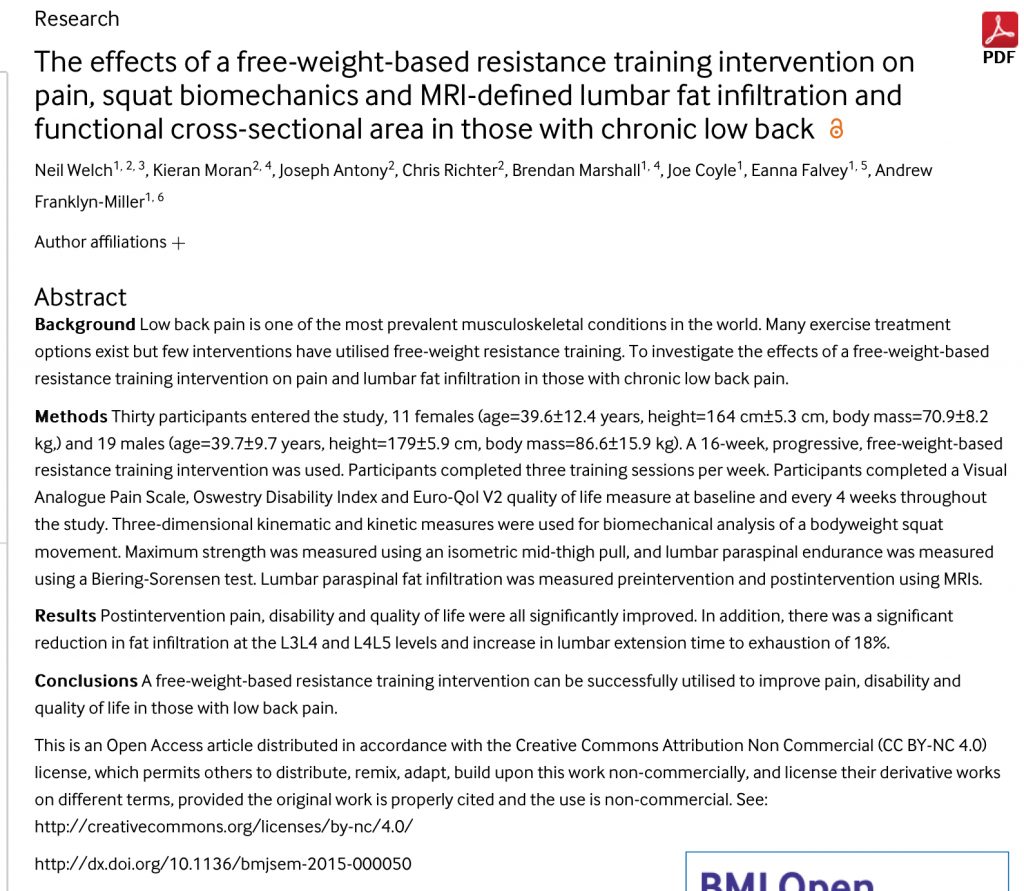
People in pain have many beliefs about their symptoms in regards to why it is present, what is causing it, what could be contributing to the pain, etc. Specific to the topic of lifting, many feel that lifting or carrying heavily weighted objects or performing heavily weighted exercise can cause low back pain. Can you strain a muscle by lifting something? Of course! However, when performed properly, a regimen of free weight-based resistance training can actually help decrease these symptoms. I stumbled across a great article that I will break down into lay terms to help explain the importance of this type of resistance in people with low back pain.
Exercise has been recommended as the most effective conservative management for persistent low back pain in combination with addressing psychological, social, genetic and physical factors. There is evidence that resistance training, specifically, can help to eliminate the requirement for surgery or injections and can help reduce the related fear associated with low back pain. It has also been shown to be more effective at addressing low back pain compared to aerobic, coordination, Pilates, or mobilization training.
When looking at different types of resistance training, we think of machine-based and free-weights. Free-weight specific resistance training helps recruit the erector spinae and other posterior chain musculature which are very important in the treatment of low back pain. An in-depth discussion of free-weight vs. machine-based exercises is outside the scope of this post, however, the focus of the following resistance training program is based upon free-weight exercise. Participation in this type of training may be contrary to popular belief about what may be detrimental to a person experiencing low back pain.
A few factors that were looked at in this study were peoples compensatory movement patterns due to pain, the amount of fatty-infiltrated muscles of the lower back, lower back muscular endurance, pain levels, quality of life, and perceived level of disability. Compensatory movement patterns are seen in people with low back pain as they try and avoid movements of the lumbar spine. Specifically movements going from sitting to standing and bending forward to pick something from the ground are often guarded. This guarding and co-contracting of trunk musculature is an altered motor pattern that can enhance the disuse of spine musculature prolong the pain continuum. With the disuse of these muscles, fatty-infiltration and decreased muscular surface area can be seen and has been proven to be associated with people dealing with persistent low back pain.
The specific movements performed in this study were based around the squat and the deadlift, two movements that are functionally performed daily by all humans. A deadlift is simply picking something up from the ground and a squat is sitting down and standing up. The participants that were included were of ages 16-60, both men and women, having a history of low back pain for >3 months. They went through a 16-week program that consisted of 3 training days per week. The resistance training was based around 7-10 rep maximum which can be associated with moderate to heavy weight training (for the purposes of this article, specifics about the positive effects of loading with heavier weight training will not be discussed).
Results? Dramatic.
Significant decrease in fatty infiltration and increase in lumbar paraspinal muscle endurance without specifically training lumbar extension – basically meaning that the resistance training performed improved spine muscle quality and strength without directly training the spine muscles. The resistance training that was performed engaged the low back muscles in an effective way!
Pain, disability and quality of life were significantly improved by over 70%!
Body mechanics and coordination of the sit to stand (squat) movement were significantly improved with decreased presence of guarding.
Take home points?
- Including free-weight-based resistance training in a rehabilitation program could improve the outcome of the treatment.
- Try not to be afraid to lift weights! As long as it is done properly, a regular strength training routine can be a very effective aspect of a rehabilitation program.

by Dr. Loni Rodriguez | Aug 27, 2018 | Back Pain

A patient’s imaging results are one of the most popular topics of conversation within the first 15 minutes of almost every evaluation with a new client experiencing low back pain. The client will either be questioning going for an MRI or be describing what was found when they received one in the past. I listen to them, I hear them out, then I drop the knowledge bomb on them…
The prevalence of an abnormal finding is high in people without symptoms and this increases with age. This means that most findings on images are normal and do not always correlate with pain. So, bulging discs, degenerative disc disease, and disc protrusions are like the gray hairs of the spine? Wrinkles on the inside? Pretty much.
A systematic review by Brinjikji et al went through articles that analyzed the imaging findings of 3110 asymptomatic individuals. The findings were outstanding:
- 30% of people at the age of 20 had disc bulges, this increased to 60% at age 50, and 84% at age 80.
- 23% of people at age 20 had disc protrusions and up to 43% at age 80
So, how relevant are the findings on MRI? Not always very relevant at all. This raises the discussion about how imaging findings impact the management of patients with low back pain. Is it very important for clinicians to know what a MRI will reveal? Imaging of the lumbar spine has not been shown to improve clinical outcomes. Why would we want to pay for a very expensive exam that will not change the course of care, management or outcome of treatment of low back pain? I know I sure wouldn’t.
Yet, I do empathize with patients wanting to “…just want to know what is going on inside.” However, what you must understand is that over half of 50 year olds imaged in the study discussed above, had a bulging disc and they did not have pain. Are you over 50? There is a high probability that you have one, too.
I do want to note that there are definitely circumstances when imaging is warranted. Images are necessary when we want to rule out red flag conditions such as cancer or fractures. So, before you jump to conclusions about what was found when you got that MRI, or push your doctor to order that image, remember that prevalence and relevance of abnormal findings are not synonymous. Pain is an experience that has sensory, cognitive and emotional components. What is found on the image is only a portion of what we as clinicians factor into the plan to help you feel better. Abnormal image findings and pain are not necessarily correlated and are likely part of the aging process.
Reference
Brinjikji et al. A Systematic Literature Review of Imaging Features of Spinal Degeneration in Asymptomatic Populations. American Journal of Radiology. 24 Nov 2014.
