
by Dr. Loni Rodriguez | Feb 6, 2020 | Client Achievements
Today we are going to highlight Joe, who has been doing great things since having his hip replaced at the end of October. When Joe first came to us, he had only had his right hip replaced two weeks earlier. As expected, he was having some pain and difficulty getting around. This wasn’t Joe’s first hip replacement, which meant he was well prepared for all the physical therapy and the time it would take to get back to 100%.
Here is Joe’s story:
“I was recovering from hip replacement surgery. This was my second hip replacement and I also struggled with overall mobility issues. Prior to the surgery my daily activities and workout programs were limited. I am very active and like a lot of activities that keep me moving and on my feet. Everything from remodeling my home, climbing ladders, cross-fit training were all painful and were becoming less and less enjoyable for me. Although my first hip replacement was successful, I wanted to take a more focused approach to recovery this time. It’s been 4 years since the first surgery and I still feel weakness in that hip. I was determined this time to find a program that could improve strength in both hips, improve my mobility and balance.”
“I found myself immediately doing movements that I didn’t expect do for months. The focus on a variety of single leg movements has helped strengthen my legs and hips as well as improve balance and core strength. At this point I’m able to do movements that I haven’t been able to do in years. I’m pain free and able to do all activities that I enjoy.”
“I really appreciate that on my first day Colin asked me what I wanted to get out of the program. We set goals which have been achieved and Colin continues to check in on what else I feel I need to work on. My sessions are challenging and fun. It’s nice to be able to work hard, but have a good conversation and a laugh while pushing some new boundaries. I really like that when I leave the session Colin sends a workout program to me to focus on in between appointments. I would highly recommend this program to anyone.”
I have had a ton of fun working with Joe, he is constantly upbeat and motivated to take on new challenges. Joe is always consistent with his program at home and is seeing the payoff from his efforts. This combination of great effort during our sessions and commitment to working hard at the gym are why he has made so much progress so quickly with his hip. I’m excited to keep working with Joe and help him reach all his goals. Thanks for being so committed to this program, we are all very proud!

by Dr. Loni Rodriguez | Nov 19, 2018 | Back Pain, Exercise advice, Injury, Injury Prevention, knee pain, lifts, squats, working with injury
What to do when you are having pain during a workout?
Have you ever just left the gym or class when pain starts to occur? How annoying is that?! First off, you didn’t get a workout in, second, you might have hurt yourself… I hope not, and third, what do you do now? Should you go back to the gym tomorrow? Take a week off?
I really would like this post to come across the right way. I am by no means, telling you it is okay to push through any significant pain while exercising. What I would like to do is to provide a guideline of what to do when pain comes on during a workout.
Before I get into the guideline, there is one major exception:
*If you actually feel like you had an injury, as in, there was an EVENT that caused your pain, please stop exercising and seek medical attention*
Eg.
- if you fall off the treadmill, and feel a pop or snap in a joint followed by severe pain
- if you hit your head
- if something occurs and you notice immediate swelling and pain
…you get the point
What this guideline is NOT…
- A way to treat your pain
- A way to continue to exercise multiple sessions in a row without seeing guidance from a medical provider
- A way to avoid formally dealing with your injury
Point being… please seek medical advice to really help your issue!
In the meantime, I want you to be able to have some understanding of how to allow training to continue despite some pain vs taking time off.
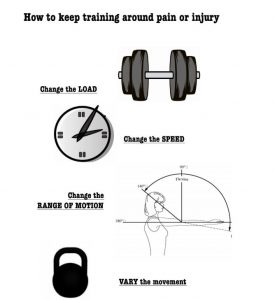
First… reduce the weight
- Try using a lighter weight, but continue the movement as prescribed.
- If the reps continue to be painful…
Next… slow it down
- Keep the weight and try using performing the movement slowly.
- If the reps continue to be painful…
Next… change the range of motion
- Keep the weight, return to a normal speed and limit how far you go into the movement being performed.
Finally… vary the movement
- There are various ways to perform different exercises.
- You can continue to get the same training effect while performing the movement in a slightly different way.
Here are a few examples of how you can vary the workout if you are experiencing pain during specific movements:
Knee pain with squatting?
- Reduce the load
- Alter the tempo – 3 seconds down, 3 seconds up
- Reduce the range of motion – Squat to a box or a bench
- Change the movement – go from front squats or goblet squats to a back squat
Back pain with deadlifting?
- Reduce the load
- Alter the tempo – try a quick lift from the floor and a slow lower
- Reduce the range of motion – Lift from an elevated surface (blocks or plates)
- Change the movement – go from a barbell to a hex bar or kettlebell
Use this to help keep yourself training, but PLEASE… also seek medical advice. There are many other things to be done in order to get you back to being pain-free during workouts… most of the time, it’s more exercise! Not rest.
