by Pippa Teague, Strength Coach | Sep 19, 2019 | Conditioning, Exercise advice, Injury Prevention, lifts, Personal training, Running, squats, strength training, Uncategorized
By Jenny Gusella
These days there are endless workout options, from spinning to barre to HIIT to personal training, bootcamps, home DVDs and more. There’s also tons of information and scientific research floating around about the benefits of one workout versus the next. With your head spinning from information overload, you finally decide to seek an expert opinion, so you ask a trainer like me, “OK. Tell me the truth. What is the best workout?”
The best workout is the one that you will actually do. Whether it’s because it’s the quickest, or you love the instructor, or your friends go to that gym, or your favorite coffee shop is next door, or because you genuinely love the workout, there is no reason too small if that reason is enough to get you to complete the workout.
The human body is much more simple than we think. Eat food, move around, sleep, repeat tomorrow. Of course, in between those things is an entire life – a career, familial responsibilities, not to mention social pressures, self-doubt, etc. All of those things complicate the basics, but you have the power to uncomplicate fitness. Are you stressed that you don’t have an hour to spare to workout? Simple solution: do a 45 minute workout. Are you dreading doing that 3 mile run you promised yourself you’d do? Simple solution: Don’t do the run. Do some squats, lunges and pushups, or go for a bike ride, or walk your dog.
Yes. I just said, “don’t do the run.” Running in particular is a topic that comes up so often in this line of work. So many of us dread running, and yet force ourselves to do it anyways, as if it’s some sort of requirement. I am here to tell you: YOU DO NOT NEED TO RUN IF YOU DON’T WANT TO. Ever. (Unless you’re being chased.) I am also here to tell you that you do not need to be “a runner” to go on some runs. If you like it, do it, if you don’t, do something else. It truly is that simple. Think about Forrest Gump. Why did he start? “I just felt like running.” Why did he stop? “I’m pretty tired. I think I’ll go home now.”
The next time you find yourself in a workout rut and are about to ditch the gym, ask yourself if there’s maybe another physical activity you’d rather do instead, and try to direct yourself down that route. Don’t worry if your workout doesn’t “scorch the most calories” or “target 90% of your muscles” – just move!

by Dr. Loni Rodriguez | Nov 19, 2018 | Back Pain, Exercise advice, Injury, Injury Prevention, knee pain, lifts, squats, working with injury
What to do when you are having pain during a workout?
Have you ever just left the gym or class when pain starts to occur? How annoying is that?! First off, you didn’t get a workout in, second, you might have hurt yourself… I hope not, and third, what do you do now? Should you go back to the gym tomorrow? Take a week off?
I really would like this post to come across the right way. I am by no means, telling you it is okay to push through any significant pain while exercising. What I would like to do is to provide a guideline of what to do when pain comes on during a workout.
Before I get into the guideline, there is one major exception:
*If you actually feel like you had an injury, as in, there was an EVENT that caused your pain, please stop exercising and seek medical attention*
Eg.
- if you fall off the treadmill, and feel a pop or snap in a joint followed by severe pain
- if you hit your head
- if something occurs and you notice immediate swelling and pain
…you get the point
What this guideline is NOT…
- A way to treat your pain
- A way to continue to exercise multiple sessions in a row without seeing guidance from a medical provider
- A way to avoid formally dealing with your injury
Point being… please seek medical advice to really help your issue!
In the meantime, I want you to be able to have some understanding of how to allow training to continue despite some pain vs taking time off.
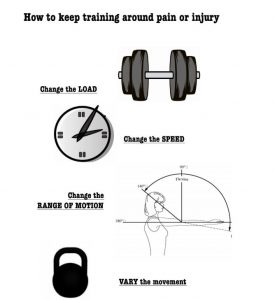
First… reduce the weight
- Try using a lighter weight, but continue the movement as prescribed.
- If the reps continue to be painful…
Next… slow it down
- Keep the weight and try using performing the movement slowly.
- If the reps continue to be painful…
Next… change the range of motion
- Keep the weight, return to a normal speed and limit how far you go into the movement being performed.
Finally… vary the movement
- There are various ways to perform different exercises.
- You can continue to get the same training effect while performing the movement in a slightly different way.
Here are a few examples of how you can vary the workout if you are experiencing pain during specific movements:
Knee pain with squatting?
- Reduce the load
- Alter the tempo – 3 seconds down, 3 seconds up
- Reduce the range of motion – Squat to a box or a bench
- Change the movement – go from front squats or goblet squats to a back squat
Back pain with deadlifting?
- Reduce the load
- Alter the tempo – try a quick lift from the floor and a slow lower
- Reduce the range of motion – Lift from an elevated surface (blocks or plates)
- Change the movement – go from a barbell to a hex bar or kettlebell
Use this to help keep yourself training, but PLEASE… also seek medical advice. There are many other things to be done in order to get you back to being pain-free during workouts… most of the time, it’s more exercise! Not rest.
