by Dr. Loni Rodriguez | Feb 20, 2020 | Exercise advice
Have you ever twisted or sprained your ankle? Sometimes it
happens while you’re playing sports, working out, hiking, or even just walking around
the house. Either way, this can be quite painful, and I’ll get asked a lot of
times if it’s worth coming in for physical therapy.
The answer is yes!
When you sprain your ankle the ligaments that help support the ankle joint are
overstretched. It can take a while for these ligaments to heal and be back to
full strength, but we don’t always think about the other parts of our ankles
that are hurt. Our muscles have a harder time doing their job for walking and
turning because of the stiffness and pain. We also have receptors in our ankles
that help keep us balanced. Basically, the receptors tell our body when we are
off balance and how to correct it. When you sprain your ankle, these receptors
and your muscles are not able to do their job very well, which can lead to poor
balance and difficulty with normal activities like walking. Without some specific
exercises it can take a lot longer to get back to feeling your best. Especially
if you’re trying to get back to exercising it is really important to make sure
your body is prepared for the specific movements you want to do.
Right after spraining your ankle there are a few things you
should make sure to do and understand. This is the first step to helping your
ankle heal and get you back to 100%
1- Protect your ankle to prevent any further twisting or
injury to the area. This means restricting the activity on your ankle for about
1-3 days. Just enough to let the area start to heal, but not too long
either.
2- Elevate your ankle above your heart to help with the
swelling. Try about 20 minutes at a time.
3- Compression can also be helpful with swelling. Try this
with an ACE bandage or compression sleeve. It is important to know that this
isn’t the most important part of rehab for your ankle, but it definitely won’t
hurt either.
4- Active recovery is the most important part of
rehabbing your ankle. This means the bulk of getting your ankle better is going
to involve exercise and gradually challenging your ankle. This includes walking,
strengthening, balance, and plenty of other exercises.
In general, let pain be your guide with this process.
If something really hurts a lot, you’re probably not ready to do it. If
something hurts a little bit. It’s okay to keep doing.
After those first few days there are a few next steps in
this rehab to help you make a quick recovery.
1- The first thing you want to do is gradually load the ankle. This
means putting weight on it, walking, and performing light exercises. By gradually
challenging your ankle with weight bearing, and light exercises you will improve
your ankles ability to become strong, pain free, and balanced.
2- You also want to remain positive and optimistic throughout this process. Suffering
any kind of injury can be really difficult, especially when it keeps you from
doing the things you love. When you sprain your ankle, you might miss part of
your sports season or be unable to exercise with friends. This can be really
hard to deal with, especially if you’ve had other ankle sprains in the past. It
is important to remember to stay positive because it will get better, it just
takes time and hard work.
3- It is also really hard to keep doing cardio when you’ve sprained your ankle.
If you’re a runner or soccer player, it isn’t easy to do your normal workout. It’s
important to find a way to do some cardio. This could be riding a bike, using an
elliptical, or working out on a rower. Any of these will work great, just make
sure to keep some kind of aerobic exercise in your routine.
4- Finally, the most important part of rehabbing your ankle is to perform
specific exercises and gradually progress them. This means challenging your balance, range of motion, and strength. It will be important to work
within your limits, but also to push yourself so you can make steady progress. As
you get stronger the exercises should progress, so they are even more challenging
and specific to your goals. The specific exercises are going to be the most
important part of healing your ankle and will help you to have long term
success.
Remember, if you sprain your ankle PT can be really helpful!
It can help you recover faster and more fully so that the chances of having
another ankle sprain aren’t as high. Take time to recover fully so you can
get back to the things you love to do sooner and safer.
by Dr. Loni Rodriguez | Feb 13, 2020 | Exercise advice, Foot Pain, Injury, Running
Plantar fasciitis (PF) is a term used to describe inflammation or pain on the bottom of the foot. The plantar fascia is a taught band of tissue that holds the arch of the foot. There are also TONS of layers of muscles on the bottom of the foot that can give pain as well meaning the pain generator is not just the plantar fascia, it can be from muscles as well.
The pain can come in a few different forms – sometimes it’s pain on the heel, sometimes it’s pain on the arch. There are a few other things that “foot pain” could be, but there are a few classic signs of PF:
- Pain that is worse with the first few steps out of bed in the morning
- Pain after a longer time standing, walking, or running
- Pain that seems pin pointed on the bottom of the foot and is sensitive to the touch.
None of the above can rule in or rule out the diagnosis, but many people who come see us for PF pain present with some of the above. The main issue with PF is that it gets stressed every day because we are upright beings and we constantly have to put pressure on the spot that hurts. PF tends also to hang around way too long and when treated improperly, can lead to a very long bout of unnecessary foot pain.
Most people get a flare up from doing a bit more of something that they aren’t use to. How can you get it?
- Running longer
- More hills/inclines
- A change in shoes
- A significant change in terrain (I got it when I went hiking for the first time last season and wore running shoes)
- Doing more of the same activity that you aren’t used to
- Doing more walking in different shoes (walking around the city for the day in flats or flip flips if you aren’t used to it
The most common ways that people manage this type of foot pain is with ice, stretching, rolling the bottom of their foot on a ball, anti-inflammatory medications, and orthotics. While all of those play a role in the recovery process, there are some other things that should be focused on to really make the most out of your rehab.
The initial stage (0-72 hours)…
Gentle stretching, ice, and normal walking around, etc is appropriate especially if it is super irritable. But this really should only last as the sole type of treatment for the first few days of a flare-up. Yes… only for the first few DAYS! This means that more can be done that is much more beneficial if this has been going on for longer than a few days.
Anything but the initial stage (past 48-72 hours)…
You can continue to stretch, ice, ball massage, etc but there is a key component to PF pain that most people don’t address. This is the concept of adding stress to the foot. This would seem counterintuitive, right? Why would we want to stress an already overworked and stressed area of the body? That is actually how rehab works… in many cases our body responds best to adding an appropriate amount of strain to actually get it back to normal. Sometimes, that initial addition of strain gets the area a bit cranky, but as it is repeated that crankiness actually subsides.
This explanation was very brief for the purposes of this article so I want you to keep in mind that every pain experience is different and involve many other factors that affect the treatment outcome. This information can at least set the stage on the idea that there is more to PF pain than ice massage with a frozen water bottle and time off from the treadmill.
Here are some of our go-to PF pain exercises!
- Toes elevated heel raise – This exercise targets the plantar fascia directly to give a combined load stress and stretch.
- Single leg heel raise (modified) – This exercise is imperative for ALL RUNNERS to be performing on the regular. Single leg heel raise strength is incredibly important for runners – you are NEVER on two feet and your calves do a ton of work. They need isolated training and it needs to be hard enough to make gainz. This is a modified version for someone with irritable PF pain, a progression would be to loose the bench and perform with hand-held assist on a chair or wall. This exercise not only strengthens the calves but it also works on the foot muscles as well which can help build and repair the irritated foot!
- Double leg weighted heel raises – This is another staple in anyone’s foot pain program. Double leg her raises work to build up the calf muscles which, as stated above can help build and support the foot as well. The double leg feature allows both calves to work, adding load can help make it challenging enough to make changes.
Lastly… Are you more of a visual / auditory learner? I put a little video together explaining the exercise in the first video! How to help your foot pain
Were you intrigued by this an have more questions? Please reach out!

by Pippa Teague, Strength Coach | Oct 7, 2019 | Abdominals, Back Pain, Client Achievements, Conditioning, Exercise advice, lifts, Recovery, strength training, Uncategorized
Today we are highlighting Michelle who has been with us since August 2018 after dealing with severe lower back and hip pain.
“I was in constant pain in my lower back and afraid that I would have to accept this as a new standard of living for myself. On July 4, 2018, I went to bed with excruciating pain in my lower back and tingling in my leg. I never had this happen in my life and had no idea what to do. The pain came out of nowhere, but now I realize that it was probably building for some time and came to the surface then. I was in my 20s and felt like I was in my 90s because of what I was told by doctors about managing my lower back issues and overall pain levels.”
Upon meeting Michelle, I quickly realized that she was in need of reassurance and was really looking for someone to guide her. She was desperate for answers and did not know where to turn as her symptoms were not just resolving on their own. She was provided with conflicting advice and was not sure who she could trust. This is a major issue that I see in many of my clients and it is my job to help make sense of some of the things that they have been told.
“My struggle affected every part of my daily life. I was always thinking about the pain when I was at work or out with friends and family. I didn’t want it to come back and was afraid that everything I was doing was making it worse whether I was exercising or staying still. I felt out of control in my body. I had no idea what I should do. My doctor told me to wear a neck brace and to essentially stay still. My spine specialist told me that I had a disc herniation in my lower back, which was scary to hear. I was not in a car accident and have always been healthy, so I did not understand why this happened.”
Michelle was in a tough position coming into our office. Many of our patients experience pain that affects their daily life and it is sometimes extremely difficult to manage on their own.
“Loni helped me get to a place where I felt stronger and comfortable in my daily life. I got to a point where I stopped feeling the pain. I gained the confidence to exercise regularly and lift boxes, etc. without being scared to injure myself. I would not be where I am today without Loni and Infinite Potential.”
Michelle has been a pleasure to work with from day one. She has shown endless appreciation for what we have provided and is also very open to new ways of thinking about her pain, alternative approaches to treatment, and has shown willingness to trust the process. Michelle has made consistent progress since beginning with us and has sought care past her original injury committing to strength training since completing her time in physical therapy. Strength training was not a part of her regular routine but she has since adopted the practice as a regular weekly activity. She has made significant progress in the realm of strength, endurance and power achieving goals that she never thought were possible.
We asked Michelle what she wants others to know about her experience with Infinite Potential PT. Here is what she had to say:
“I want others to know that they should go to Infinite Potential (IP)! The business is different than the standard physical therapy at out-patient centers or hospitals, but this is what makes her special and one-of-a-kind. I had been in and out of PT at hospitals before being a client at IP. I was only there for a few weeks (6 at most) and then discharged and my issues would come back. I wasn’t given one-on-one treatment plan like I get here. Loni spends the time to really understand your needs and help you not just for a short time, but for your life. I wish everyone could discover what I’ve found in Infinite Potential. Loni has been life-changing and I will follow her wherever I go. I live closer to the North Shore now and commute to see her weekly! She’s the best!
Our passion at IPPTW is to empower people to realize their full potential. We strive to decrease their fears, help them understand what is going on and what can be done in the long and short term. We want to be YOUR resource for help and feel strongly that we can give you informed guidance to help you make decisions about your health.
If this story spoke to you, or speaks to someone you know, please pass it on. Can you relate to Michelle? Let us know by replying to this email.

by Dr. Loni Rodriguez | Nov 19, 2018 | Back Pain, Exercise advice, Injury, Injury Prevention, knee pain, lifts, squats, working with injury
What to do when you are having pain during a workout?
Have you ever just left the gym or class when pain starts to occur? How annoying is that?! First off, you didn’t get a workout in, second, you might have hurt yourself… I hope not, and third, what do you do now? Should you go back to the gym tomorrow? Take a week off?
I really would like this post to come across the right way. I am by no means, telling you it is okay to push through any significant pain while exercising. What I would like to do is to provide a guideline of what to do when pain comes on during a workout.
Before I get into the guideline, there is one major exception:
*If you actually feel like you had an injury, as in, there was an EVENT that caused your pain, please stop exercising and seek medical attention*
Eg.
- if you fall off the treadmill, and feel a pop or snap in a joint followed by severe pain
- if you hit your head
- if something occurs and you notice immediate swelling and pain
…you get the point
What this guideline is NOT…
- A way to treat your pain
- A way to continue to exercise multiple sessions in a row without seeing guidance from a medical provider
- A way to avoid formally dealing with your injury
Point being… please seek medical advice to really help your issue!
In the meantime, I want you to be able to have some understanding of how to allow training to continue despite some pain vs taking time off.
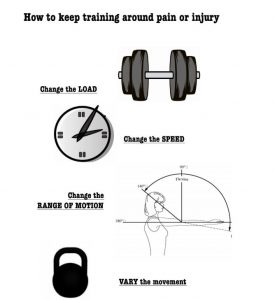
First… reduce the weight
- Try using a lighter weight, but continue the movement as prescribed.
- If the reps continue to be painful…
Next… slow it down
- Keep the weight and try using performing the movement slowly.
- If the reps continue to be painful…
Next… change the range of motion
- Keep the weight, return to a normal speed and limit how far you go into the movement being performed.
Finally… vary the movement
- There are various ways to perform different exercises.
- You can continue to get the same training effect while performing the movement in a slightly different way.
Here are a few examples of how you can vary the workout if you are experiencing pain during specific movements:
Knee pain with squatting?
- Reduce the load
- Alter the tempo – 3 seconds down, 3 seconds up
- Reduce the range of motion – Squat to a box or a bench
- Change the movement – go from front squats or goblet squats to a back squat
Back pain with deadlifting?
- Reduce the load
- Alter the tempo – try a quick lift from the floor and a slow lower
- Reduce the range of motion – Lift from an elevated surface (blocks or plates)
- Change the movement – go from a barbell to a hex bar or kettlebell
Use this to help keep yourself training, but PLEASE… also seek medical advice. There are many other things to be done in order to get you back to being pain-free during workouts… most of the time, it’s more exercise! Not rest.
