Last post I tried to set the stage, light the fire, get you all jazzed up to start strength training but didn’t give you any of the tools to begin.
DISCLAIMER: These are instructions for someone who has never strength trained before or has minimal experience. It is advised that you proceed with caution, go easy and follow the recommendations.
“Where should I start?”
Simple and Consistently.
“You said it should be hard, how do I know it is challenging enough?” I want you to feel like you are giving effort. Run through the program provided below twice per week for two weeks. If it did not tire you out or make you sore at all, you have to progress. Resistance training can and will make you sore, but not so sore that you can’t climb the stairs, sit on the toilet and are limping while you walk.
“What exercises should I do?”
I am going to review the main components of a resistance training routine for a beginner. These require no equipment at all and can be performed at home. You can begin all of these with 2-3 sets of 10-12 repetitions, 2 days per week.
Hip thrust
This is a great exercise for the legs and lower back. It is a VERY important area to strengthen in order to lift, carry, go on long walks, prevent falls… the list goes on.
Push up with assist
Push-ups are a standard movement to get good at. The problem is, most people can not do even one! It’s a tough one… That being said, there are many ways to get stronger at them and this is one. This movement is very important for a handful of reasons but one major reason is that if you fall, you want to be able to get back up!
Air Squat
This is one of the most foundational movements known to the world of resistance training. You can not go wrong here! This is an un-weighted squat but can be a very effective way to build up leg strength, help your knees and your lower back!
Plank
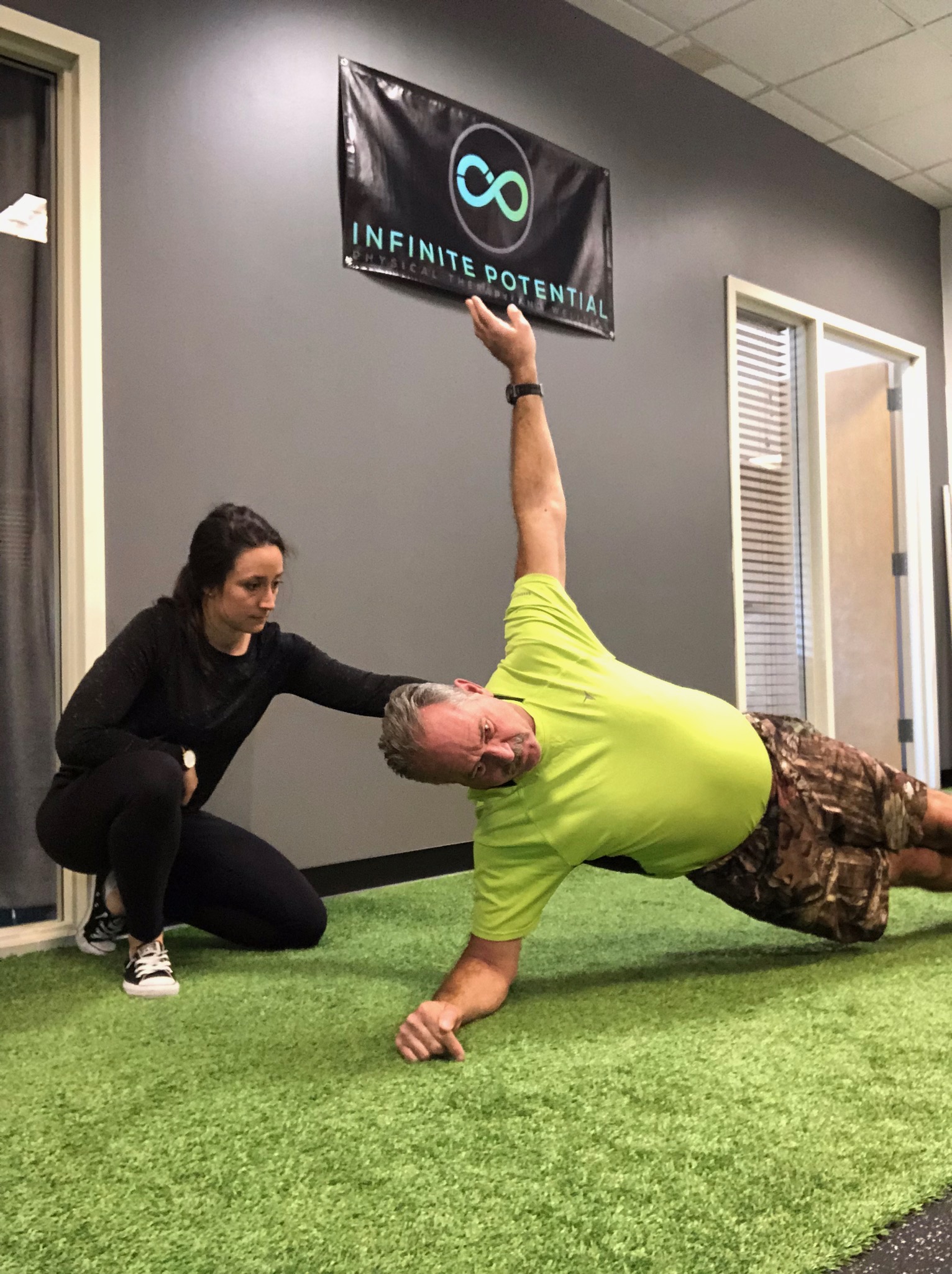
The plank… another foundational movement! This is a FULL BODY move that works everything! This is an exercise that not only helps you gain a stronger core, but it is great for shoulder strengthening, lower back and knee health. This would be one that is performed for time, suggested at 3 sets of 15-20 seconds for beginners.
Reverse lunge
Now… This one is a bit advanced but I love it. There are many people who are not able to perform this move as shown in the video. That being said, it can be easily made less challenging by holding onto something like a door handle, door frame, kitchen counter, etc… This move works on balance, strength and coordination. If you are someone who can not get up from a kneeling position without your hands, this exercise is a must!
Suitcase carry/ march
This is one that many don’t know about but is is incredibly beneficial! Have you ever struggled at carrying in the groceries? Been challenged by dragging a heavy bag of leaves across the yard? Felt the strength of your grip disintegrate? The suitcase carry works all of the above. This would be an exercise also performed for time if you are marching, or distance if you are walking. I would suggest 3 sets of 20 seconds per arm – hold a gallon of water, fill a grocery bag with canned goods…?
Step up
This one is fairly obvious but I’ll give you some examples as to WHY it’s important. How often do we carry things up and down stairs? (Often). You never want to lost the ability to do that! You also want to keep your knees, hips and lower back’s healthy, too? Of course.
Try these out… See what’s challenging, see what’s easy and make adjustments accordingly. Resistance training should be a part of your life forever if you plan to live long and healthy. It doesn’t have to be fancy to be effective.
If you took the time to watch the WHOLE thing I don’t even think I have to write anymore…
This is not just about being able to lift up a meaningful being. This ad shows some of the benefits and results of strength training as we age.
Strength training continues to be recommend as part of an adults regular exercise routine at least two days per week. This is based upon a recent update of the W.H.O’s (World Health Organization) physical activity guidelines from 2020 (Reference: World Health Organization 2020 guidelines on physical activity and sedentary behavior). They even state that strength training is more beneficial than aerobic training based on its benefits of improved coordination, increased bone density, and improved quality of muscle. Of course, aerobic or endurance training has its benefits, but the strength work benefits outweigh those of aerobic work.
But WHY… Why is strength training so incredibly beneficial as we move across the lifespan? Because it allows us to do things with more ease and less risk of injury!
Doing that yard work job without getting hurt
Carrying in the groceries without fear of dropping them
Carrying the laundry up from the basement without needing a rest
Climbing the stairs going step over step
Getting up from a low beach chair without your hands
Getting up and down from the floor while playing with your kids or grandkids without needing to use the coffee table
As we slow down, do less, and are exposed to less challenge, our bodies adapt. Our muscles weaken, our tendons get thin and frail, our bones become less dense. Strength training works because it consistently exposes your body to challenges so it can adapt and become more resilient. It doesn’t only make our muscles stronger but it helps area’s of the body like the rotator cuff, the Achille’s tendon, the discs in your lower back, your hip joints and the list goes on.
Oh, and it has to be challenging. You can’t get stronger by lifting weights that aren’t challenging. You just need some supervision and guidance.
So… Why aren’t adults doing more of it? Fear and confirmed fear from trusted sources.
Medical professionals believing that lifting challenging weight is harmful on the joints of the body and unsafe.
Many people agree with this and it is then confirmed once they speak with their physicians or other healthcare providers.
Based on my personal, anecdotal evidence these are some of the most common barriers to reaching more people with this fabulous modality. I work mostly with very active people who are already exercising, they are just not lifting weights… and this is the primary reason.
Strength training can be incredibly helpful in so many ways for all walks of life, ages, and ability levels. I can beg and plead everyone to get involved in it but it is YOU and only YOU who can make it happen.
Find your why, hire some help, invest in your body… it’s the only one you’re given.
Dr. Loni here, bringing you some seriously awesome advice on reducing your risk of activity and sports-related injury. The main focus on this content surrounds strength training and its benefits. Research has shown us that strength training is paramount in the reducing the risk of injury.
That being said, there are very strong people who still get injured. We have to look at strength training as something that we can do to REDUCE injuries, not prevent them. Injuries and pain are also multifactorial and strength training CANNOT eliminate injuries from occurring.
I like to use the analogy of driving in a car… We wear seatbelts to reduce our risk of injury if we are to get into a car accident. Wearing a seatbelt doesn’t PREVENT the accident, it just keeps us from getting injured or worse. Think of strength training as a the seatbelt…
Onto the tips…
Tip #1Become strength “trained”
One of the best methods to prevent sports-related injuries is to become “STRENGTH TRAINED”
To become “trained” is to achieve a level of fitness such that you become resilient to the demands of that said activity. For athletes, this means being able to handle what the sport hands them at any given time during competition.
But, why do we want to be “STRENGTH” trained if we aren’t a weight lifter? Even though strength training movements are not seen in competition (unless you are a barbell athlete), they have amazing effects on athletes of all sports.
To be strength “trained” we need to be doing it CONSISTENTLY, for LIFE! Even in season (more on this in future posts)
What are the benefits?
Has shown to decrease rate of injury three-fold among soccer players (assumed to be considered to other field sports like lacrosse for example)
Reduce running related injuries
Improves tendon and ligament size (you know, that ACL?)
Improves confidence!
Tip #2 Keep lifting
If you don’t keep lifting, you can slowly lose your gains!
Did you know that if you participate in a strength training routine for lets say 6, 8 or even 12 weeks and then STOP, you will regress in strength?
You will begin to lose the benefit of all of the hard work that you put in! This is a phenomenon called “Reversibility”, or reversing your gains. This is especially important and meaningful when we are talking about athletes.
It is important to maintain a strength training routine mid-season!
Yes, IN SEASON strength work is KEY! It is all about how it is programmed, just enough to maintain the gains, but not too much to tire them out.
Even one day per week is enough with a competitive athlete!
Tip #3 You have to practice more than just bodyweight exercise
What’s the overload principal?
It’s the basis of how you make gains with strength training.
Simply put, to make changes you must stimulate your muscles so they have to do more than what they are comfortable doing at baseline. This is weight training somewhere between your baseline and what your maximum capacity is.
Key Points
You have to start slow and build up over time
Starting point depends on your baseline… did you know that most runners (who do not strength train) have pretty low baselines?
You must begin to add external load or WEIGHTS to your program
Why do we want to overload? The changes made with overloading can be extremely beneficial when talking about reducing injury risk and becoming super strong!
Here are the benefits of “The Overload Principal”
Increases tendon capacity
Improves flexibility
Trains you to take on the strenuous activities you enjoy
Tip #4 Use only the most important exercises for YOU
Variability is important in some cases, but when you are looking to make improvements in strength even in specific areas, less can be more.
One major injury risk reducer is monitoring how much volume you are doing.
If you keep the same volume, but adjust the intensity of the activity you can create progress without increasing your total volume by training numerous, less-economic isolation exercises.
So… What is volume? The accumulation of how many reps per session
If we are adding a bunch of accessory work, aside form our major multi-joint movements (like squats, deadlifts, lunge variations), in attempts to help our pain, deficits, etc… We may actually be adding MORE volume and be more taxing to the body.
Before you add MORE, think about prioritizing the effectiveness of what you are doing.
Try keeping the same compound movements (ie. Squats, deadlifts, lunges) and making them more challenging.
How?
Tempo (slow the movements down)
Pauses (pause in the bottom of the squat or just before you touch the plates to the floor in a deadlift
…just to name a few.
Thank you for reading! If you really thought this content was informative, please let us know or share with someone who would benefit!