by Dr. Loni Rodriguez | Aug 21, 2018 | Back Pain

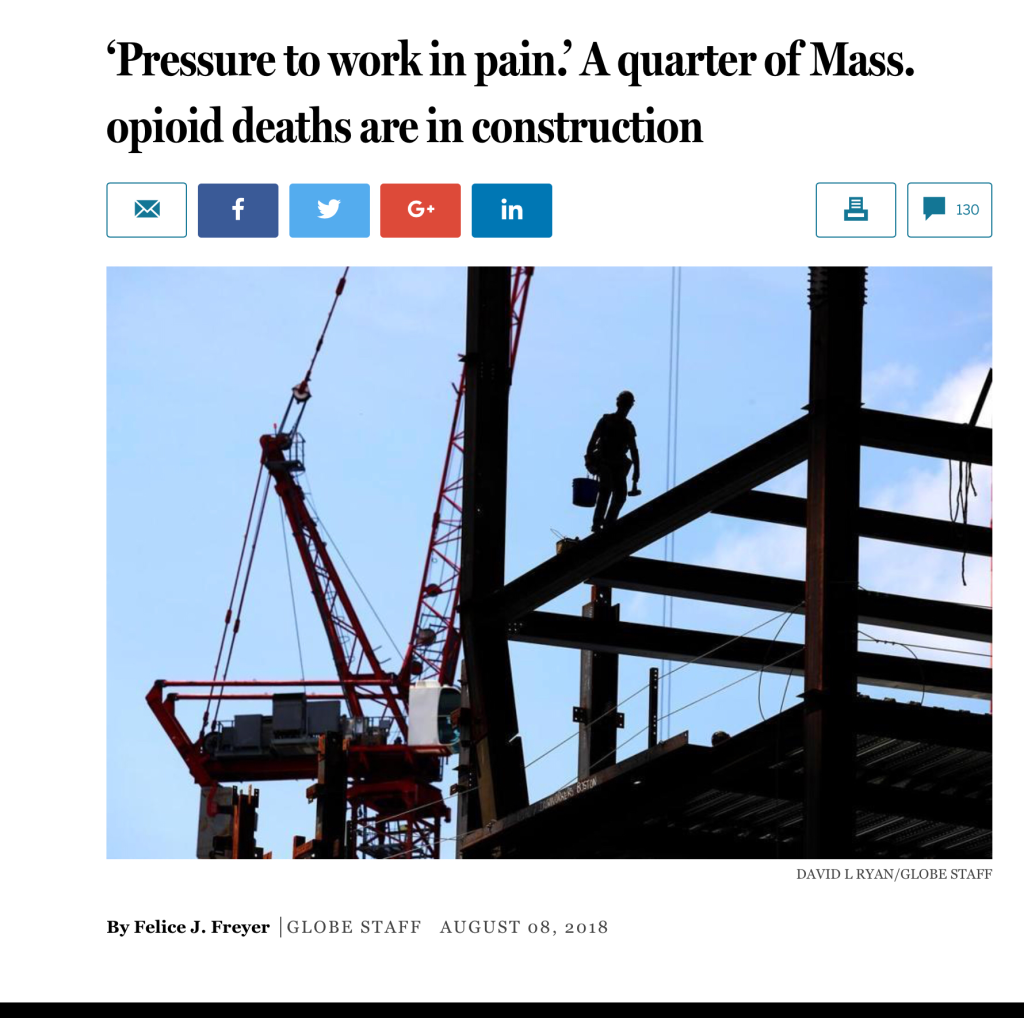
Recently, an article in the Boston Globe was brought to my attention by a patient of mine. It was in reference to opioid-related deaths in Massachusetts.
“The report by the Massachusetts Department of Public Health found that nearly a quarter of overdose deaths in a five-year period occurred among people, mostly men, who work in construction. Farmers and fishermen also had higher-than-average rates of overdose deaths.
The common factor: Workplace injuries occur frequently in these occupations.”
The current method of pain management has a very unfortunate cycle. The article referenced above gives a disturbing example of how the management of pain MUST change. Based on this article, we can assume that there may be a relationship with injury / pain and opioid addiction-related death. The image below describes popular pain management after being hurt on the job (or getting injured in any manner):
Go to the doctor

Prescribed pain medication (Opioids in most cases)
Pain improves = more / continued medication
Reliance on Pain medication
Possible addiction… etc
What if there was existing treatment that has been proven to decrease the rate of opioid prescription?
A recent study published by Dr. Bianca Frogner discusses the effect of choosing Physical Therapy as the first line of defense to address low back pain. She reports that there was an 89.4% reduction in opioid addiction rates for patients who saw a PT to address their pain FIRST vs any other form of pain management. Health News from NPR published a great article that helps summarize Dr. Frogner’s study. This is a staggering number! Physical therapy has been shown to dramatically effect this epidemic if it is chosen as the first line of defense. If we can begin to raise awareness on this topic, can there be a shift from opioid prescription to physical therapy prescription? I sure hope so.
References
Frogner et al. “Physical Therapy as the First Point of Care to Treat Low Back Pain: An Instrumental Variables Approach to Estimate Impact on Opioid Prescription, Health Care Utilization, and Costs”. Health Serv Res. 2018 May 23.

by Dr. Loni Rodriguez | Aug 13, 2018 | Back Pain

Where the heck is my back pain coming from?
What I was taught in PT school was that back pain was mechanical. It was coming from a muscle imbalance, tight hamstrings, tissue damage, a weak core, an unstable lumbar spine, etc. This directed treatment around a biomedical approach.
However, over the last 10 years there has been a significant shift in the way that low back pain is treated and approached. Additionally, this shift has been more profoundly researched in the study of low back pain, specifically. This is the biopsychosocial model of addressing this epidemic. There has been an immense amount of research on the connection between low back pain and psychological factors, social factors, beliefs about pain, pain catastophization, poor nutrition, lack of sleep, and co-morbid conditions. These factors are affecting patients therapeutic outcome AND their risk of long-term disability. Low back pain goes far beyond tissue damage!
For example, a patient has a higher risk of developing low back pain if they are dealing with depression. Patients whom are living with excess stress about finances, losing their job, or poor work satisfaction are more likely to experience low back pain. These are some examples of the social and psychological factors that must be addressed within a treatment plan.
Beliefs about pain and pain catastrophization also have been shown to play a role in persistent low back pain. It has been shown that the brain observes the world around us and makes predictions about how things are going to feel. It adapts to what we become used to and mimics the thoughts, feelings and beliefs beginning at early childhood with the observation of our parents. Similar coping styles are observed in children that resemble those of the adult.
So, if you witnessed your mother or father deal with debilitating, persistent low back pain for the greater part of your childhood, you may be more likely to experience this level of debilitating pain.
We also respond to others in pain with neuropsychological reactions, including anxiety and distress. If you are to watch someone experience a horrific bout of back pain, you will then begin to have negative thoughts during any back pain that you may experience in the future. Similarly, responding in dramatic fashion to a current bout of back pain can truly make it worse!
One thing that I am NOT eluding to is that back pain is “all in your head”. There are absolute circumstances when a tissue overuse condition can occur and may be CONTRIBUTING to the symptoms, but the CAUSE and EFFECT is not black and white. Back pain is complex and 110% multi-factorial. All factors discussed above SHOULD be talked about and addressed to truly get to the root of the issue.

by Dr. Loni Rodriguez | Aug 6, 2018 | Back Pain
Introduction:
Low back pain is one of the leading causes of work-related disability and activity limitations around the world, as well as one of the highest reasons for rising healthcare cost. Startling statistics also have been released in regards to the climbing incidence of chronic low back pain, or pain greater than 12 weeks. From 1996 to 2006, the incidence of people who experience this chronic low back pain climbed from 3.9% to 10.2%. Recent research has also shown that up to 33% of individuals whom have experienced low back pain, experience it again within one year(Delitto, et al).
How can this be? There have been advances in medical technology including improved surgical procedures, imaging techniques, and medications. We would assume the incidence would decrease with all the improvements we have made with regards to treatment. Well, it has not! So, what are we doing?!
Low back pain is widely under-understood and ineffectively managed by many healthcare professionals. I am not saying that people with low back pain are not being helped to a certain degree. What I am referring to is that there ARE effective means of treating low back pain that are WIDELY UNDERUTILIZED. Over the next few weeks, I will be writing about low back pain and explaining some of the most important aspects of the epidemic, talking about symptoms, and some effective treatments. This series is to not only help the general public understand a bit more about what has been proven effective, but also to help remind and / or educate fellow practitioners that a shift in our treatment styles NEEDS to happen. Let’s raise the awareness of the seriousness of this epidemic that is wasting the precious dollars of our healthcare system!
References
Delitto et al. “Clinical Practice Guidelines linked to the international classification of functioning, disability, and health from the orthopedic section of the American Physical Therapy Association”. J Orthop Phys Ther. 2012;42(4):A1-A57
ANATOMY

The back is made up of a web of intricate structures that include the five lumbar vertebrae and the sacrum, the various joints between each vertebrae, ligaments (bone to bone attachments) which serve as supporting structures, wide array of muscles that can span across many vertebrae, discs (everyone loves to talk about their discs) which help provide cushion and mobility, and an intricate weave of nerves and blood vessels.
The anatomy of the low back is important to understand for the sole reason of knowing that there are a TON of structures that are in there! It is impossible to assess these independently and determine if one specific structure is causing someone’s pain.
Next week’s post will focus on explaining the more recent understanding of a more effective treatment approach to low back pain.
Stay tuned folks, KNOWLEDGE IS POWER. EDUCATION IS THERAPEUTIC.
