
by Dr. Loni Rodriguez | Feb 10, 2020 | Abdominals, Back Pain, Flexibility, Injury Prevention
There are so many exercises in the world of fitness that we can not keep up. My advice is to keep hold on some basic moves to make sure that you are covering all your bases.
Today we are going to cover some core exercises that most people don’t do regularly. Why aren’t they doing them? Most people perform core exercises that keep your core in a “stable” or stationary position. Those types of movements are great, but one of the best things we can do is keep our “core” well rounded position (not literally…).
What do I mean by well rounded?
We want to move our bodies in all directions! We want to be able to bend forward, backward, rotate and twist. In order to be able to do so, we have to teach our core to help out.
So what is our core?
It is from your mid chest and upper back down to your mid thigh! That whole thing is your core! I am going to review some of my favorite exercises that hit all of those ares.
What is the benefit of core work?
- Can improve performance! It can help people perform better at their sport or activity and make you stronger and more confident to do household chores like carrying in groceries.
- Can help with pain! Core movements are a staple in many of our rehabilitation programs no matter where someone is experiencing pain.
- Can help flexibility! Have you ever said that you have tight hamstrings? I sure have heard that… guess what? Core exercise can help.
Here is what we recommend…
The straight leg sit up
This is a phenomenal movement that can help strengthen your abdominal muscles and get you more flexible hamstrings. It is so common that people can not do this move! Can you do it?
The back extension
Back extension exercise can help improve low back pain and flexibility. It can also help strengthen the spinal muscles that help support your entire body! If you do not have a ball like in the video, you can use a ottoman or a stack of pillows.
V-up hold
This is a holding exercise that helps the straight leg sit up and hamstring flexibility. Sometimes this can be very challenging for people to hold for any time at all so have low expectations…
Superman hold
Have you ever felt your back feel tired? This is the exercise for you. It can make your back feel like it is working and guess what? That is exactly what we are looking for!
Hip flexor strength with band
This is the top exercise that no one is doing for core! Have you ever felt that you had tight hip flexors? This exercise is for you.
Hip thrusts
This one is by FAR one of my favorite exercises. This is incredibly beneficial to help hip and lower back pain and gain flexibility!
by Pippa Teague, Strength Coach | Oct 14, 2019 | Back Pain, Exercise advice, Injury, Injury Prevention, Personal training, Recovery, strength training, Uncategorized
By Loni Rodriguez, DPT
Having an animal in pain is really scary.
They can’t talk, they can’t tell you what makes it hurt, how severe it is, how it makes them feel, or what makes them feel better.
You can’t ask questions like, “Does eating make the pain worse?”
Or… “Has this been going on for a long time, you just haven’t done anything about it?”
You must rely on watching their body language and for signs of distress. But man, to base your plan of attack on a dogs sign of pain is really challenging.
It is hard because when you see these said signs (shivering, whimpering, panting), you want to try not to freak out and run to the emergency room. Sometimes, things like this just go away on their own. Also, everyone knows how expensive the vet can be and you are 110% at their mercy which means you have to have a trusted source for care.
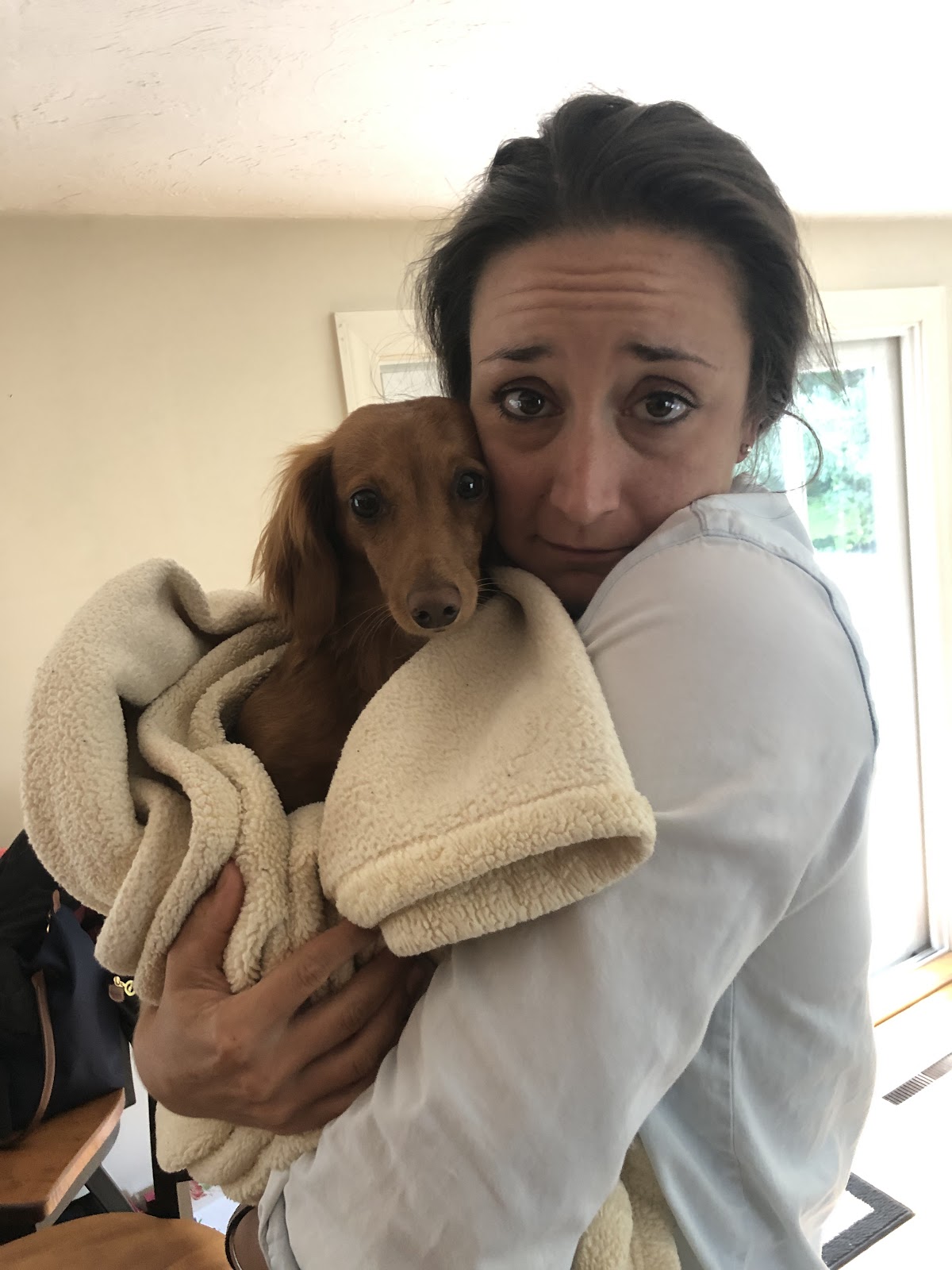
Gracie (our 5 year-old Long-haired Dachshund) had suddenly began to show signs of distress one day. The signs would fluctuate, but she just was not herself and we made the decision to take her to the vet. After some blood testing and ruling out the real serious things, she was diagnosed with lower back pain. Now, Dachshunds are known for back issues because of their bodies, but she’s 5 years-old! She does love to play, jump and run but has had no prior history of this…
The vet’s treatment plan was high-dose anti-inflammatory medications and ‘crate’-rest for 2 weeks. I asked about physical therapy, I knew that “doggy” chiropractors existed but they didn’t have any resources for us. Nevertheless, we took the docs recommended plan and headed home. Mommy went into PT-mode.
I texted and messaged Instagram friends all over the country to see who knew what I could do for my dog with low back pain. Soon enough, responses poured in and I was in contact with one of the best animal chiropractors! (Social media is WILD). We spoke briefly on the phone and not to my surprise, the vet’s recommendations were pretty poor and she explained that it was a very ancient school of thought. I needed to find myself a local chiropractor for my pup…
A few days went by, Gracie was looking a bit better but still was well below 100%. She was not really eating, not wanting to leave her crate very much (even though that is what was recommended, I left the crate door open). She really was just feeling like crap. During this time, we also have Mr. Tucker (our other pup) right by her side cleaning her ears, eyes and mouth like a caring little bro – the CUTEST thing ever.

A few more days went by, still not looking up for our furry baby. One morning I woke up to get ready to go to OrangeTheory and took Gracie out to pee. She seemed like she had a little pep in her step without showing signs of distress so I was happy. That was until I took her outside and she stumbled and fell over on her hind legs while going to the bathroom. Her back legs were not working normally! That was it, to the vet ER I went at 5:30 am. Even though I could tell she was not in as much pain, I needed to get her looked at.
After waiting patiently and going through with the evaluation with the ER doc, they cleared her for severe loss of function via some testing and diagnosed her with MILD disc herniation and recommended HIGHER-dose pain medication for 6 weeks and complete crate rest (for 6 more weeks).
WHAT?!
But she wasn’t in pain? She was actually happy and seeing some improvements? If you clear the big scary diagnoses and say the leg weakness is a sign of a mild disc herniation then why the 6 weeks of bed rest and super high does pain meds that will knock her out?!
Could ANY of this be similar to a human? (I asked, and they said sort of but not really…) They said that if I did not follow these recommendations, I could be looking at severe negative effects and possibly needing surgery…
This seemed WAYYYY too close to some recommendations made to patients in the past who have made amazing strides without heavy meds, rest, or surgery.
Again, I reached out to the trusted chiro and she said PLEASE find a local doc. So… that is what I did. The SAME day that I brought her to the ER, she was seemingly better so I think she was gradually improving in regards to discomfort and pain, but her leg weakness and lack of coordination continued to be present. I absolutely wanted another opinion. I found a doctor of doggy chiropractic medicine that the other chiropractor approved of. We were seen for an appointment and all of my worries and thoughts of having to rest and medicate her were gone. He agreed with some mild disc-related pain, but explained that dogs are self-limiting. They will do as much activity as their bodies can handle. Yes, I needed to keep her from jumping, playing hard with her brother and limit how MUCH play… but to let her play and be normal. He did some gentle work on her and off we went.
Movement was medicine and she is now close to 100% after about a week.

Now… what did I learn from this experience?
It is really hard to trust ANYONE when your loved one is going through pain. You want what is best, but are not sure who’s recommendations to follow.
I need to continue to be very mindful of how I approach education and treatment recommendations for my clients. I found myself reflecting on how I have approached recommendations to patients. I am confident in what I tell people to do, but they HAVE to be confident themselves before they will follow what I have recommended. Even though I really did trust the original “virtual” chiropractor, I was faced with significantly different conflicting recommendations by an ER doctor… I am SO glad that I did not follow the original recommendations.
Find a medical professional that you trust. Find that medical provider that you really feel has your best interest in mind, has the resources to allow you to make your OWN informed decision on how you would like to proceed, AND has enough humility to admit when they may not know exactly what to recommend, but know someone who can help.
If this story resonated with you, please let us know leave a comment below or shoot us an email. If you are a current client and see Gracie in the office on the regular, give her a hug! She is a happy pup who loves attention.
Looking for the doggy chiropractor? Get in touch and I’m happy to share 🙂

by Pippa Teague, Strength Coach | Oct 7, 2019 | Abdominals, Back Pain, Client Achievements, Conditioning, Exercise advice, lifts, Recovery, strength training, Uncategorized
Today we are highlighting Michelle who has been with us since August 2018 after dealing with severe lower back and hip pain.
“I was in constant pain in my lower back and afraid that I would have to accept this as a new standard of living for myself. On July 4, 2018, I went to bed with excruciating pain in my lower back and tingling in my leg. I never had this happen in my life and had no idea what to do. The pain came out of nowhere, but now I realize that it was probably building for some time and came to the surface then. I was in my 20s and felt like I was in my 90s because of what I was told by doctors about managing my lower back issues and overall pain levels.”
Upon meeting Michelle, I quickly realized that she was in need of reassurance and was really looking for someone to guide her. She was desperate for answers and did not know where to turn as her symptoms were not just resolving on their own. She was provided with conflicting advice and was not sure who she could trust. This is a major issue that I see in many of my clients and it is my job to help make sense of some of the things that they have been told.
“My struggle affected every part of my daily life. I was always thinking about the pain when I was at work or out with friends and family. I didn’t want it to come back and was afraid that everything I was doing was making it worse whether I was exercising or staying still. I felt out of control in my body. I had no idea what I should do. My doctor told me to wear a neck brace and to essentially stay still. My spine specialist told me that I had a disc herniation in my lower back, which was scary to hear. I was not in a car accident and have always been healthy, so I did not understand why this happened.”
Michelle was in a tough position coming into our office. Many of our patients experience pain that affects their daily life and it is sometimes extremely difficult to manage on their own.
“Loni helped me get to a place where I felt stronger and comfortable in my daily life. I got to a point where I stopped feeling the pain. I gained the confidence to exercise regularly and lift boxes, etc. without being scared to injure myself. I would not be where I am today without Loni and Infinite Potential.”
Michelle has been a pleasure to work with from day one. She has shown endless appreciation for what we have provided and is also very open to new ways of thinking about her pain, alternative approaches to treatment, and has shown willingness to trust the process. Michelle has made consistent progress since beginning with us and has sought care past her original injury committing to strength training since completing her time in physical therapy. Strength training was not a part of her regular routine but she has since adopted the practice as a regular weekly activity. She has made significant progress in the realm of strength, endurance and power achieving goals that she never thought were possible.
We asked Michelle what she wants others to know about her experience with Infinite Potential PT. Here is what she had to say:
“I want others to know that they should go to Infinite Potential (IP)! The business is different than the standard physical therapy at out-patient centers or hospitals, but this is what makes her special and one-of-a-kind. I had been in and out of PT at hospitals before being a client at IP. I was only there for a few weeks (6 at most) and then discharged and my issues would come back. I wasn’t given one-on-one treatment plan like I get here. Loni spends the time to really understand your needs and help you not just for a short time, but for your life. I wish everyone could discover what I’ve found in Infinite Potential. Loni has been life-changing and I will follow her wherever I go. I live closer to the North Shore now and commute to see her weekly! She’s the best!
Our passion at IPPTW is to empower people to realize their full potential. We strive to decrease their fears, help them understand what is going on and what can be done in the long and short term. We want to be YOUR resource for help and feel strongly that we can give you informed guidance to help you make decisions about your health.
If this story spoke to you, or speaks to someone you know, please pass it on. Can you relate to Michelle? Let us know by replying to this email.

by Pippa Teague, Strength Coach | Sep 4, 2019 | Back Pain, Injury Prevention, Recovery, Uncategorized, working with injury
By Loni Rodriguez, PT
We know that many people do. It is actually one of the leading causes of disability world-wide. Did you know that at any given time, about 540 million people are experiencing low back pain? This is one of the most COMMON areas of pain! It also has dramatically increased healthcare costs and how many people use their healthcare dollars to treat it. Back pain is costing YOU more money than it needs to.
I want you to understand the fears that surround low back pain and help you understand it. It is important to talk about this stuff! Helping you understand these fears is vital to creating a positive outcome for both short term and long term pain.
I have put together the most common fears that surround this topic. It is important to understand that these fears are real, many people have similar beliefs, and the way that these fears are handled is very important. If you have some of these thoughts or beliefs, please be open to the explanations, ask questions, and make your own assumptions based on what you read.
There are also many other medical and fitness professionals out there who have different viewpoints. Please understand that this is my viewpoint backed by the most recent understanding of what science knows about low back pain. I learn the up-to-date stuff because I just want to be a bit less wrong, versus being right. The hope is that I can help you learn HOW to view low back pain and not WHAT to view about it.
Additionally, this is NOT supposed to be a guide to help your exact situation. Please seek the help of a trusted professional to deal with your individual case of low back pain. It can be used as a guide to help you understand back pain a bit more versus directing your treatment.
- Definition… What is low back pain? We can define low back pain as a symptom and not a condition. A symptom is well known to come and go, a condition feels like it is there to stay.
- Vulnerability… You may view your lower back as being vulnerable and needing protection. When back pain is experienced, you may view it as though your back has lost that protection. Many people experience lower back pain after trivial events and view the pain as damage, now needing protection. The feeling of vulnerability is real! You feel this way because first off, the back pain happened after something so simple as bending over to move a dog bowl. Second, you now think there is damage. Your back is not vulnerable and you do not need to worry that it will fail on you, even if you feel that has happened in the past. If you have been diagnosed with degeneration or arthritis, you do not have to feel fragile and that vulnerability will slowly fade as you become more and more confident. Your back is built to last, treat it with what it was born to take.
- Protection… You may feel that you have to protect your back if you have had a painful experience, leaving you feeling fragile. Back pain has been thought to be a result of lost protection. Now we know, however, that protection is not the key. Whether it means avoiding certain things because you do not want to have back pain, or keeping yourself out of certain activities because you fear your back pain will worsen. Both scenarios could actually be prolonging the issue. You get the permission to move! We want to add movement into your normal routine, little by little. It is like building up a retirement account, adding money in little by little builds to a solid chunk of change. Adding confidence to your low back over time creates long-lasting resiliency.
- Uniqueness… You may view back pain as being very special in nature, very different or unique from other forms of pain experiences in regards to how it impacts you. Back pain seems incredibly complex because it’s severe and you don’t know much about your back or its structures. Low back pain is viewed differently than other types of pain, but it shouldn’t be. It is commonly seen as special and its own entity, however it needs to be viewed under a different light. Back pain is just like pain in any other area of the body and it is not a warning sign for the spine. It does not mean you must stop doing the activity and it sure as hell does not mean that you are damaging anything.
- Damage… Pain means damage, damage needs healing, best to rest? Pain is commonly viewed as damage in the lower back, or anywhere in general. We now know that there can be a ton of pain and no damage, or a ton of damage and no pain. The correlation is just not there. Pain and damage do not go hand in hand and we do not need to be worried that increasing pain means further damage.
- MRI scans… MRI to the rescue? Many people seek to get MRI scans done to help direct treatment, identify worsening conditions, or rule out anything serious. We must rethink our views on medical testing (MRI’s, X-ray’s). Many of the findings are normal and just a part of the aging process and can be considered the grey hair of the spine. Most conditions such as arthritis, degeneration, or disc herniations do not cause pain. If MRI’s were the only ways to identify gray hair, would you want and MRI? So why would you want one? The most important reason to get an MRI would be to rule out the very serious conditions such as fractures, infections, cancer or tumors. Those conditions are extremely rare and found in about 3% of cases of low back pain. There are also very specific questions that could lead us to believe that one of those cases could be an issue. If those answers don’t fit, then the likelihood of you having any those conditions is extremely low. Not many doctors follow this protocol because they aren’t trusting in the new direction of medicine and reimbursement is pretty high for MRI’s and X-rays.
- You and your back need to be friends… You need a positive relationship with your lower back. It can feel like your back pain rules your life, and you have become a different person as it consumes you. Before you know it, you begin to notice that your back pain has made you a real bear. Your spouse, kids, and co-workers know when you are in a fight with your spine. Well, the reality is that it does not have to be like that and you have to trust that your back won’t fight back if you begin to make it do its job.
- Back pain, personified… A mind of its own. Your back pain does not have to rule you or your life. Personification of low back pain is common and understandable, but it does not truly have a mind of its own. You don’t have to walk on eggshells around it or tread lightly. Poke the bear with activities that slightly make it angry. Over time, you will notice that the amount of activity you can handle will sky rocket and you will once again be in control.
- Understand the uncertainty… It is hard to tell what someone’s outcome will be, but we know that it will get better. The outcome of low back pain is commonly unknown. The healing process is hard to see, especially because you aren’t really sure what is damaged or what needs to heal. The truth is that in most cases, nothing needs to heal and we always fall back on the fact that pain does not mean there is damage. Trying to search for the root cause will be a never ending battle and it is always multifactorial in nature. There is a ton of misinformation out there and you have to remember that. In general, you must understand that most cases of low back pain get better. If you are someone who has had back pain for years, there is TONS of hope. There are likely some underlying factors that have yet to be revealed.
Thank you for reading. This topic weighs heavily in my passion to pave the road of pain relief for many suffering from both short-term and long-term pain. I am determined to help you understand more about what is going on inside your body and empower you, versus scare you. You must remember that all cases of low back pain are different and treatment and education is extremely individualized. If you are suffering from low back pain and have yet to seek medical attention, please DO NOT use this editorial as a treatment guide. Please ask for help or find a trusted professional to guide you in the best direction.
That’s all folks…
![5 Misconceptions Surrounding Low Back Pain]()
by Pippa Teague, Strength Coach | Jun 10, 2019 | Back Pain, Exercise advice, Injury, Injury Prevention, lifts, squats, strength training, Uncategorized, working with injury

By Loni Rodriguez DPT
Low back pain is an extremely common condition that many people are faced with on a daily basis and the incidence is climbing. From 1996 to 2006, the number of people who experienced low back pain increased from 3.9% to 10.2%. Recent research has also shown that up to 33% of individuals who have experienced low back pain experience it again within one year.
How can this be?
There have been significant advancements in medical technology including improved surgical procedures, imaging techniques, and medications. With these advancements, however, the incidence of low back pain continues to increase.
What are we doing wrong?!
One main underlying issue is the misconceptions surrounding the topic of low back pain. These misconceptions can lead to poor treatment outcomes, fear of movement, incorrect diagnoses, and worsening symptoms. The discussion today will help debunk some of these misconceptions and will better educate YOU on this low back pain epidemic.
Misconception #1: My back hurts, I should rest.
I don’t recommend anyone take complete rest from their activity. In every case of low back pain, there are specific activity modification recommendations that can be made. I will never tell someone to completely rest!
These modifications are specific to each person – it is recommended that you seek medical advice to find out what the right path is when you are dealing with pain.
Not convinced? Let’s hear Roy’s Story
Misconception #2: I should not lift weights because it is bad for my back.
One of the most effective ways to treat low back pain is strength training. Strength training creates full body resiliency. The most beneficial weight training exercises involved in low back pain rehabilitation programming include squatting, deadlifting, carrying, pressing, and pulling. All of these exercises help strengthen the muscles throughout the entire body including the lower back, which help to decrease pain and improve activity tolerance. Just like the previous recommendation, if you have low back pain do not think that jumping into these exercises without supervision is a good idea. Seek advice from a trusted professional!
Misconception #3: My back pain is from the chair I sit in at work.
Most of the time, back pain and the type of chair you sit in do not correlate. In some cases, the amount of time sitting and the lack of time spent up and moving are bigger contributors to symptoms. As stated before, movement is medicine, especially in the case of low back pain – when in doubt, just get up and move as frequently as you can.
Misconception #4: My back is stiff, I probably should be stretching more.
A stiff back does not always mean that it has to be stretched. A lot to times, stiffness is a perception of being tight and it is your body’s way of telling you that it needs some attention. Low back stiffness can be helped with frequent, active movement, versus stationary, passive stretching. This type of stretching does serve a purpose, but is not the most effective way of helping your stiff back. Here is a quick video to a great routine that you can perform on your own to “loosen” your lower back!
Misconception #5: I know where my pain is coming from, I have a disc herniation.
Disc herniations are not proven to be the cause of back pain. In most cases, disc herniations are not causing the symptoms. Especially when the pain has been going on for a while. This condition can be considered part of the normal aging process! The percentage of people with disc herniations increases with age and most of the people with herniations do not have pain! Please quit blaming your pain on a condition that can be considered the gray hair of the spine.
If you would like more information on back pain, or any pain for that matter, please visit www.infinitepotentialptw.com. On this website there is a plethora of free information and content, as well as a forum to ask questions.
References
Delitto et al. “Clinical Practice Guidelines linked to the international classification of functioning, disability, and health from the orthopedic section of the American Physical Therapy Association”. J Orthop Phys Ther. 2012;42(4):A1-A57

by Pippa Teague, Strength Coach | May 14, 2019 | Back Pain, Injury, Injury Prevention, knee pain, Ladies, lifts, Neck Pain, Running, running help, strength training, Uncategorized, working with injury
By Loni Rodriguez,
Physical Therapist
Do you know what fires me up more than anything? It’s hearing a story from a client that begins with… “I felt like the doctor did not understand where I was coming from.”
You may not know this story, but I dealt with hip and low back pain for just over 2 years when I was going through graduate school. It came on gradually while running one day on the treadmill. It was sharp, came on strong and would not let go. It gradually persisted and ultimately led me to have to stop running all together. It derailed me and created a borderline depression around the fact that I was unable to exercise like I had wanted to. I went from running almost every day to dealing with persistent hip pain that I would feel first thing in the morning and be with me until the minute I went to bed. I would wake up wondering if it would just go away…
How I was going to be able to go out with friends? Sit at a baseball game? Go shopping? Play football with friends on the beach? It consumed me.
I went to a plethora of doctors and physical therapists, had injections, saw specialists and was convinced that my hip required surgery because one MRI found a cartilage tear. I was constantly searching for answers to the cause of my symptoms and coming up short time and time again. Fast forward 7 years, symptoms have improved dramatically and I no longer deal with persistent pain. I feel stronger and more resilient than ever… so what can I contribute it to? That is a question I do not have the answer to… yet, but is not the point of my story. I am not going to tell you I have the magic answer to solve all persistent pain like this… But I am damn sure I know what would have helped me along the way.
Looking back on this, I realized one common piece that I was missing. I didn’t have a healthcare provider that told me that I was going to get through this and they were going to guide me… that is all I wanted, someone to tell me they would lead me on a path to feeling better and more confident in my hip.
At 21 I had one person – a doctor, surgeon and low back pain specialist tell me that I was going to be dealing with pain for the rest of my life. I remember crying in my car after the session, not because I thought he was right, but because I knew he was wrong. I was more upset because I knew he was going to be giving that same screwed up advice to all the other poor souls in the waiting room. I knew that I had a better understanding of pain and did not want to take that answer as my fate.
I wanted someone to listen to my entire story and not seem like the details were obsolete. I remember creating a pain log to show one of my providers and they didn’t even look at it. Finally, overtime I gradually improved and found my way of returning to exercise – running, lifting weights, competing in CrossFit and running races without even thinking about my hip or low back. This took time and hard work, but I made it.
This is not how an experience with a medical professional should be. You should 110% be involved in your own plan and be guided in that direction.
Have you ever had an experience with this? Have you ever been a fly on the wall in this situation with a family member? How many times have you or someone you know had to accompany a family member at a doctors appointment because you do not remember what they said.
I would love to hear YOUR story…
It does not have to be like this! Seek other advice from someone who listens.
Thank you for taking the time to read and have an awesome rest of the week!
