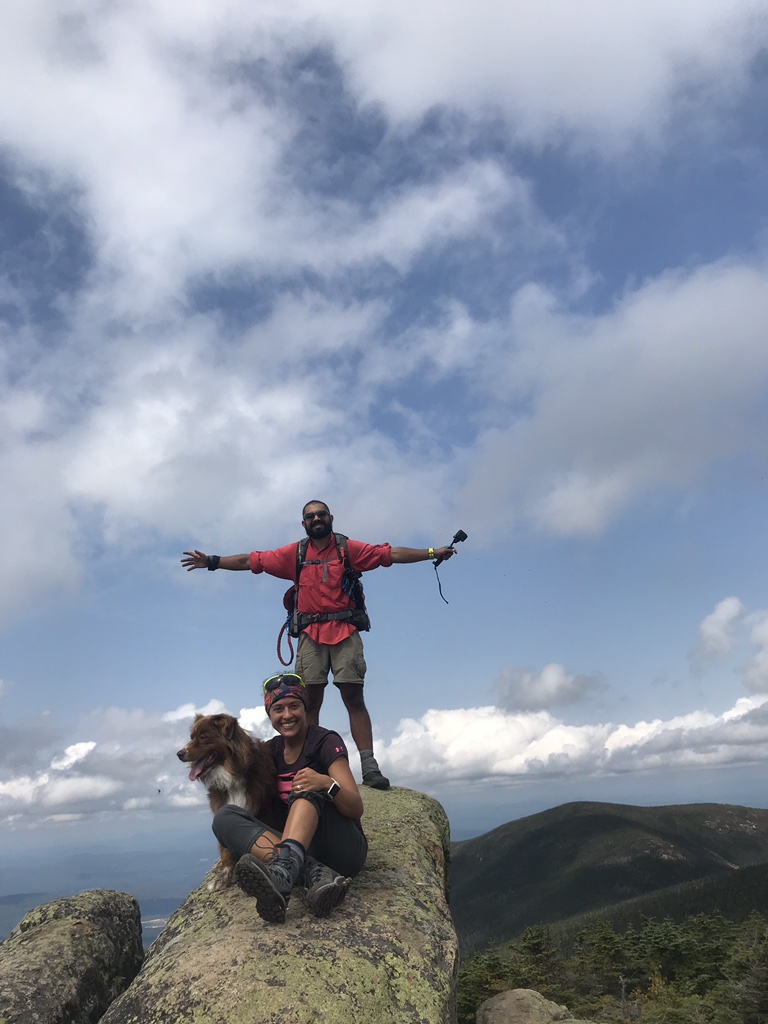
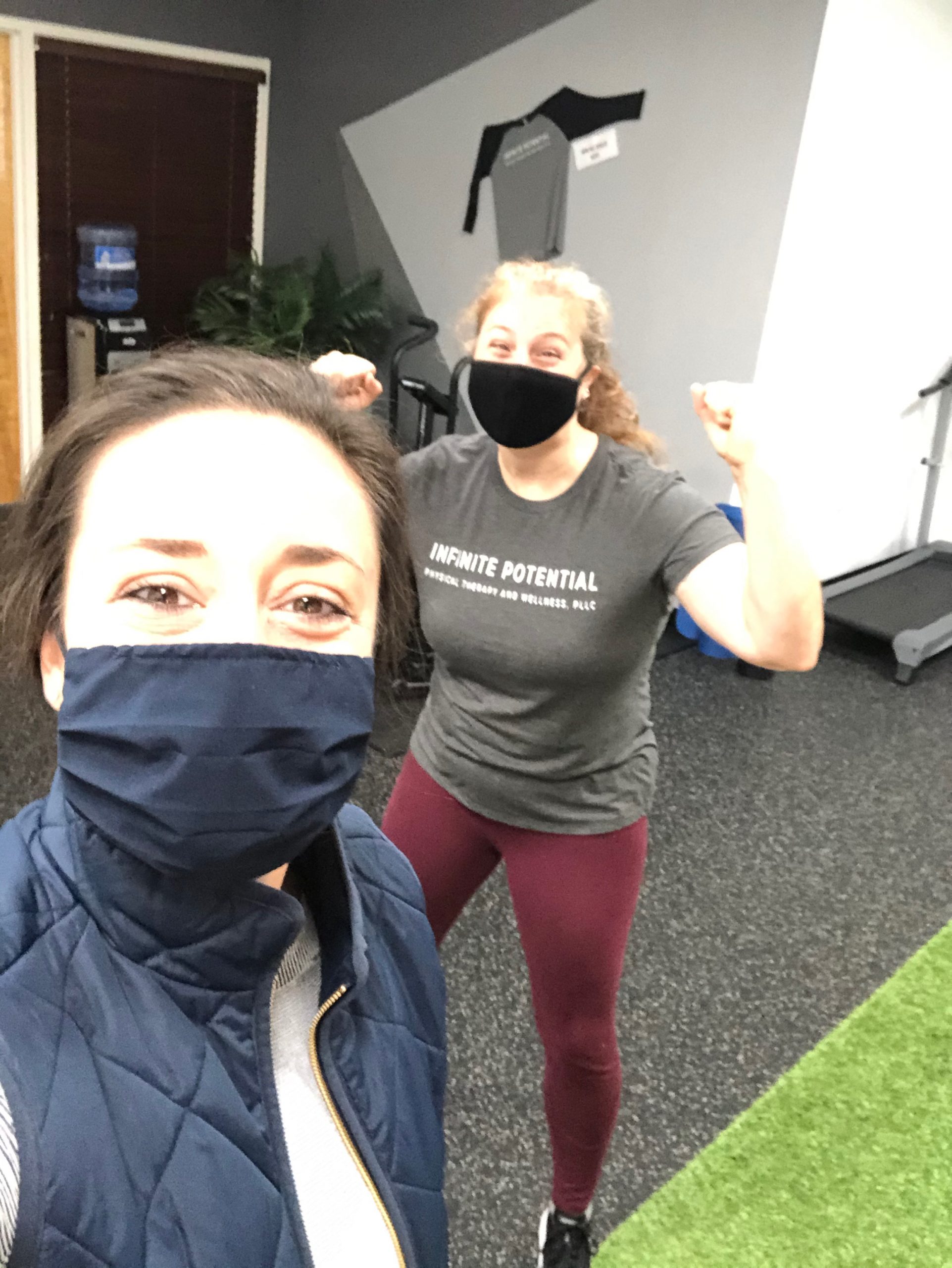
This month we are highlighting Veronica! Veronica came to us this past summer with a complain of knee pain that was very concerning to her. She has always been very active as her and her husband love to hike, run and bike ride. Her knees have affected her ability to do these things with ease and she was sick of it. She came to us feeling rather hopeless and thought that it was possible that surgery was her answer if Physcial Therapy wasn’t able to help.
“Before finding Infinite potential I was really frustrated of not knowing when I was going to have knee pain. It was a constant doubt of how much my body could do without being sore for days. I enjoy being outdoors either hiking, running, cycling or climbing. It was tough to doubt if any of these activities would impact my health at some point that I would no be able to complete a multi day adventure or not be able to go to the next one.”
Just a little backstory on her and her husband… to say they “hike” and “run” is an understatement. They enjoy going on extended day trips in the mountains, completing mile long adventures, running up and down mountains. They are not your average weekend warriors! This means that I had to create a program to reflect those goals and aspirations. She was challenged and hesitant at first, but soon realized that she was on the right track.
“I learned to live my life thinking I was not able to perform regular exercises like lunges, squats, ufff!! and don’t even think about air squats. All those exercises that one day I was able to do they were on my “no way list”. I think I lived with an unconscious fear of not knowing how my body was going to feel after doing what I love, that is exercise.“
One of my favorite things to do with clients is instill hope! Veronica was one of those that I was able to give hope to.
“I felt sad of being in pain. I felt I needed to ask for help if I didn’t want to have knee surgery in the future. I had so many dreams and goals that I wanted to achieve, but didn’t seem realistic since even though I was training and living and active life, the pain was always there, not letting me get better or go to the next level. I felt limited.”
I had to take her out of her comfort zone a bit, as the best way to begin the process of pain relief is some form of resistance training…
“I started to enjoy exercises with weights (which I hated), it made me feel more confident about my body and its capacities. After every session, Loni added new exercises or increased the difficulty. It was fun, there was always a new challenge and I way to feel the benefits from the treatment.”
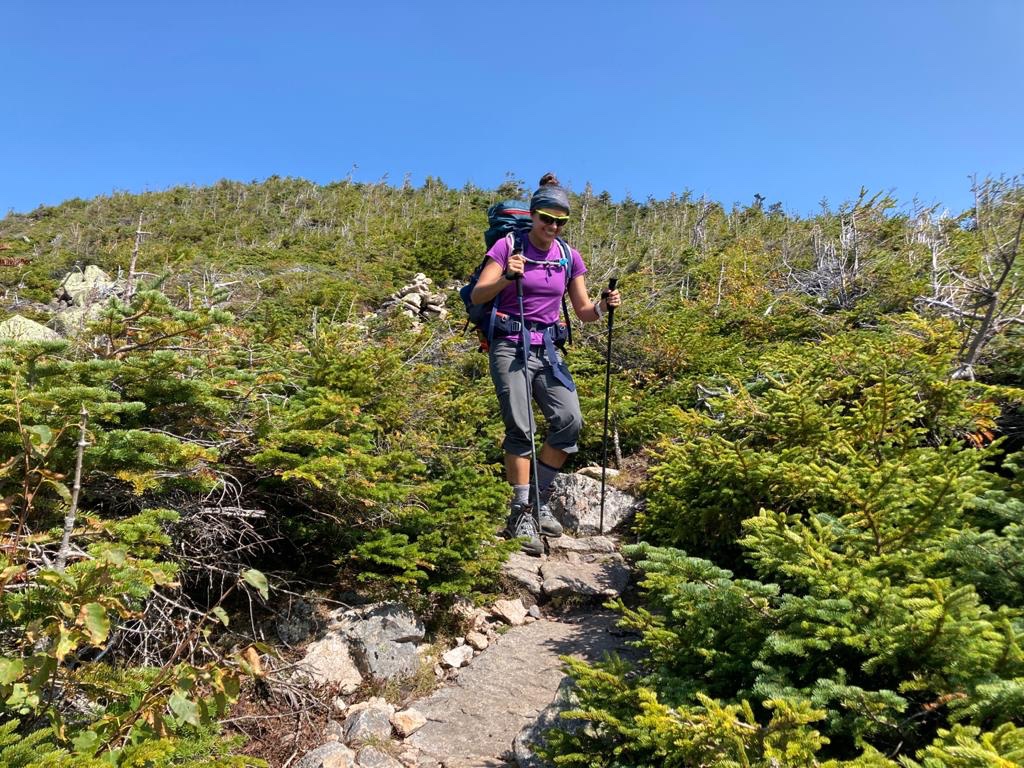
One of my favorite moments is when we begin to see the fruits of our labor both inside and outside these walls. This was a picture of her climbing a mountain in NH, where she used to have to be very careful on the decline… Now getting down with ease!
“My husband and I always had to take in consideration the possibility of me getting pain and/or inflammation on the knees after a hike or high intensity exercise. That was frustrating because we needed to have always a plan B, or don’t even plan for a multi day hike. My husband was stressed and worried when we went on adventures. Pain was impacting my activities and emotions.”
When someone is in pain for a long, long time it begins to be part of their normal day to day. It can sometimes worsen more and more over time if nothing is done about it. There are many, many reasons why chronic pain is present, too many to discuss here. One of the most effective ways to help anyone in dealing with chronic pain is to improve their self-efficacy, or belief that they can help themselves out of this!
“I started trusting my body and have a better connection with it. I understood that my body could do anything I wanted, I just needed to prepare it for what I was asking it to do. The program had also a mental work since some of the exercises push me to go further from the limit I had in my mind. Loni taught me to understand the chronic pain, and not to fear it. Playing music to don’t listen my knees cracking sound and go always a little bit further.”
I asked her how our program design and implementation was different than what she had experienced in the past.
“I loved the app “TrueCoach”. It includes the program for the day, and also the passed and future sessions. That allows you to compare results, and plan your schedule. I liked that there is a video on each exercise in case you have questions of how to do it. It is always good to have that available since you can forget the instructions given in the therapy day. Being able to have communication with the therapist was great. Loni always responded fast , helped with any doubts and was cheering for my accomplishments. In my experience the program is great because it really focuses on getting the patient better while understanding the needs of an athlete, the desire of performing exercise, and giving a constant challenge.“
I felt incredibly fortunate to have been able to work with such a hard working, goal-oriented, and motivated individual. She worked incredibly hard on something that she did not have much hope in. Veronica’s story is a true depiction of “trusting the process”.
I asked her how life is different…
“I feel very happy to trust my body and understand it. I have been increasing the intensity of my workouts, going to longer runs and hikes. I feel stronger and prepared for the activities I enjoy. I am not limiting myself as much, because I learned to listen to my body and to know what it is capable of doing.
I go down the stairs and hike down a mountain way easier. During the sessions, we recreated the movements that caused pain, so my body and mind got used to them. My muscles are stronger and are able to stabilize the knee.
I am happy to start planning again for more adventures. I know it will still be a long process and hard work, butI have hope of being able to do whatever I want for a long time.”
Thank you Veronica, for being such a great client! I look forward to helping you continue your fitness journey one step (or mountain) at a time!
Welcome back for the resiliency series, HEART RATE MONITOR EDITION! WTF?
Are you someone who is always sore? Maybe you have been told by trainers or coaches that it’s good to take rest days but like…
What is a rest day?
How should you go “light” during a workout? Keep reading.
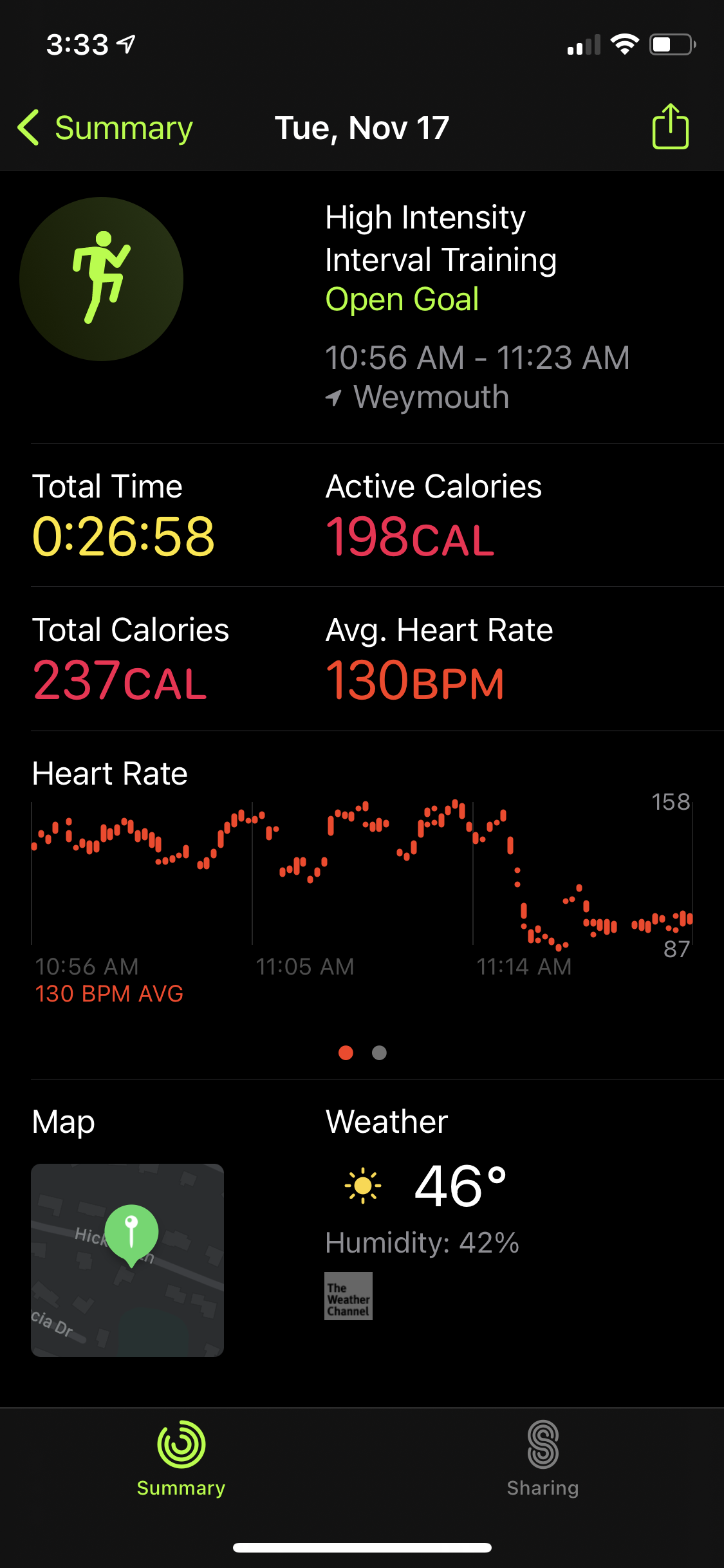
I began using an Apple Watch back in the summer. I was never someone who cared too much about my activity levels but I really needed to know what time it was and I love new gadgets, so why not…
This is not a blog to promote the Apple Watch at all BUT it is a post to talk about how you can use your heart rate monitor to gauge how hard you are working and why that’s important!
If you have read all the other resiliency series posts, you’ll be sick of hearing this but here’s goes…
Over the next few months (or however long it takes for me to run out of content), I will be covering the most common areas of the body where people have their aches and pains. Each week will cover a specific area that we suggest people work on in order to resist injury.
This will NOT serve as a way to treat an injury or direct medical advice, but it will be a resource that will house the most up-to-date information on how to make yourself stronger and and more… RESILIENT! We ALWAYS suggest you seek medical attention if you feel you need more help.
This time is a bit different! I am going to talk about exercise intensity, aka “how hard your body is working at a given time”.
Why do you care? ONE BIG REASON!
Most people who get hurt, get hurt because they put their body through more than it can handle, time after time, after time without enough lighter days…
Most gym goers aren’t in touch with being able to fine tune their exercise intensity – it’s either really hard or nothing.
I am going to explain how you can use your heart rate monitor (Apple Watch, Fitbit, OT beat, Garmin… the list goes on) to decrease your injury risk and use it as a tool to monitor your exercise intensity!
Here is what is recommended by the Academy of Sports Medicine:
“All healthy adults aged 18–65 yr should participate in moderate intensity aerobic physical activity for a minimum of 30 min on five days per week, or vigorous intensity aerobic activity for a minimum of 20 min on three days per week.”
– Directly from the ACSM website, “Physical Activity Guidelines 2020”
Note how it recommends some moderate intensity days and some vigorous intensity days? They say that for a reason! We aren’t supposed to push our bodies into a puddle of sweat every workout!
That being said, most people don’t know what moderate vs vigorous feels like. You can use your favorite heart rate gadget to help!
Start with calculating your max heart rate…
Do you know how to calculate it? You can quickly do some math,
220 – (your age) = Your maximum heart rate
We can gauge our exercise intensity by using a percentage of your maximum heart rate.
It is easy to break it up into zones
Very Easy = 50-60%
Light = 61-70%
Moderate = 71-85%
Vigorous (high intensity) = 85% +
So why does this matter?
If you are someone who goes hard every, single workout, it is eventually going to catch up to you. Maybe you haven’t gotten hurt, but maybe you are just sore all the time… should we just chalk it up to a good workout? That’s not how you should feel all the time! Soreness and stiffness CAN be a precursor to injury.
Key Points
It is recommended that you exercise twice per week at a high intensity (85% or more max HR), and at least three times per week at a moderate intensity (71-85% max HR).
Use your HR monitor DURING a workout to gauge how hard you are working! Do the math so you know what your moderate intensity and high intensity numbers are ahead of time!
If you “aren’t feeling it” on a given day or you know you should be going easy, use your HR monitor to tell you how hard you are working and stay in the easy to light zones!
You can decrease your risk of injury by varying your intensity levels throughout the week to prevent yourself from overdoing it!
I hope this brought some light to how valuable heart rate-based training and monitoring can be. Next time you are in a workout, try and guess what your HR is based on how hard you are working… Maybe you can get so in tune with your body that you can accurately guess the number!
Welcome back for the resiliency series, ACHILLES EDITION!
Over the next few months (or however long it takes for me to run out of content), I will be covering the most common areas of the body where people have their aches and pains. Each week will cover a specific area that we suggest people work on in order to resist injury.
This will NOT serve as a way to treat an injury or direct medical advice, but it will be a resource that will house the most up-to-date information on how to make yourself stronger and and more… RESILIENT! We ALWAYS suggest you seek medical attention if you feel you need more help.
If you don’t know what the Achilles tendon is then you probably won’t read much further. That is unless you really love to read what I write and want to gain some knowledge 👩🏻⚕️…
The Achilles tendon is a structure that connects your calf muscles to your heel! It serves as a very important structure that we use everyday when we walk, stand, run, climb stairs, etc. It is also a common structure to be torn and the most common population who tear are middle-aged, active men. Those who participate in recreational sports such as tennis, basketball, soccer or any quick start / stop play. I am not saying that it’s a common injury, I am saying that when it does happen, it’s the middle-aged population who suffer more from it. You do NOT want this injury because it can be a long, long road to recovery.
I am going to take you through some of our favorite exercises and ways to prescribe exercises to help strengthen and protect against injuries in this area.
One thing to remember, and this is a common theme in these types of posts, injuries can NOT be 100% prevented by any program, we can only reduce our risk. The best way to reduce our risk is to get stronger!
The key to improving the durability of our tendons is to work on heavy, slow resistance training. This means exercise that uses weight, is performed slowly and is challenging enough to make changes in the actual structures within. What we know from research, which is consistently proven time and time again, that exercises have to be challenging enough to make changes within. We don’t have to pose great challenge with every single exercise we do, but for the ones that we are hoping to make measurable gains with, we must challenge ourselves regularly.
Now, onto the good stuff. Here are a few of our fave exercises to perform to help improve Achilles durability. It is suggested that you begin at a level that you think will be challenging enough, but not so hard that you are sore for days, but sometimes it takes a few sessions to figure out the difficulty level.
We suggest that each of these exercises be performed twice weekly to make measurable changes. We also suggest repetition ranges of 8-10 for 3, challenging sets.
Double leg calf raises off a step
FYI… This exercise can be done with or without shoes. I was trying to be cool without shoes but as the weight goes up, the step will feel more and more sharp and shoes may allow you to go heavier 🙂
This is a great exercise to target the upper calf which has a direct correlation with the Achilles. This can be loaded with a dumbbell, kettlebell, barbell, weight vest…
Soleus heel raise
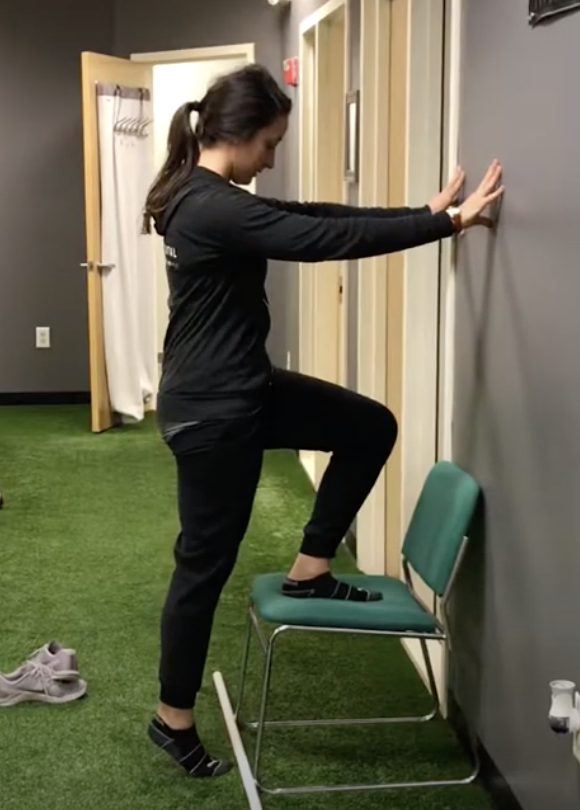
This is a new one for most (myself included), but a really important muscle in the Achilles connection is the Soleus or lower calf. This one is not the easiest one to set up but you have to find a way to weight your working leg with a bent knee. Some gyms have those seated, bent knee calf raise machines? You can use that!
Double leg Soleus raise off a step
Also can be done with shoes, LOL
This one targets the same muscle group as the previous, but is a little easier to set up. However, I do find that most people get a pretty good quad burn here taking away from the calf work that is intended. You have to keep your knees bent the whole time and then coordinate holding some weight once 8-10 of bodyweight exercise gets to be too easy.
Lastly… getting in some regular jumping is always a great way to train the Achilles to take on the activities that we want to perform in our regular, daily lives! I am referring to things like playing tennis, basketball, playing with kids and grandkids, etc.
Jumping rope
If you aren’t proficient at jumping rope, not to worry. Simply jumping up and down, in place for about 20 seconds for 4 rounds is a perfect place to start!
This concludes our Achilles edition of the Resiliency series. If you learned something, give us a shout! If you know someone who would learn something, pass it along with a share!
Thank you for reading and stay tuned for more next month… topic is TBD.
Janine has been working with us since mid July of 2020 to help leg and back pain that she had been experiencing for a long time but more recently, it has been impacting her daily and workout life dramatically. Her story is not unique at all and unfortunately this type of thing happens far too often. The medical system somewhat fails somebody and they are left without results, answers or a place to turn.
We asked her what her greatest frustration was before beginning her treatment here at our office.
“ I was assigned a doctor recommended physical therapist (“here, pick from this list”) and had no idea what to expect. I had never done PT before. I did 12 full weeks and had no changes and each time I went, felt like it was pretty much a waste of my time. But the doctor said it was what I was supposed to do, so I did it. I thought it was weird they didn’t give me anything to do between sessions, but again, I didn’t know. I got frustrated because I went twice a week for an hour each time and felt like I made no progress. That is a lot of wasted time.”
Each and every medical professional on someones team should be 100% in tune with someone’s goals, ability levels and progress is throughout the process. By no means do we make every human better who walks in these doors, we make mistakes to but this was more than just a small mishap. This experience really gives physical therapy a bad name.
“I wasn’t getting better. I wasn’t getting worse either, but no progress at all definitely didn’t make my mindset any better. Plus, I quit going to the gym, which was my outlet – not because they specifically told me not to, but I got the sense that it wasn’t helping. Which turned out not to be true. Without the gym, I really struggle mentally. I felt also like I had no guidance, I didn’t even know what to do about my symptoms since the PT person I was assigned to, didn’t know what to tell me after the 12 weeks was over – just sort of an “oh well, you did it, good luck with that“.
A program for pain relief should begin by creating a plan that works towards the goals of the person. If someone wants to get back to working out regularly, their HOME PROGRAM should reflect that.
“I was feeling low and discouraged. I thought I was stuck like this and that I would have to quit doing many of my favorite things. I didn’t know where else to go and really didn’t know what I would do if Infinite Potential could not help me.”
We asked her how the treatment began to help her. When I refer to treatment, I mean a guided home program and remote coaching between sessions.
“I was able to go back to the gym. I saw small incremental progressions – Loni said she saw great progress so I think bigger things were happening too (it’s tough to tell when it’s you). I started hiking for the first time and did really well (for me – I’m not an avid hiker but thought I would *never* be able to do it, so that is progress!). I felt more in control of what was going on, which was great.”
Now, all of that is how her rehabilitation team was not terribly helpful. This next statement is the unfortunate truth about the medical system and how it can instill great fear and anxiety into people. Many times, when someone is dealing with leg and back pain, they are sent for an MRI. Given that we (rehab pros) now know so much more about pain then we did even a few years ago, we know that an MRI is rarely necessary to help treat the symptom but should be more about ruling OUT a scary disease such as cancer. When something like cancer is not likely, the MRI can actually hurt someone mentally because, in most cases, it reveals findings that don’t tell us much. These findings are then explained in a very demonizing way and can scare people into thinking they can never be active again. These words that I am referring to are things like degenerative disc disease, disc herniations, and arthritis. We now know that they, in most cases, mean nothing more than grey hair…
This is Janine explaining how life is different now…
“I have a tricky situation – potentially something I will have to live with the rest of my life, which initially was very depressing. However, thanks to Loni at Infinite Potential, we keep a positive mind-set and I am doing EVERYTHING I want to do and with guidance. I plan to keep being active and living how I want to – I will not let my diagnosis define my life – instead with Loni’s help, I will adapt and continue. I can’t stress enough that I would not feel this positively about my situation at all if I was with my old physical therapist”
Janine and I continue to work through the understanding of her diagnosis and how it will NOT define her. She has minor fare-ups here and there but she has consistently shown that she is working on a positive and active outlook on her treatment plan.
Finally, we asked her what she would like others to know about her experience.
“Do your home program. I know there are days I don’t want to either, but truthfully, you are just cheating yourself. GIVE FEEDBACK on said program. If it doesn’t feel right, don’t be shy! If you can do more – you should mention that. They can’t help you if they don’t know what is or is not working. Try and stay positive, even if you feel your progress is small. The body is an amazing thing and sometimes things take time. Finally, Infinite Potential is really on the cutting edge of physical therapy – just like medicine, things change and improvements are made. They are doing the research and finding new ways to help, but you also need to meet them halfway and do the work. You will get better!
I am so incredibly grateful to have been given the opportunity to take her on as part of OUR team. I have for sure made my fair share of mistakes with patients, given them poor advice (in hindsight) and failed treatment plans but here in our office, we are trying to change the face of pain management and how physical therapy is viewed by the world of active people.
I could not be more proud of Janine to be working through this phase of her life, trusting the process and totally kicking ASS.
Her long term goal is to do a 2 (maybe 3) day hike next summer and she is well on her way to being able to handle that.
Welcome back for the resiliency series, SHOULDER EDITION!
Over the next few months (or however long it takes for me to run out of content), I will be covering the most common areas of the body where people have their aches and pains. Each week will cover a specific area that we suggest people work on in order to resist injury.
This will NOT serve as a way to treat an injury or direct medical advice, but it will be a resource that will house the most up-to-date information on how to make yourself stronger and and more… RESILIENT! We ALWAYS suggest you seek medical attention if you feel you need more help.
Most people want shoulder help when they are in pain.
Kicking it off with a disclaimer… Start off by understanding what kind of shoulder help you need. If you are dealing with some pain, it is best that you go easy with these recommendations because some moves aren’t for everyone! All the moves are worth a try, but go light and slow at first.
The exercises and advice I have provided in this post are the most common long-term exercises that I recommend folks be performing regularly to keep the shoulders happy for a lifetime.
First piece of advice… Some pain is okay! Unbearable pain is not! The shoulder has a ton of moving parts and many people avoid certain movements because of pain. Sometimes, what can happen is that movement lessens and pain increases over time… The cycle repeats and you lose range of motion. You should try and perform movements that make the pain happen a bit, but then back off. Don’t barge through unbearable pain, but when it’s manageable and doesn’t send you off into days of soreness, then it’s okay.
Second… You don’t just need rotator cuff-specific exercise! If you are reading that line and it seems foreign to you, then disregard and keep reading. The rotator cuff is a group of muscles in the shoulder can are common sources of pain and injury in many active people. Many people come to me wanting exercises specifically for their rotator cuff because they were told that is what needs to get stronger. Sure! It does need to get stronger, but there are many common exercises that attack the rotator cuff that we overlook (ie. bench press, overhead press, rows).
Third… Try out these movements and tell me what you think! I would suggest pick 2-3 of the following to test out. Sprinkle them in 2 days per week, you don’t need much!
Scaption! This one is great for the shoulders. It really builds strength well and it’s a common place of weakness for most people. Begin with 3 sets of 8-10, slow reps.
Lateral raises! Another one similar to scaption but it’s at a slightly different angle. The position of the hand does matter and in this video I am demonstrating palms down. Keep those elbows straight!
The Swimmer! 🌶 Spice-E. This one is no joke, don’t grab 5’s… Trust me. Shoot for 3 sets of 8.
Single arm row! This is a staple in any upper body program for longevity and shoulder strength. We forget that these big moves are super beneficial for any shoulder injury and really help with long-term health. As for reps and sets, this one can start with 3 sets of 10-12 but the rep schemes are really endless and all depend on your goals.
DB bench press! Very similar to the row, this one is an oldie but a goodie. It is a solid, big shoulder move that hits the major push direction that we need for lots of life things (lawn mowing, picking up heavy things, reaching overhead, etc). Reps and sets? same as above.
DB incline press! This one is like a cross between the flat bench press and the overhead press. It is more challenging than the flat bench, but not as hard as the overhead one. This is a great exercise if overhead pressing is a little uncomfortable. Ditto the above on the reps and sets! Side note… when you’re having pain, reps and sets really matter but if your goal is to just get stronger a 3 sets of 8-10 is a great place to begin.
Front rack carry Last but NOT least… this one is a challenge to the WHOLE shoulder and a great way to learn to carry more groceries into the house (LOL). It also gets the rotator cuff to work on all cylinders! Try it out for 30 seconds per side for 3 rounds.