So you get hit with a case of back pain… What is the first thing you do? Everyone’s response is different! If you have had it before, you try what worked last time. If you have never had it and it is bad enough you may resort to running to the ER, resting on the couch, taking medication? Calling the doctor?
Lower back pain is one of THE MOST COMMON areas of pain that people experience AND one of the most common things that I treat. Most people in their lifetime experience it at least once.
In the world of pain management, it is one of the diagnoses that is treated with the least amount of efficacy… AKA what is most commonly being used for treatment is old school and doesn’t have great outcomes! Doctors are over prescribing medications, still recommending rest, and referring for MRI’s. This treatment is completely outdated and can actually harm people more than it can help! Some doc’s are up on the research, but many aren’t…
The most recent pain management guidelines for doctors states that MRI’s are ONLY indicated to rule out things like cancers, tumors, or fractures. They should only be used if ANY one of those things are suspected. It is NOT indicated for people who have a non-traumatic onset of lower back pain.
I like to rely on research to direct my treatment strategies. I let the pros do the work, I read what they find and the rest is history. The most updated way to handle back pain begins in physical therapy and is surrounded by specific exercise. The faster someone can get into the hands of a PT, the better their outcome. That is what the research tells us!
Why is that?
Back pain responds best to movement and physical therapists are movement specialists.
So… to make a statement based on the title of this blog post, “Back pain to day, what to do tomorrow…”. Timing is everything. Please call your local PT office and request an appointment.
In the meantime…
Find movements that you CAN do! Find the ones that make you feel better (ie. bending forwards, backwards, bridging on the floor, etc)
Try NOT to stay in one spot for too long (ie. on the couch or in your desk chair)
If you can manage continuing to workout, DO IT! Making workout modifications in order to get a little sweat on is very important.
Honestly, I am just trying to spread the word and teach you about the things that work. I want to help people realize that they will fair BETTER in the long run if they go to PT FIRST.
Do you know someone who just started with some back pain? Maybe they have had it for a while? Send this their way.
If you have been following over the past few months, we have been covering a handful of topics that help you learn how to become more resilient. Most of which surround the concept that resistance training is your ticket to longevity and long term resilience in life!
But what if you don’t really want to lift weights? What if you have gotten hurt from weightlifting before or just feel that it is not the right fit for you? Does that mean you are destined for failure? Destined to be a sorry case cooped up in a nursing home for the latter half of life?
No way…
What do you do if the above describes YOU but you would like to feel better, last longer, be capable of more things and be better at life? (My definition of resilience).
The key to being resilient is putting yourself under stressors that eventually elicit the change you are hoping to see. You want to apply it over and over again until it becomes less stressful, almost easy if you will. If you want more change, you apply it again, but in a more challenging scenario… Here are a few examples.
Example 1: Person 1 wants to be able to handle life’s stress with less internal turmoil. Person 1 uses the incoming stress as lessons versus barriers, utilizing the growth mindset. Over time, the turmoil that was once a result of a life’s stress no longer comes on with as much vengeance as it did prior to the growth mindset application.
Example 2: Person 2 wants to have less knee pain after long runs. Person 2 sees a PT who tells them that they need stronger tendons to withstand the long runs. Person 2 begins to apply resistance training principals that are slightly challenging but do-able to that said tendon, creating strength over time. Person 2 now can run with little to no knee pain now that things are a bit stronger.
Example 3: Person 3 wants to stay active for a lifetime but does not want to lift weights. Person 3 knows the benefits of weightlifting but has a previous experience that made her realize that her body is not build for that “type of thing”. Person 3 sees a healthcare and performance specialist who is able to find a baseline level of strength and build from there. Person 3 begins with a fews weeks of bodyweight exercise. It was challenging at first but now has become much easier. Person 3 realizes that she does need to add weights to her routine to keep up the progress. A few months later, Person 3 now lifts weights 3 days per week and feels better than ever. Person 3 did NOT think that weightlifting was for her, but was fortunate to have been gradually introduced as it changed her life for the better.
Exercise is the best way to gain and maintain longevity. Period. The type of exercise recommended is both in the realm of resistance and cardiovascular training. If you are unsure about strength training, it’s all about starting… well… where you start? and all starting points are different…
Every exercise routine has a starting point and your starting point is based upon your goals, what you believe in, what your body can handle, and science. Why science? Science tells us that if we gradually add resistance training (bodyweight, bands, or weights) into a person’s regular routine, they will see positive changes including less disease, less pain, and better life.
Adding resistance training can begin with bodyweight exercises, like Person 3 from the above example. (Who is a real person I may add). It should transition into more challenging work when you are ready and with proper instruction from a coach.
The point of all of this? If you have some form of aversion to weight lifting, you are not alone! There is a time an a place to add heavy weights and it may not be where you should start when it comes to a resiliency plan!
Last post I tried to set the stage, light the fire, get you all jazzed up to start strength training but didn’t give you any of the tools to begin.
DISCLAIMER: These are instructions for someone who has never strength trained before or has minimal experience. It is advised that you proceed with caution, go easy and follow the recommendations.
“Where should I start?”
Simple and Consistently.
“You said it should be hard, how do I know it is challenging enough?” I want you to feel like you are giving effort. Run through the program provided below twice per week for two weeks. If it did not tire you out or make you sore at all, you have to progress. Resistance training can and will make you sore, but not so sore that you can’t climb the stairs, sit on the toilet and are limping while you walk.
“What exercises should I do?”
I am going to review the main components of a resistance training routine for a beginner. These require no equipment at all and can be performed at home. You can begin all of these with 2-3 sets of 10-12 repetitions, 2 days per week.
Hip thrust
This is a great exercise for the legs and lower back. It is a VERY important area to strengthen in order to lift, carry, go on long walks, prevent falls… the list goes on.
Push up with assist
Push-ups are a standard movement to get good at. The problem is, most people can not do even one! It’s a tough one… That being said, there are many ways to get stronger at them and this is one. This movement is very important for a handful of reasons but one major reason is that if you fall, you want to be able to get back up!
Air Squat
This is one of the most foundational movements known to the world of resistance training. You can not go wrong here! This is an un-weighted squat but can be a very effective way to build up leg strength, help your knees and your lower back!
Plank
The plank… another foundational movement! This is a FULL BODY move that works everything! This is an exercise that not only helps you gain a stronger core, but it is great for shoulder strengthening, lower back and knee health. This would be one that is performed for time, suggested at 3 sets of 15-20 seconds for beginners.
Reverse lunge
Now… This one is a bit advanced but I love it. There are many people who are not able to perform this move as shown in the video. That being said, it can be easily made less challenging by holding onto something like a door handle, door frame, kitchen counter, etc… This move works on balance, strength and coordination. If you are someone who can not get up from a kneeling position without your hands, this exercise is a must!
Suitcase carry/ march
This is one that many don’t know about but is is incredibly beneficial! Have you ever struggled at carrying in the groceries? Been challenged by dragging a heavy bag of leaves across the yard? Felt the strength of your grip disintegrate? The suitcase carry works all of the above. This would be an exercise also performed for time if you are marching, or distance if you are walking. I would suggest 3 sets of 20 seconds per arm – hold a gallon of water, fill a grocery bag with canned goods…?
Step up
This one is fairly obvious but I’ll give you some examples as to WHY it’s important. How often do we carry things up and down stairs? (Often). You never want to lost the ability to do that! You also want to keep your knees, hips and lower back’s healthy, too? Of course.
Try these out… See what’s challenging, see what’s easy and make adjustments accordingly. Resistance training should be a part of your life forever if you plan to live long and healthy. It doesn’t have to be fancy to be effective.
If you took the time to watch the WHOLE thing I don’t even think I have to write anymore…
This is not just about being able to lift up a meaningful being. This ad shows some of the benefits and results of strength training as we age.
Strength training continues to be recommend as part of an adults regular exercise routine at least two days per week. This is based upon a recent update of the W.H.O’s (World Health Organization) physical activity guidelines from 2020 (Reference: World Health Organization 2020 guidelines on physical activity and sedentary behavior). They even state that strength training is more beneficial than aerobic training based on its benefits of improved coordination, increased bone density, and improved quality of muscle. Of course, aerobic or endurance training has its benefits, but the strength work benefits outweigh those of aerobic work.
But WHY… Why is strength training so incredibly beneficial as we move across the lifespan? Because it allows us to do things with more ease and less risk of injury!
Doing that yard work job without getting hurt
Carrying in the groceries without fear of dropping them
Carrying the laundry up from the basement without needing a rest
Climbing the stairs going step over step
Getting up from a low beach chair without your hands
Getting up and down from the floor while playing with your kids or grandkids without needing to use the coffee table
As we slow down, do less, and are exposed to less challenge, our bodies adapt. Our muscles weaken, our tendons get thin and frail, our bones become less dense. Strength training works because it consistently exposes your body to challenges so it can adapt and become more resilient. It doesn’t only make our muscles stronger but it helps area’s of the body like the rotator cuff, the Achille’s tendon, the discs in your lower back, your hip joints and the list goes on.
Oh, and it has to be challenging. You can’t get stronger by lifting weights that aren’t challenging. You just need some supervision and guidance.
So… Why aren’t adults doing more of it? Fear and confirmed fear from trusted sources.
Medical professionals believing that lifting challenging weight is harmful on the joints of the body and unsafe.
Many people agree with this and it is then confirmed once they speak with their physicians or other healthcare providers.
Based on my personal, anecdotal evidence these are some of the most common barriers to reaching more people with this fabulous modality. I work mostly with very active people who are already exercising, they are just not lifting weights… and this is the primary reason.
Strength training can be incredibly helpful in so many ways for all walks of life, ages, and ability levels. I can beg and plead everyone to get involved in it but it is YOU and only YOU who can make it happen.
Find your why, hire some help, invest in your body… it’s the only one you’re given.
Here we go again with another rendition of our resiliency series! If you have been following along, thank you! We have been enjoying the feedback from our wonderful followers on our presented topics.
If this is your first time reading, thanks for joining!
This series is a set of topics that are supposed to help YOU build up resilience to the many aches, pains, and physical issues people face. I dove into things like shoulder pain, low back pain, foot pain but now we take a slightly different approach.
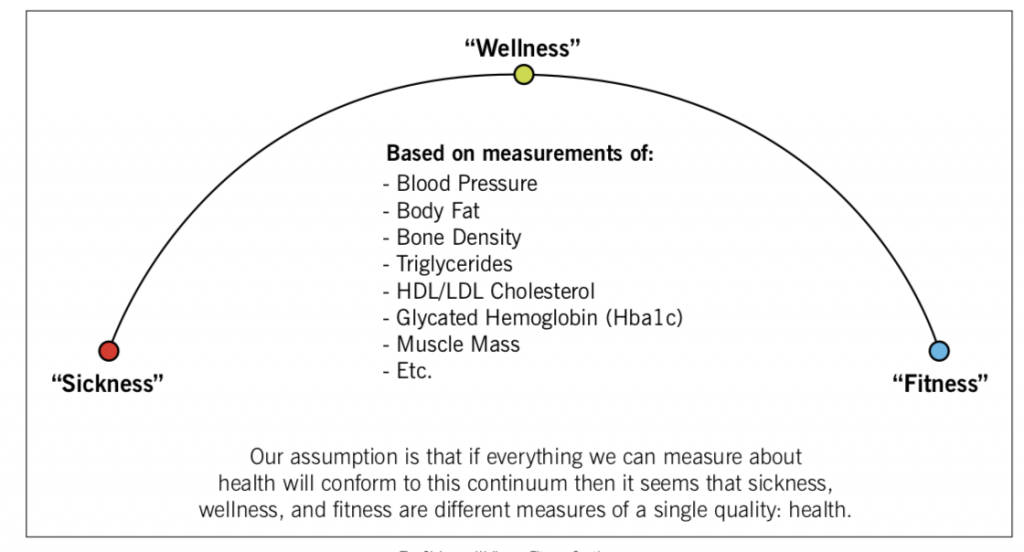
I want to introduce you to the SICKNESS, WELLNESS, FITNESS continuum.
I will reference CrossFit HQ (headquarters) for this concept. As many of you know, I hold Crossfit near and dear to my heart despite many accusations that it is a leading cause of injury and overtraining in the general population. That being said, they have done a great deal of work over the past few years to direct the goal of their brand to target the health of the general population. One concept that they are shining light on is this SICKNESS, WELLNESS, FITNESS continuum.
Photo Credit: Crossfit Journal, August 2016
In brief, they suggest to set a goal to strive for the “fitness” level of this continuum. At the fitness level we are much more resistant to things like injury and disease.
We can be categorized as sick for a variety of reasons such as physical injuries or health conditions. For the purposes of today, we are going to refer to being “sick” as suffering from a physical injury, “well” as being back to baseline, and “fit” as being more resistant to injury and disease.
Example 1
Two people get into a car accident and suffer the exact same injures. In this example, let’s say they are both of the same age, gender and do not possess any underlying health conditions.
Person one exercises at a high level and can squat and deadlift more than their bodyweight. They train 4-5 days per week.
Person two exercises at an average level of fitness and primarily exercises with light weights. They train 3-4 days per week.
Who do you think will have a shorter recovery?
BOTH of these people were likely on the “fitness” side of the continuum pre-accident, but the one with more strength is likely more fit thus more likely to have a shorter recovery time. They both slid onto the sickness side but the more fit person did not slide as far, as their baseline was higher. Hence they have less distance to travel to get back to where they were.
Example 2
Person comes to PT with shoulder pain. They have been suffering from it for a while and can be considered on the sickness side of the continuum.
They are rehabbed, their pain goes away and their PT got them to baseline. They can do everything they are doing before they got hurt.
Where do they stand? I would consider them being in the wellness category at this point. They could easily slip back down to sickness if they put their shoulder under the conditions it faced just before they got hurt before. Unless, they prepare it to handle more…
Why are we stopping at wellness or the low end of fitness?
These examples explain the idea that we MUST slowly and gradually put our bodies under exercise stress in order to see the changes we need. There is a TON of research out there that backs the idea that the more fit someone is, the less likely they are to get sick or injured. This “fit” idea is in both areas of cardio and weight lifting.
The better your cardiovascular fitness you have, the less likely you are to develop chronic disease.
The stronger your muscles, tendons, and ligaments are, the less likely you are to develop injuries to them.
They key is to train you body at a level that actually creates a change. Slowly push the boundaries of challenge with weight lifting and your cardio of choice and you WILL see the benefits long term.
If you have never lifted heavy weights, I HIGHLY suggest consulting a health and fitness pro to provide you with the proper programming to keep you safe.
Let’s strive for getting as fit as possible and your body will thank you.