
by Dr. Loni Rodriguez | Sep 10, 2018 | Back Pain, Dry Needling, Injury Prevention
Where do you think your pain is coming from??
There are many questions that I ask people when they come in for their first session. One of the questions that has dramatically improved my ability to connect with a person is to ask them, “what do you think is happening…?” OR “where do you think the pain is coming from…?” This allows the person to open up and tell more of their story and gives them some control. When is the last time a doctor asked you what you thought was going on?
Are you in pain…? Where do you think it is coming from? Answer that question guided by the following:
- Was my pain caused by physical activity?
- Does physical activity actually make my pain worse?
- Will physical activity harm my (enter area of pain here)?
- Are you afraid to move because you may feel it could make the pain worse?
Do you think you have structural damage? In many cases, structural damage is not the cause of the pain and gradual physical activity is the best medicine. It is my job as a clinician to help educate, or sometimes de-educate the person. You may have heard from another practitioner, google, WebMD, that there is something structurally wrong with you. This can instill a fear and confirms your thoughts that those structural abnormalities are causing the pain.
Are you fearful of moving? Have you been told NOT to do something that you love to do? Do you feel that if you move you will make things worse and increase your pain? In many situations, moving is OKAY. I love giving people the freedom to move. Empowering people to take control of their movement, their everyday tasks, and their lives again is an amazing part of my job. There is a time and a place for rest post-injury to allow an area of the body to calm down. However, that time is very short and when pain persists, lack of movement can cause worsening of the condition.
If you are dealing with pain like this, please seek some ACCURATE education from a qualified practitioner. Please do not let someone increase your fears and heighten your anxiety. There is so much evidence to support movement, loading the body and regular activity to assist in the treatment of pain. This treatment, however, has to be done gradually and with the assist of a professional! The body is extremely resilient and can recover from the state that it is in. So, be positive and find a coach, a physical therapist who can assist you on this journey to improving your quality of life.
Reference
Fear avoidance beliefs questionnaire
by Dr. Loni Rodriguez | Oct 16, 2017 | Dry Needling
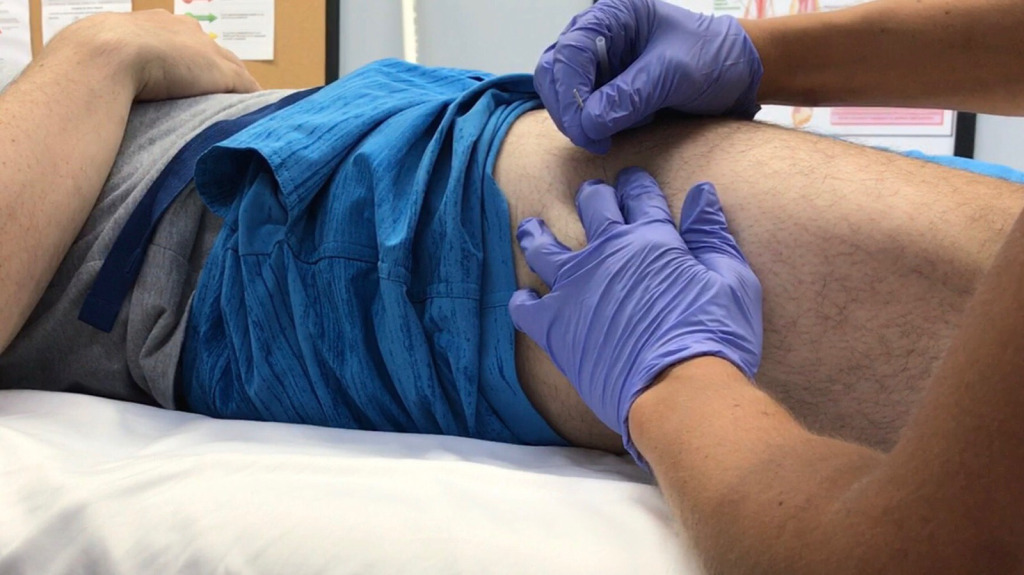
 Some of you who are reading this have either worked with myself or another therapist who practices Trigger Point Dry Needling. Some of you still do not even know what it is or what it does, but you are well aware of the benefits, am I right?
So, what is it? Is it like acupuncture? That is the number one question I get aside from, “…does it hurt?” Both answers are, “Well, no, not really.”
Trigger Point Dry Needling is NOT acupuncture. Acupuncture is a completely different treatment that you will have to ask an acupuncturist about.
Dry Needling It is a technique that uses an acupuncture needle to enter a muscle and directly release a trigger point.
Now, what is a trigger point? A trigger point is a series of muscle fibers which are contracted in a unnatural way. This trigger point is a knot that can create problems within a muscle during an activity, it can cause pain, a potentially lead to injury.
Trigger Point Dry Needling is not comfortable, however is not truly painful. The best way I can describe the feeling is just plain weird. Most of the time, you barely feel the needle until a trigger point is released. At that point, what you feel is a brief sensation that has been described as a “zap” or “shock-like”, and you actually feel the involuntary twitch of the muscle releasing.
So how does it compare to massage?
By no means do I wish to deter anyone from going for their deep tissue massage, as there is a time and a place for it, however, there are some benefits to Dry Needling.
The treatments are quick and efficient. A 30 minute session can address 1-2 areas of the body.
It can provide lasting relief. The number of sessions required depend on how long the issue has been going on. However, most painful areas can be treated within 4-6 sessions, as cumulative treatments are the most effective way to truly eliminate pain. In some cases, regular treatments are recommended. Maintenance care is usually the recommendation for athletes who perform high-demand sports or activities, (i.e. Spartan Races, CrossFit, Orange Theory, Distance Running, etc).
How do you know if it is for you?
- If you are a person who sits at a desk all day, hunched over a computer with poor posture, chronic neck aches, head aches, or tight shoulders, Dry Needling may be for you.
- If you are a runner who complains of tight calves, cranky knees, constant knots in your glutes, Dry Needling may be for you.
- If you are a CrossFitter who has started to have a cranky shoulder or a stiff lower back but does NOT want to stop CrossFit because CrossFit is life, Dry Needling may be for you.
- If you have become a couch potato because some injury has sidelined you from your favorite fitness routine, Dry Needling may be for you.
Last but not least, what happens if you are afraid of needles? First off, I have successfully treated MANY people whom have a needle fear.. and they come back. It does NOT feel like getting a shot or getting blood drawn, you DO NOT have to look at the needle, and if you start with a treatment and decide you don’t want to continue the session, we stop, that’s it.
If you are still unsure, contact me. I am available by call or text at 617-249-4011, or by email at loni@infinitepotentialptw.com. Complimentary consults are available to all who inquire.
I treat people of all ages, shapes, sizes and ability levels. I treat all areas of the body including the neck, shoulder, back, elbow, hand, hip, knee, ankle and foot. I have experience treating in hospitals, rehabilitation facilities, and outpatient centers caring for the terminally ill to the high level collegiate athletes. You name it, I have treated it. So, if you are someone or know someone who may benefit from a consult, reach out and choose PT first over medication, diagnostic imaging, or expensive treatments and procedures.
