![Nociception]()
by Dr. Loni Rodriguez | Sep 17, 2018 | Back Pain
 Nociception… what is it and why should you care?
Inside our bodies, we have these receptors (nociceptors) that sense movement, chemical and temperature changes. Why is this important? Because they tell us what is happening with our bodies and can be a very integral piece to explaining your current level of pain.
When changes in temperature, pressure, or movement are sensed, the receptors send signals to the spinal cord and up to the brain. The brain then gets to determine if it is a potential threat or not and take action. For example, if you place your hand near a hot stove, the receptors sense the heat, send the signal to the spinal cord then up to the brain. The signal is processed as threatening, it is sent down from the brain to the spinal cord to the receptors and tell your arm to pull your hand away. This is a normal and accurate response. However, sometimes these signals get crossed.
You can think of the spinal cord as a switchboard operator and the brain as the boss. All incoming calls are screened by the operator based on what the boss says are important (threatening) or not, some calls go to the boss, some don’t. When the boss or brain says that all calls are very important, the switchboard operator can begin confusing the incoming calls that are normally just categorized as pressure or movement and categorize them as threatening and painful. We now begin to sense normal things like pressure as pain and threatening. Our bodies get better at thinking we need protection and improve our ability to feel pain. However, if we can re-wire some of those crossed lines, we can attempt to improve the brains understanding of the normal signals, like pressure, and not interpret them as pain.
This is an important concept to comprehend because it can help you understand the some of the reason behind your symptoms that you are feeling. Do you want to learn more about pain? Stay tuned for future blog posts or message me directly at loni@infinitepotentialptw.com.
Reference
Greg Lehman – Recovery Strategies Pain Guidebook. (greglehman.com)

by Dr. Loni Rodriguez | Sep 10, 2018 | Back Pain, Dry Needling, Injury Prevention
Where do you think your pain is coming from??
There are many questions that I ask people when they come in for their first session. One of the questions that has dramatically improved my ability to connect with a person is to ask them, “what do you think is happening…?” OR “where do you think the pain is coming from…?” This allows the person to open up and tell more of their story and gives them some control. When is the last time a doctor asked you what you thought was going on?
Are you in pain…? Where do you think it is coming from? Answer that question guided by the following:
- Was my pain caused by physical activity?
- Does physical activity actually make my pain worse?
- Will physical activity harm my (enter area of pain here)?
- Are you afraid to move because you may feel it could make the pain worse?
Do you think you have structural damage? In many cases, structural damage is not the cause of the pain and gradual physical activity is the best medicine. It is my job as a clinician to help educate, or sometimes de-educate the person. You may have heard from another practitioner, google, WebMD, that there is something structurally wrong with you. This can instill a fear and confirms your thoughts that those structural abnormalities are causing the pain.
Are you fearful of moving? Have you been told NOT to do something that you love to do? Do you feel that if you move you will make things worse and increase your pain? In many situations, moving is OKAY. I love giving people the freedom to move. Empowering people to take control of their movement, their everyday tasks, and their lives again is an amazing part of my job. There is a time and a place for rest post-injury to allow an area of the body to calm down. However, that time is very short and when pain persists, lack of movement can cause worsening of the condition.
If you are dealing with pain like this, please seek some ACCURATE education from a qualified practitioner. Please do not let someone increase your fears and heighten your anxiety. There is so much evidence to support movement, loading the body and regular activity to assist in the treatment of pain. This treatment, however, has to be done gradually and with the assist of a professional! The body is extremely resilient and can recover from the state that it is in. So, be positive and find a coach, a physical therapist who can assist you on this journey to improving your quality of life.
Reference
Fear avoidance beliefs questionnaire
by Dr. Loni Rodriguez | Sep 4, 2018 | Back Pain
Have you ever felt stiffness in your lower back? Have you ever thought about what it could be? It feels like bone on bone, tearing, ripping, and compressing structures. It feels like there is a vice around your back, right? It’s doesn’t let you bend over, or touch your toes, or put on your shoes. What if I told you that this feeling could be a sensation, a protective response, that it may not correlate with any actual biomechanical stiffness?
Many conditions such as arthritis, neck pain, and low back pain treatments are targeted around joint stiffness. Stiffness is a significant predictor of disability. The most prevalent condition treated of these three is low back pain, accounted in about 10% of individuals worldwide. As healthcare costs rise, our ability to treat this area does not improve, something is wrong here…
The following explains the findings of a 2016 study by Stanton et al, whom experimented to explain the argument against a correlation of actual structural stiffness and the perception of feeling stiff. They looked at structural stiffness, perception of force applied to the spine, and the effect of adding an auditory stimulus to applied pressure to the spine. They compared individuals with chronic back pain and the perception of stiffness to healthy individuals without low back pain.
First, stiffness in the lower back was shown to be poorly correlated with actual objective stiffness in the structures of this area. Instead, it can be more accurately viewed as a “perceptual inference that may serve to reduce movement and re-injury.” (1) Stiffness can be viewed as a possible learned behavior that severed to protect a once acutely injured area. Our bodies are extremely smart and they try and protect us from injury, however, once the injury has healed, if we do not retrain that area to move once again, it will remain guarded, “stiff” if you will.
Second, people with the perception of stiffness in their lower back overestimated the amount of force applied to the spine and were better at detecting a change in this force applied. Being hypersensitive in an area of the body can be correlated with a change in the brain’s perception of how it views, controls, and perceives that area. The connection is a bit blurry. With a blurry connection, the brain can get protective and hence can create this learned “stiffness”
Lastly, adding a sound in conjunction with the applied force altered the sensation of the degree of force applied to the area of the spine. This means when force was applied to the spine with a sound that is perceived as light, soft, airy, it changed how much force the person reported feeling.
This article concluded that the feeling of stiffness in the spine is multimodal and is derived from both sensory and perceptual inputs, NOT necessarily actual spine stiffness. This is a very interesting finding and can significantly alter how we as clinicians treat low back pain. As a person with low back pain, this can change how you view your symptom. It does not mean that it is not there, it is truly there! You feel the stiffness, but what this article debunks is the feeling that there is actual, structural stiffness that needs to be broken up, stretched, or cut. Next time you feel that symptom, try and think about what is NOT happening vs what you may think is happening.
Reference
Stanton et al. Feeling stiffness in the back: a protective perceptual inference in chronic low back pain. Scientific Reports August 29, 2017.

by Dr. Loni Rodriguez | Aug 27, 2018 | Back Pain

A patient’s imaging results are one of the most popular topics of conversation within the first 15 minutes of almost every evaluation with a new client experiencing low back pain. The client will either be questioning going for an MRI or be describing what was found when they received one in the past. I listen to them, I hear them out, then I drop the knowledge bomb on them…
The prevalence of an abnormal finding is high in people without symptoms and this increases with age. This means that most findings on images are normal and do not always correlate with pain. So, bulging discs, degenerative disc disease, and disc protrusions are like the gray hairs of the spine? Wrinkles on the inside? Pretty much.
A systematic review by Brinjikji et al went through articles that analyzed the imaging findings of 3110 asymptomatic individuals. The findings were outstanding:
- 30% of people at the age of 20 had disc bulges, this increased to 60% at age 50, and 84% at age 80.
- 23% of people at age 20 had disc protrusions and up to 43% at age 80
So, how relevant are the findings on MRI? Not always very relevant at all. This raises the discussion about how imaging findings impact the management of patients with low back pain. Is it very important for clinicians to know what a MRI will reveal? Imaging of the lumbar spine has not been shown to improve clinical outcomes. Why would we want to pay for a very expensive exam that will not change the course of care, management or outcome of treatment of low back pain? I know I sure wouldn’t.
Yet, I do empathize with patients wanting to “…just want to know what is going on inside.” However, what you must understand is that over half of 50 year olds imaged in the study discussed above, had a bulging disc and they did not have pain. Are you over 50? There is a high probability that you have one, too.
I do want to note that there are definitely circumstances when imaging is warranted. Images are necessary when we want to rule out red flag conditions such as cancer or fractures. So, before you jump to conclusions about what was found when you got that MRI, or push your doctor to order that image, remember that prevalence and relevance of abnormal findings are not synonymous. Pain is an experience that has sensory, cognitive and emotional components. What is found on the image is only a portion of what we as clinicians factor into the plan to help you feel better. Abnormal image findings and pain are not necessarily correlated and are likely part of the aging process.
Reference
Brinjikji et al. A Systematic Literature Review of Imaging Features of Spinal Degeneration in Asymptomatic Populations. American Journal of Radiology. 24 Nov 2014.
by Dr. Loni Rodriguez | Aug 21, 2018 | Back Pain

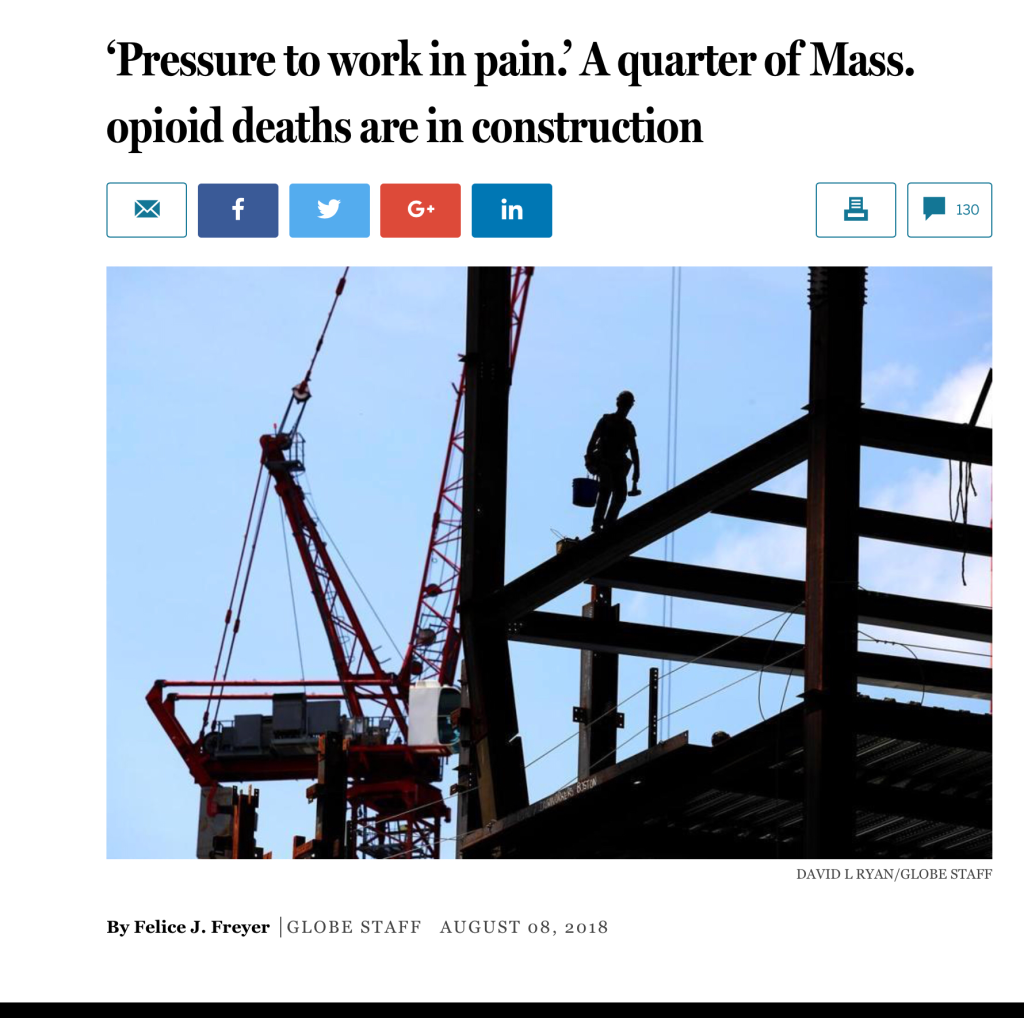
Recently, an article in the Boston Globe was brought to my attention by a patient of mine. It was in reference to opioid-related deaths in Massachusetts.
“The report by the Massachusetts Department of Public Health found that nearly a quarter of overdose deaths in a five-year period occurred among people, mostly men, who work in construction. Farmers and fishermen also had higher-than-average rates of overdose deaths.
The common factor: Workplace injuries occur frequently in these occupations.”
The current method of pain management has a very unfortunate cycle. The article referenced above gives a disturbing example of how the management of pain MUST change. Based on this article, we can assume that there may be a relationship with injury / pain and opioid addiction-related death. The image below describes popular pain management after being hurt on the job (or getting injured in any manner):
Go to the doctor

Prescribed pain medication (Opioids in most cases)
Pain improves = more / continued medication
Reliance on Pain medication
Possible addiction… etc
What if there was existing treatment that has been proven to decrease the rate of opioid prescription?
A recent study published by Dr. Bianca Frogner discusses the effect of choosing Physical Therapy as the first line of defense to address low back pain. She reports that there was an 89.4% reduction in opioid addiction rates for patients who saw a PT to address their pain FIRST vs any other form of pain management. Health News from NPR published a great article that helps summarize Dr. Frogner’s study. This is a staggering number! Physical therapy has been shown to dramatically effect this epidemic if it is chosen as the first line of defense. If we can begin to raise awareness on this topic, can there be a shift from opioid prescription to physical therapy prescription? I sure hope so.
References
Frogner et al. “Physical Therapy as the First Point of Care to Treat Low Back Pain: An Instrumental Variables Approach to Estimate Impact on Opioid Prescription, Health Care Utilization, and Costs”. Health Serv Res. 2018 May 23.
