
by Dr. Loni Rodriguez | Dec 17, 2018 | Exercise advice, Injury Prevention, lifts, Running, running help, squats, strength training
Why should runners strength train? PART II

Again, this post was inspired by Chris Johnson, my GO-TO for all things running!
For more information about Chris and some of the amazing content he has to offer, visit his website at Chris Johnson PT.
In the last post, we covered some of the benefits of strength training and the specific importance of this practice for runners. In this second piece, I will cover some of the most important and effective exercises that a runner’s strength training routine should include.
Dynamic Warm Up
This is often neglected by runners because it is easy just to get out and run. We want to allow adequate perfusion of blood to the necessary tissues and prepare the nervous system for the run itself. There is also likely too much time spent on unnecessary stretching. This stretching has little to no effect on injury prevention or preparing for the run.
Here are two recommended exercises that can be included in a dynamic warm up:
Hugging knee to chest
Quad stretch with overhead reach
The March
It is important for a runner to demonstrate solid single leg balance. Marching provides training for single leg balance that simulates running. It also allows for training of shortened stride length which can help reduce the risk of running related injuries.
Here are two recommended marching exercises:
Baseline marching with or without weights
Prisoner March
Lateral Toe Tap
This exercise is important to train the glute muscles. The glutes play a large role at reducing running related injuries, as they are large contributors to the activity of running itself. This exercise directly targets those glutes, challenges single leg balance and simulates running as it is an upright activity.
Here are two recommended lateral toe tap exercises:
Lateral toe taps with band
Single leg stance hip abduction
Step up (7-8” step)
This exercise challenges single leg stance just like the demands of life. It is important to focus on control, coordination, and timing with this one. It is NOT an exercise that should be challenging on the muscles but more on balance, quality, and form.
Here are two recommended step up exercises:
Standard step up
Fluid step up
The Bridge
This exercises is one of the most basic yet it is very important. It is also performed without equipment. It works on glutes, hamstrings, calves, low back, and abdominals
It is great for preventing knee pain in runners.
Here are two recommended bridge exercises:
Standard bridge
Bridge march
The Plank
This is NOT just a core exercise. It challenges the lateral hip musculature which is very important for runners. It is recommended to not jump too quickly into unstable surface work as you want to master these first.
Here are two recommended plank exercises:
Standard plank arms bent with or without knee taps
Standard plank arms straight with or without knee taps
Calf Raise
Calves can not be overlooked in training for the lower body as they are the powerhouse for distance running. Calf exercises can create tissue resiliency and build capacity to tolerate the demands of the sport and resistance to injury.
Here are two recommended calf exercises:
Isometric double leg calf raise
Isometric single leg calf raise
Squat
The squat is the most fundamental strength training exercise that is involved in everyday life. It has the ability to create full body resistance to running-related injuries.
Here are two recommended squat exercises:
Air squat
Goblet Squat
Loaded Carry
Life demands that we carry stuff. So why not train it? Loaded carries play a primary role in working with runners of all ages and abilities as it is important to get acquainted with being tall and upright.
Here is a recommended carry exercise:
Farmers carry march
Deadlift
This exercise, along with the squat is one of the most important functional exercises that every human should perfect. It is also extremely important for injury prevention. The correct form is crucial and introductory exercises for this movement are important to perfect.
Here are a few deadlift exercises to introduce you to to the movement:
Hip hinge with PVC
KB Deadlift
WANT MORE?!?!?!?!?
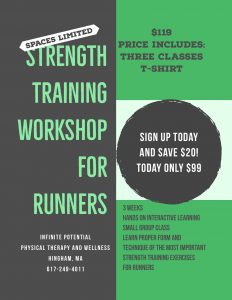
Interested in live group training that covers this content?
We will be hosting a 3-part series workshop held on 3 consecutive Wednesday’s in January from 6:30-7:30pm
JANUARY 9th, 16th, and 23rd.
This workshop will be located at our brand new office on 1 Derby Street in Hingham. Space is limited so please sign up ASAP!
Email Loni through loni@infinitepotentialptw.com or call 617-249-4011 x 700 for ANY and all questions!
Sign up through this link– choose the 6:30pm class on January 9th. Follow the prompts to complete registration.
 @
by Dr. Loni Rodriguez | Dec 11, 2018 | Exercise advice, Injury Prevention, Running, running help, strength training
Why should runners strength train? PART I
The following is a very brief overview of Chris Johnson’s book, Running on Resistance. For more information about Chris and some of the amazing content he has to offer, visit his website at Chris Johnson PT.
Strength training is an integral part of any regular exercise routine. Here are some major benefits of this fundamental practice:
- Builds cardiovascular health
- Improves body image
- Improves flexibility
- Improves full body resiliency and resistance to injury
For runners, not only are you focused on the above, but for more competitive runners, there is a focus on performance. There is an element of excitement when we improve our mile time or come back for a run feeling refreshed.
Here are some of the running specific benefits that strength training can provide:
- Improve capacity
- Increase running economy
- Increase speed
- Delay fatigue onset
Body weight exercises are a great entry into resistance training, yet additional resistance with the use of weighted equipment will provide the necessary stimulus to gain strength. However, to reduce the risk of injury from strength training, a general periodization program should be followed. There are various programs out there and have been proven to be effective. The major areas of interest when choosing a program are exercise selection, recommendations for load, repetition count, and rest periods. Each of these should be well understood and planned before initiating a program.
Here are some general recommendations
- Exercises need to be individualized to the person’s goals and exercise history
- Initially, 2-3 sets of 8-12 reps of bodyweight movement. Progressed then to weighted routine as form and comfort improves
- Single leg exercises need little to no rest
- Two-legged exercises require a rest of 1-2 minutes recommended
- Frequency is most effective at about two days per week for 12 weeks on days of lower volume running or drill/tempo days
Stay tuned for Part II, where I will review the most important and effective exercises for runners to add into their regular routine.
WANT MORE?!?!?!?!?
Interested in live group training that covers this content?
We will be hosting a 3-part series workshop held on 3 consecutive Wednesday’s in January from 6:30-7:30pm
JANUARY 9th, 16th, and 23rd.
This workshop will be located at our brand new office on 1 Derby Street in Hingham. Space is limited so please sign up ASAP!
Email Loni through loni@infinitepotentialptw.com or call 617-249-4011 x 700 for ANY and all questions!
Sign up through this link– choose the 6:30pm class on January 9th. Follow the prompts to complete registration.
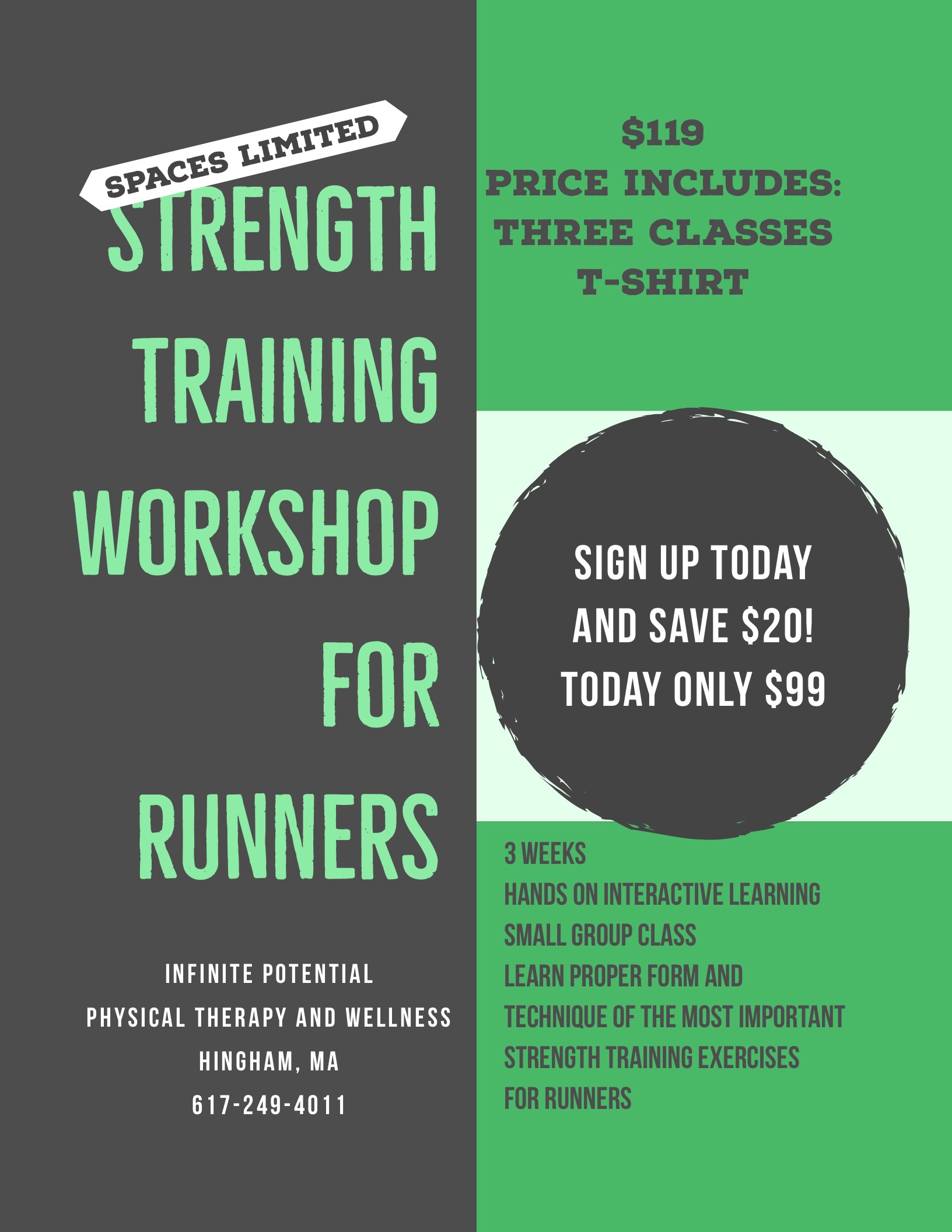
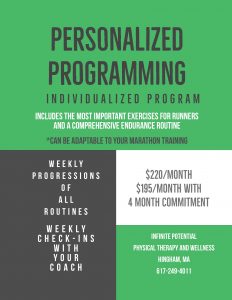
Are you interested in personalized programming?
It is a great way to safely and effectively implement this strength training program that was touched upon in the workshop.
HINT >>>> Most of it will be addressed in more detail in the 3-part series in January!
However, for a more personalized approach, the remote programming is a great way to be sure that you are doing EVERYTHING you need to do to improve your running performance and reduce your injury risk.
Email Loni through loni@infinitepotentialptw.com or call 617-249-4011 x 700 for ANY and all questions!

by Dr. Loni Rodriguez | Nov 19, 2018 | Back Pain, Exercise advice, Injury, Injury Prevention, knee pain, lifts, squats, working with injury
What to do when you are having pain during a workout?
Have you ever just left the gym or class when pain starts to occur? How annoying is that?! First off, you didn’t get a workout in, second, you might have hurt yourself… I hope not, and third, what do you do now? Should you go back to the gym tomorrow? Take a week off?
I really would like this post to come across the right way. I am by no means, telling you it is okay to push through any significant pain while exercising. What I would like to do is to provide a guideline of what to do when pain comes on during a workout.
Before I get into the guideline, there is one major exception:
*If you actually feel like you had an injury, as in, there was an EVENT that caused your pain, please stop exercising and seek medical attention*
Eg.
- if you fall off the treadmill, and feel a pop or snap in a joint followed by severe pain
- if you hit your head
- if something occurs and you notice immediate swelling and pain
…you get the point
What this guideline is NOT…
- A way to treat your pain
- A way to continue to exercise multiple sessions in a row without seeing guidance from a medical provider
- A way to avoid formally dealing with your injury
Point being… please seek medical advice to really help your issue!
In the meantime, I want you to be able to have some understanding of how to allow training to continue despite some pain vs taking time off.
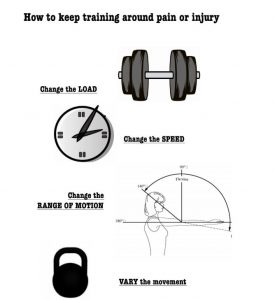
First… reduce the weight
- Try using a lighter weight, but continue the movement as prescribed.
- If the reps continue to be painful…
Next… slow it down
- Keep the weight and try using performing the movement slowly.
- If the reps continue to be painful…
Next… change the range of motion
- Keep the weight, return to a normal speed and limit how far you go into the movement being performed.
Finally… vary the movement
- There are various ways to perform different exercises.
- You can continue to get the same training effect while performing the movement in a slightly different way.
Here are a few examples of how you can vary the workout if you are experiencing pain during specific movements:
Knee pain with squatting?
- Reduce the load
- Alter the tempo – 3 seconds down, 3 seconds up
- Reduce the range of motion – Squat to a box or a bench
- Change the movement – go from front squats or goblet squats to a back squat
Back pain with deadlifting?
- Reduce the load
- Alter the tempo – try a quick lift from the floor and a slow lower
- Reduce the range of motion – Lift from an elevated surface (blocks or plates)
- Change the movement – go from a barbell to a hex bar or kettlebell
Use this to help keep yourself training, but PLEASE… also seek medical advice. There are many other things to be done in order to get you back to being pain-free during workouts… most of the time, it’s more exercise! Not rest.
by Dr. Loni Rodriguez | Nov 12, 2018 | Exercise advice, Injury, Injury Prevention
Should you exercise through injury?
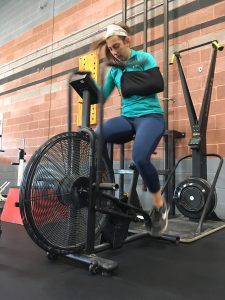
I get asked many times about continuing to exercise despite being injured. This is definitely a loaded question. If you want to know how hard you can push yourself while dealing with pain, that concept is beyond the content in this post.
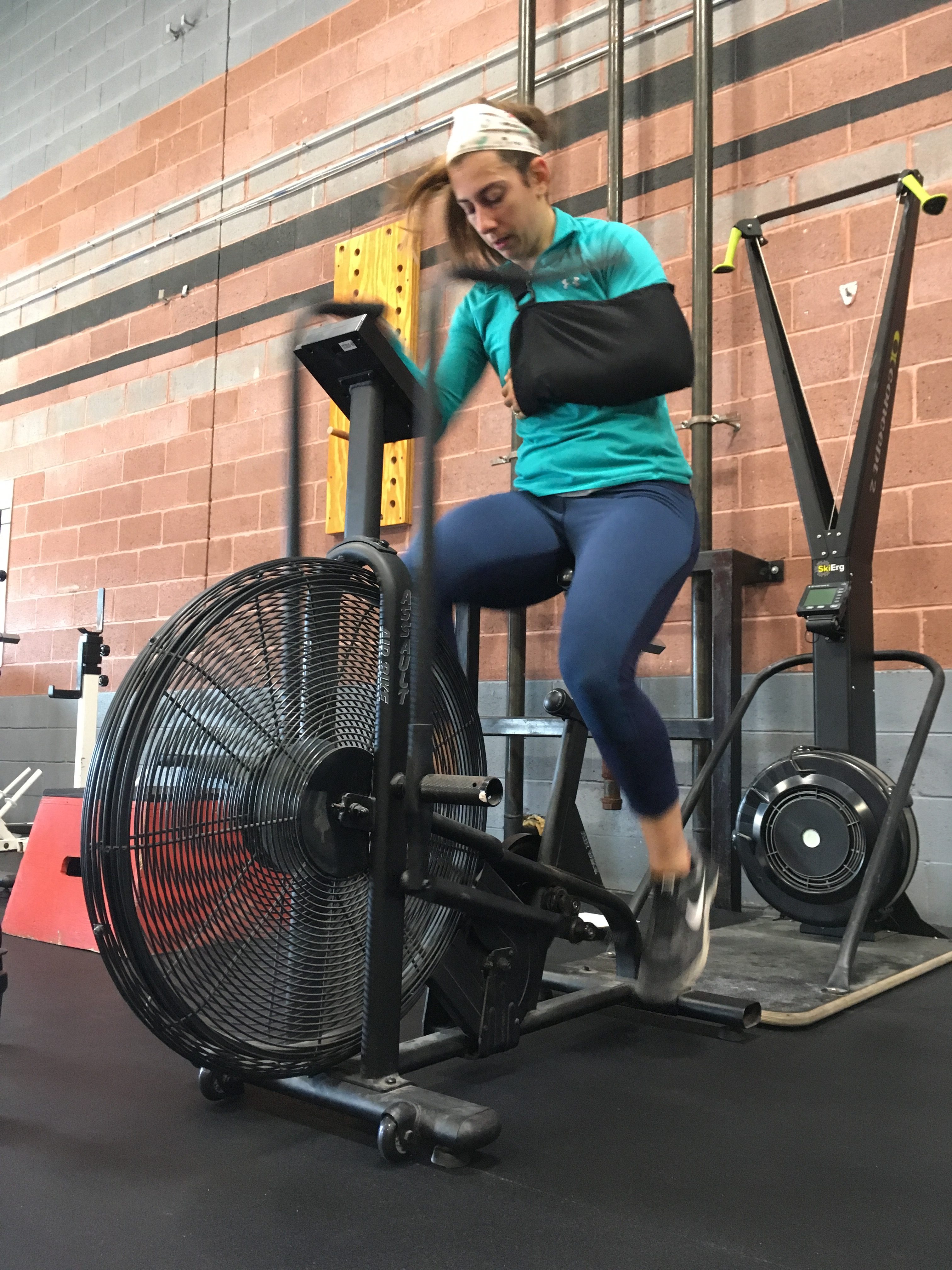
Today’s post is about what to do when you perform full body exercise on a regular basis and go and break your arm.
I would like to quickly highlight the inspiration of this post today- coach, teammate and friend, Miss. Adrienne Itri. This girl can not catch a break! She has been prepping for months for a competition this past weekend, training harder than ever and feeling the healthiest she has in a long time. She got there and gave it her all in event 1..… and broke her elbow. It was a fluke accident and could have happened to any of us. She is quite a trooper and a team player, however, showing up at the competition later that afternoon (following her trip to the hospital) AND the next day to cheer us on. No better teammate than that!
Hats off to you my good friend, I will help you every step of the way in this healing process!
Back to the post… I will be listing a few tips about the benefits of exercising around injury!
First piece of advice is… There is hope!
The good thing about functional fitness, is that there is a plethora of modifications that can be made to any exercise routine. These modifications can continue to allow for stimulation of muscle growth and improvements in endurance.
You won’t be doing exactly what you did before, but it will be damn near close.
Second, general exercise stimulate healing…
When you have an area of your body that needs some time to heal, it needs just that, time to heal. However, if you allow the other working parts of your body to exercise, you can stimulate the healing process of the injured region. It works through hormonal, heart rate and blood pressure stimulation.
Third, train the non-injured extremity…
There is a ton of research that shows strengthening the non-injured side can actually improve the strength of the injured side. In Adrienne’s case, she will be instructed to continue to perform as much strength training as she can using her right arm. Sure, the left arm will continue to have strength loss, however, training the right side will actually deaden the impact of not using her left arm for the next 6 weeks.
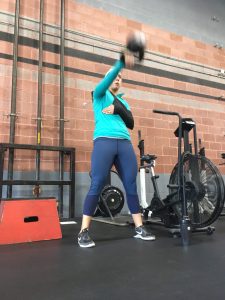
Fourth and final…
We all know that we FEEL better when we exercise. It increases endorphins, or your “feel good” hormones. If we are down and out because of a broken arm, we will feel even worse if we stay home and do nothing. So, if you are injured, please seek some advice from a trained professional who understands your injury and can help you create a modified program for the next few weeks of recovery!
by Dr. Loni Rodriguez | Sep 24, 2018 | Back Pain
 Why squatting and deadlifting are GOOD for your back.
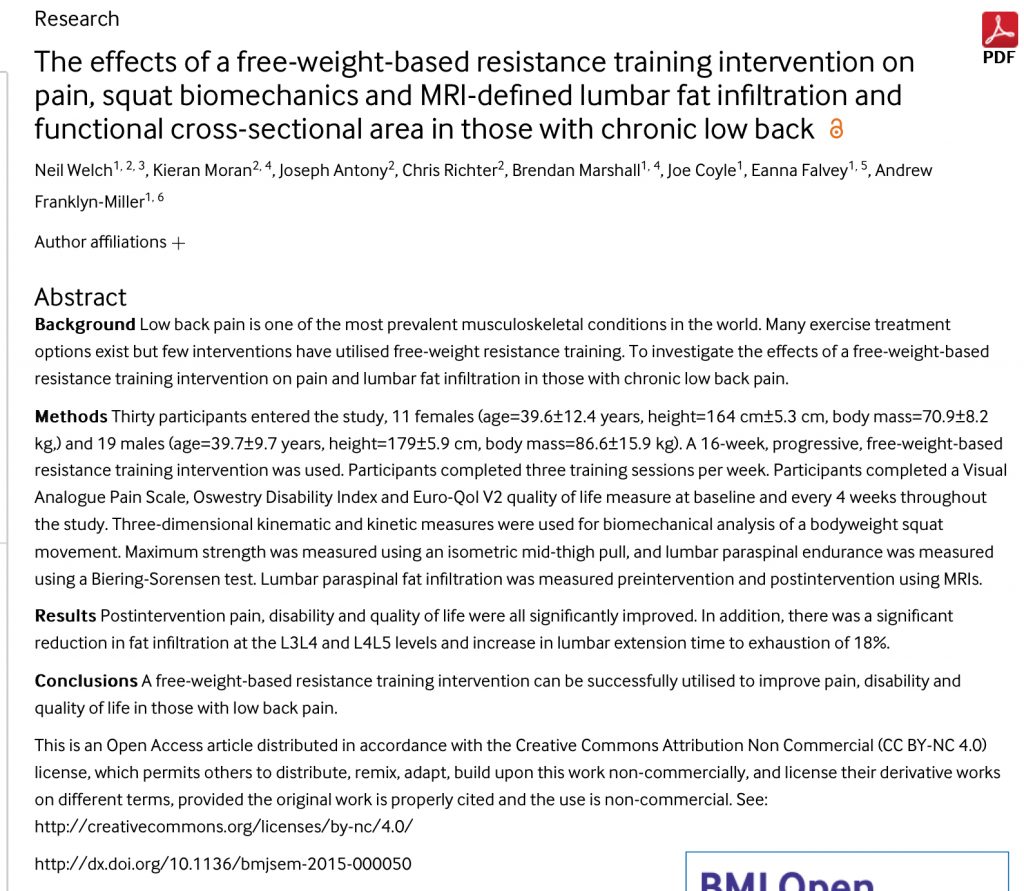
People in pain have many beliefs about their symptoms in regards to why it is present, what is causing it, what could be contributing to the pain, etc. Specific to the topic of lifting, many feel that lifting or carrying heavily weighted objects or performing heavily weighted exercise can cause low back pain. Can you strain a muscle by lifting something? Of course! However, when performed properly, a regimen of free weight-based resistance training can actually help decrease these symptoms. I stumbled across a great article that I will break down into lay terms to help explain the importance of this type of resistance in people with low back pain.
Exercise has been recommended as the most effective conservative management for persistent low back pain in combination with addressing psychological, social, genetic and physical factors. There is evidence that resistance training, specifically, can help to eliminate the requirement for surgery or injections and can help reduce the related fear associated with low back pain. It has also been shown to be more effective at addressing low back pain compared to aerobic, coordination, Pilates, or mobilization training.
When looking at different types of resistance training, we think of machine-based and free-weights. Free-weight specific resistance training helps recruit the erector spinae and other posterior chain musculature which are very important in the treatment of low back pain. An in-depth discussion of free-weight vs. machine-based exercises is outside the scope of this post, however, the focus of the following resistance training program is based upon free-weight exercise. Participation in this type of training may be contrary to popular belief about what may be detrimental to a person experiencing low back pain.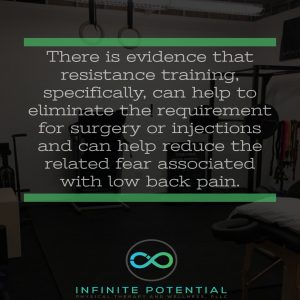
A few factors that were looked at in this study were peoples compensatory movement patterns due to pain, the amount of fatty-infiltrated muscles of the lower back, lower back muscular endurance, pain levels, quality of life, and perceived level of disability. Compensatory movement patterns are seen in people with low back pain as they try and avoid movements of the lumbar spine. Specifically movements going from sitting to standing and bending forward to pick something from the ground are often guarded. This guarding and co-contracting of trunk musculature is an altered motor pattern that can enhance the disuse of spine musculature prolong the pain continuum. With the disuse of these muscles, fatty-infiltration and decreased muscular surface area can be seen and has been proven to be associated with people dealing with persistent low back pain.
The specific movements performed in this study were based around the squat and the deadlift, two movements that are functionally performed daily by all humans. A deadlift is simply picking something up from the ground and a squat is sitting down and standing up. The participants that were included were of ages 16-60, both men and women, having a history of low back pain for >3 months. They went through a 16-week program that consisted of 3 training days per week. The resistance training was based around 7-10 rep maximum which can be associated with moderate to heavy weight training (for the purposes of this article, specifics about the positive effects of loading with heavier weight training will not be discussed).
Results? Dramatic.
Significant decrease in fatty infiltration and increase in lumbar paraspinal muscle endurance without specifically training lumbar extension – basically meaning that the resistance training performed improved spine muscle quality and strength without directly training the spine muscles. The resistance training that was performed engaged the low back muscles in an effective way!
Pain, disability and quality of life were significantly improved by over 70%!
Body mechanics and coordination of the sit to stand (squat) movement were significantly improved with decreased presence of guarding.
Take home points?
- Including free-weight-based resistance training in a rehabilitation program could improve the outcome of the treatment.
- Try not to be afraid to lift weights! As long as it is done properly, a regular strength training routine can be a very effective aspect of a rehabilitation program.
