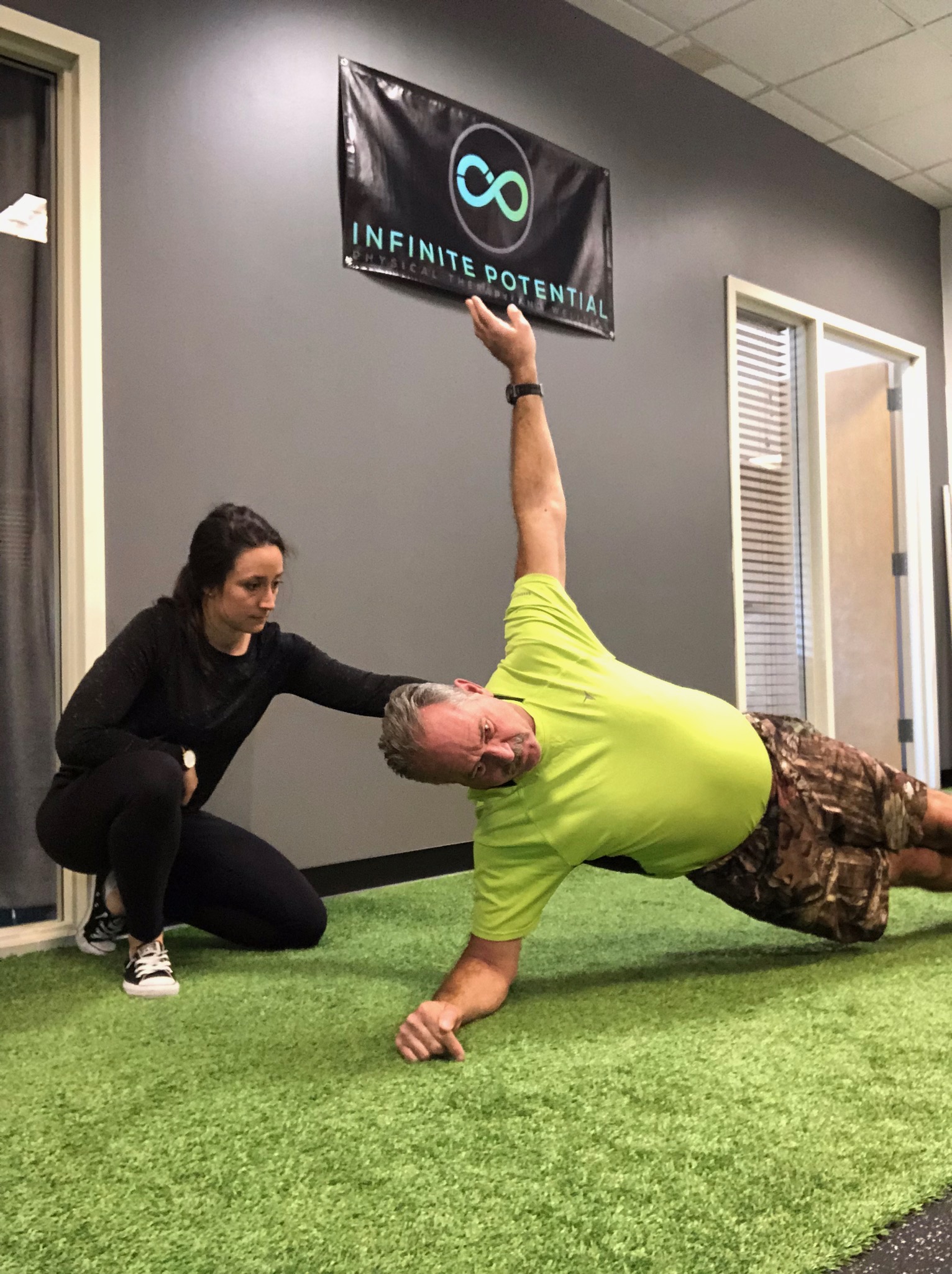
Last post I tried to set the stage, light the fire, get you all jazzed up to start strength training but didn’t give you any of the tools to begin.
DISCLAIMER: These are instructions for someone who has never strength trained before or has minimal experience. It is advised that you proceed with caution, go easy and follow the recommendations.
“Where should I start?”
Simple and Consistently.
“You said it should be hard, how do I know it is challenging enough?” I want you to feel like you are giving effort. Run through the program provided below twice per week for two weeks. If it did not tire you out or make you sore at all, you have to progress. Resistance training can and will make you sore, but not so sore that you can’t climb the stairs, sit on the toilet and are limping while you walk.
“What exercises should I do?”
I am going to review the main components of a resistance training routine for a beginner. These require no equipment at all and can be performed at home. You can begin all of these with 2-3 sets of 10-12 repetitions, 2 days per week.
Hip thrust
This is a great exercise for the legs and lower back. It is a VERY important area to strengthen in order to lift, carry, go on long walks, prevent falls… the list goes on.
Push up with assist
Push-ups are a standard movement to get good at. The problem is, most people can not do even one! It’s a tough one… That being said, there are many ways to get stronger at them and this is one. This movement is very important for a handful of reasons but one major reason is that if you fall, you want to be able to get back up!
Air Squat
This is one of the most foundational movements known to the world of resistance training. You can not go wrong here! This is an un-weighted squat but can be a very effective way to build up leg strength, help your knees and your lower back!
Plank
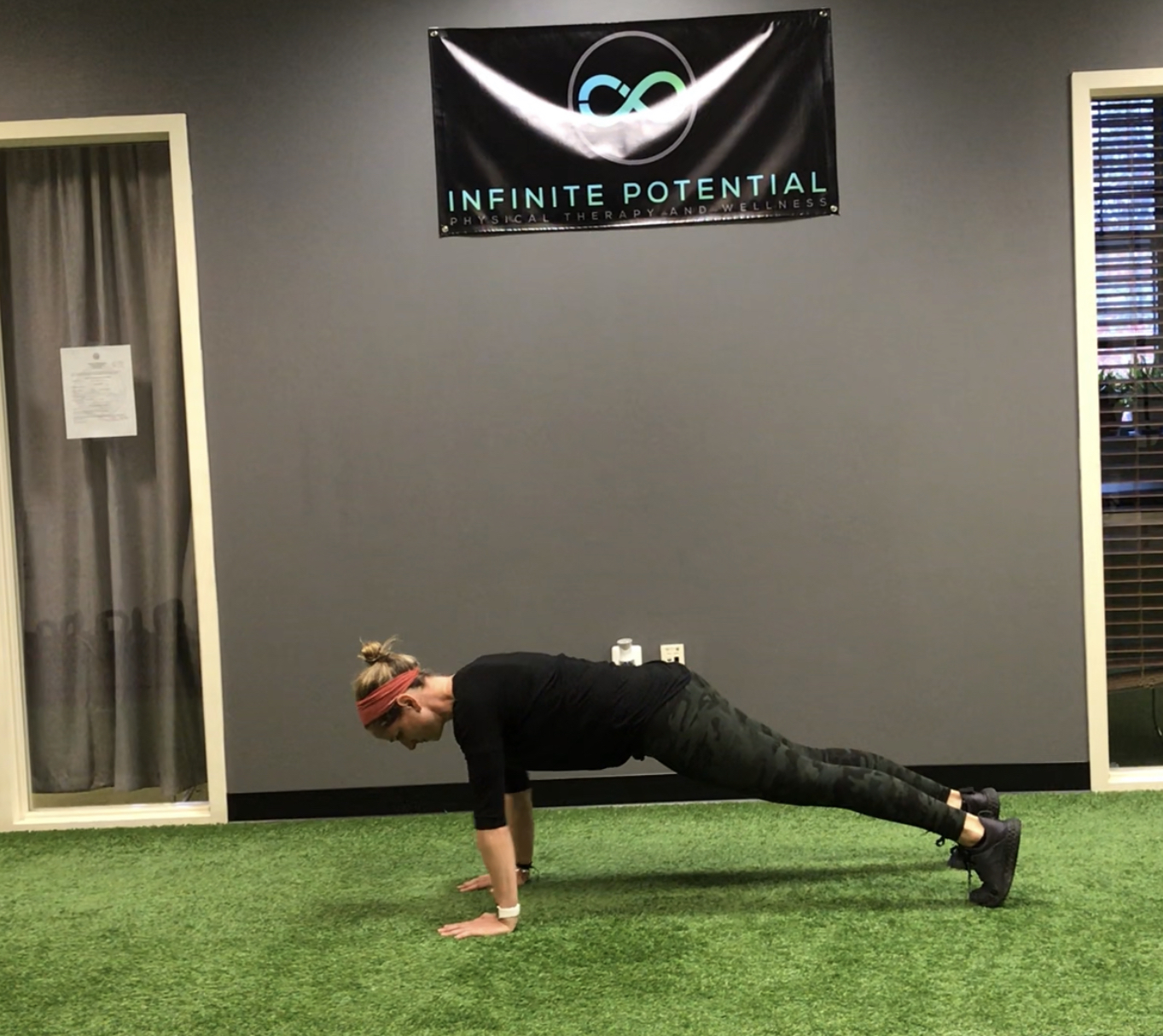
The plank… another foundational movement! This is a FULL BODY move that works everything! This is an exercise that not only helps you gain a stronger core, but it is great for shoulder strengthening, lower back and knee health. This would be one that is performed for time, suggested at 3 sets of 15-20 seconds for beginners.
Reverse lunge
Now… This one is a bit advanced but I love it. There are many people who are not able to perform this move as shown in the video. That being said, it can be easily made less challenging by holding onto something like a door handle, door frame, kitchen counter, etc… This move works on balance, strength and coordination. If you are someone who can not get up from a kneeling position without your hands, this exercise is a must!
Suitcase carry/ march
This is one that many don’t know about but is is incredibly beneficial! Have you ever struggled at carrying in the groceries? Been challenged by dragging a heavy bag of leaves across the yard? Felt the strength of your grip disintegrate? The suitcase carry works all of the above. This would be an exercise also performed for time if you are marching, or distance if you are walking. I would suggest 3 sets of 20 seconds per arm – hold a gallon of water, fill a grocery bag with canned goods…?
Step up
This one is fairly obvious but I’ll give you some examples as to WHY it’s important. How often do we carry things up and down stairs? (Often). You never want to lost the ability to do that! You also want to keep your knees, hips and lower back’s healthy, too? Of course.
Try these out… See what’s challenging, see what’s easy and make adjustments accordingly. Resistance training should be a part of your life forever if you plan to live long and healthy. It doesn’t have to be fancy to be effective.
If you took the time to watch the WHOLE thing I don’t even think I have to write anymore…
This is not just about being able to lift up a meaningful being. This ad shows some of the benefits and results of strength training as we age.
Strength training continues to be recommend as part of an adults regular exercise routine at least two days per week. This is based upon a recent update of the W.H.O’s (World Health Organization) physical activity guidelines from 2020 (Reference: World Health Organization 2020 guidelines on physical activity and sedentary behavior). They even state that strength training is more beneficial than aerobic training based on its benefits of improved coordination, increased bone density, and improved quality of muscle. Of course, aerobic or endurance training has its benefits, but the strength work benefits outweigh those of aerobic work.
But WHY… Why is strength training so incredibly beneficial as we move across the lifespan? Because it allows us to do things with more ease and less risk of injury!
Doing that yard work job without getting hurt
Carrying in the groceries without fear of dropping them
Carrying the laundry up from the basement without needing a rest
Climbing the stairs going step over step
Getting up from a low beach chair without your hands
Getting up and down from the floor while playing with your kids or grandkids without needing to use the coffee table
As we slow down, do less, and are exposed to less challenge, our bodies adapt. Our muscles weaken, our tendons get thin and frail, our bones become less dense. Strength training works because it consistently exposes your body to challenges so it can adapt and become more resilient. It doesn’t only make our muscles stronger but it helps area’s of the body like the rotator cuff, the Achille’s tendon, the discs in your lower back, your hip joints and the list goes on.
Oh, and it has to be challenging. You can’t get stronger by lifting weights that aren’t challenging. You just need some supervision and guidance.
So… Why aren’t adults doing more of it? Fear and confirmed fear from trusted sources.
Medical professionals believing that lifting challenging weight is harmful on the joints of the body and unsafe.
Many people agree with this and it is then confirmed once they speak with their physicians or other healthcare providers.
Based on my personal, anecdotal evidence these are some of the most common barriers to reaching more people with this fabulous modality. I work mostly with very active people who are already exercising, they are just not lifting weights… and this is the primary reason.
Strength training can be incredibly helpful in so many ways for all walks of life, ages, and ability levels. I can beg and plead everyone to get involved in it but it is YOU and only YOU who can make it happen.
Find your why, hire some help, invest in your body… it’s the only one you’re given.
Burpees: They are that universally challenging but all-around effective move that works most major muscle groups and ups your cardio endurance.
How to: The basic burpee is a four point maneuver. From standing position, drop into a squat with hands on the ground in front of your feet. Next, kick your feet behind you into a solid plank position then jump your feet back towards your hands. Jump up into the air, then do it all over again.
This exercise is no joke. Since it’s a combo move, the exerciser should have a good master of the plank and good mobility to be able to deep squat.
You’ll notice that arms, back, chest, core, glutes & legs are fired-up as your heart rate raises. The full-body/full-cardio maneuver is super effective at burning fat and building muscle. This is a perfect at-home exercise as no equipment is needed: high intensity interval training anytime & anywhere.
Believe it or not, there actually was a Dr. Burpee who invented this infamous move. Exercise physiologist Royal Burpee created “the burpee” in the late 1930’s as a multi-part exercise for a fitness test – part of his “seven tests of physical capacity.” Its origins were for a WWII military-fitness test where participants were asked to do as many burpees as they could in 20 seconds then 60 seconds.
If you are looking to get into shape quickly for functional everyday living or sport specific training, this is the move for you. Even 90 years after its inception, it’s a training staple.
Today we are highlighting Lily who has been with us since the Fall of 2019. Lily is a high school crew athlete who was dealing with knee pain that lead her to stop running at practice. The pain crept in seemly out of nowhere and she noticed that it just was not going to go away on it’s own.
“I have been doing crew since 6th Grade and really enjoyed rowing out on the water with my friends. When I joined the High School Crew Team in late August 2019 however, I noticed that my knees would begin to hurt during our warm-up runs and would then prevent me from participating in the other activities in practice. Due to the already existent pain, my knees would then begin to hurt when I was sitting down, often at school. This would prevent me from paying attention to my full abilities in class.”
She was impacted on a daily basis by her symptoms and was at a loss of what to do about it. Being a teen, she felt that she shouldn’t have to deal with pain like she was having.
“I had pain in my knees when I was walking up and down hills or stairs, running, jumping or any form of impact on my knees. I often found that my knee pain would flare up during the day at school.”
After the first session with Lily, I knew that I was working with an incredibly dedicated young lady. It isn’t uncommon for a young client to speak for themselves during the evaluation (versus their parent), but it is truly impressive when it does happen. Lily took the lead and consistently advocated for herself throughout her entire rehab. She was very diligent with her program and communicated with us between sessions like a mature adult.
“Before starting the treatment I did not think that there was any way that my pain and discomfort could be helped. I knew that, after talking to a Orthopaedic Surgeon, nothing could be done to directly treat the symptoms.”
I can’t say there wasn’t any eye rolling, big sighs or, “do we have to?!’s” during sessions, however, Lily worked hard, poured in a ton of effort and always did her best.
“Even though sometimes the treatment is difficult, after every session I feel stronger and my knees do not hurt nearly as much as they did only a few months ago.”
At this point, Lily is in her third and final rehabilitation phase. She has progressed to returned to running, she performs her strength routine at least 2 days per week on her own, and returns to our office for a monthly session to review and progress her home program.
“I can now run, with little to no pain for a relatively long period of time. The treatment has not only strengthened my leg and the other muscles surrounding my knees, but also my core and upper body. This has an incredible advantage when rowing and allows me to participate in all the practices and spend time with my friends and teamates.”
We asked Lily to tell us what others should know about seeking treatment at Infinite Potential PT.
“I believe that if you are prepared to work hard and persevere through the treatment plan that Lori gives you, which can sometimes feel like a challenge (especially when you have other commitments to your studies & crew team, and also want to spend time with friends and family!), you will definitely feel the benefits! Don’t give up – trust that you are strong enough, both physically and mentally, to succeed and become the best that you can!”
Thank you, Lily for your hard work! It was a pleasure to have gotten to know you and help you through this process.
The push up is a very effective body weight movement and one that requires practice to master!
Here is my advice on how to get a push up!
First of all you need to be comfortable in a plank position, so get this position down and aim to hold for 20-30 seconds. Plank from the hands first and then forearms (which is a little more difficult).
Push up descent
Push up to a box (incline)
Next up you can try a push up to a box. Step away from the box and get into a plank position with hands on the box. Slowly lower yourself down maintaining the straight body plank position until your chest makes contact with the box. From here, squeeze and engage the core muscles and push back up to the plank position. Repeat 8-10 reps for 3 sets
Once you have mastered the push-up decline and the push up incline to a box you can move forward to the next steps.
Push up from the knees
Starting on your knees with your hands directly below your shoulders bend the elbows maintaining a straight body position, lowering slowly until your chest touches the floor. Contract your core and press your body back up.
repeat 5-8 reps for 3 sets
When you feel comfortable doing this from the knees you can try your first full push-up!
This time from a high plank position lower yourself to the floor, keeping your elbows tucked in to your side. Contract your core muscles by pulling your belly button to your spine and will pressure through your palms press yourself back up to the high plank position maintaining the straight body position throughout.
They can’t talk, they can’t tell you what makes it hurt, how severe it is, how it makes them feel, or what makes them feel better.
You can’t ask questions like, “Does eating make the pain worse?”
Or… “Has this been going on for a long time, you just haven’t done anything about it?”
You must rely on watching their body language and for signs of distress. But man, to base your plan of attack on a dogs sign of pain is really challenging.
It is hard because when you see these said signs (shivering, whimpering, panting), you want to try not to freak out and run to the emergency room. Sometimes, things like this just go away on their own. Also, everyone knows how expensive the vet can be and you are 110% at their mercy which means you have to have a trusted source for care.
Gracie (our 5 year-old Long-haired Dachshund) had suddenly began to show signs of distress one day. The signs would fluctuate, but she just was not herself and we made the decision to take her to the vet. After some blood testing and ruling out the real serious things, she was diagnosed with lower back pain. Now, Dachshunds are known for back issues because of their bodies, but she’s 5 years-old! She does love to play, jump and run but has had no prior history of this…
The vet’s treatment plan was high-dose anti-inflammatory medications and ‘crate’-rest for 2 weeks. I asked about physical therapy, I knew that “doggy” chiropractors existed but they didn’t have any resources for us. Nevertheless, we took the docs recommended plan and headed home. Mommy went into PT-mode.
I texted and messaged Instagram friends all over the country to see who knew what I could do for my dog with low back pain. Soon enough, responses poured in and I was in contact with one of the best animal chiropractors! (Social media is WILD). We spoke briefly on the phone and not to my surprise, the vet’s recommendations were pretty poor and she explained that it was a very ancient school of thought. I needed to find myself a local chiropractor for my pup…
A few days went by, Gracie was looking a bit better but still was well below 100%. She was not really eating, not wanting to leave her crate very much (even though that is what was recommended, I left the crate door open). She really was just feeling like crap. During this time, we also have Mr. Tucker (our other pup) right by her side cleaning her ears, eyes and mouth like a caring little bro – the CUTEST thing ever.
A few more days went by, still not looking up for our furry baby. One morning I woke up to get ready to go to OrangeTheory and took Gracie out to pee. She seemed like she had a little pep in her step without showing signs of distress so I was happy. That was until I took her outside and she stumbled and fell over on her hind legs while going to the bathroom. Her back legs were not working normally! That was it, to the vet ER I went at 5:30 am. Even though I could tell she was not in as much pain, I needed to get her looked at.
After waiting patiently and going through with the evaluation with the ER doc, they cleared her for severe loss of function via some testing and diagnosed her with MILD disc herniation and recommended HIGHER-dose pain medication for 6 weeks and complete crate rest (for 6 more weeks).
WHAT?!
But she wasn’t in pain? She was actually happy and seeing some improvements? If you clear the big scary diagnoses and say the leg weakness is a sign of a mild disc herniation then why the 6 weeks of bed rest and super high does pain meds that will knock her out?!
Could ANY of this be similar to a human? (I asked, and they said sort of but not really…) They said that if I did not follow these recommendations, I could be looking at severe negative effects and possibly needing surgery…
This seemed WAYYYY too close to some recommendations made to patients in the past who have made amazing strides without heavy meds, rest, or surgery.
Again, I reached out to the trusted chiro and she said PLEASE find a local doc. So… that is what I did. The SAME day that I brought her to the ER, she was seemingly better so I think she was gradually improving in regards to discomfort and pain, but her leg weakness and lack of coordination continued to be present. I absolutely wanted another opinion. I found a doctor of doggy chiropractic medicine that the other chiropractor approved of. We were seen for an appointment and all of my worries and thoughts of having to rest and medicate her were gone. He agreed with some mild disc-related pain, but explained that dogs are self-limiting. They will do as much activity as their bodies can handle. Yes, I needed to keep her from jumping, playing hard with her brother and limit how MUCH play… but to let her play and be normal. He did some gentle work on her and off we went.
Movement was medicine and she is now close to 100% after about a week.
Now… what did I learn from this experience?
It is really hard to trust ANYONE when your loved one is going through pain. You want what is best, but are not sure who’s recommendations to follow.
I need to continue to be very mindful of how I approach education and treatment recommendations for my clients. I found myself reflecting on how I have approached recommendations to patients. I am confident in what I tell people to do, but they HAVE to be confident themselves before they will follow what I have recommended. Even though I really did trust the original “virtual” chiropractor, I was faced with significantly different conflicting recommendations by an ER doctor… I am SO glad that I did not follow the original recommendations.
Find a medical professional that you trust. Find that medical provider that you really feel has your best interest in mind, has the resources to allow you to make your OWN informed decision on how you would like to proceed, AND has enough humility to admit when they may not know exactly what to recommend, but know someone who can help.
If this story resonated with you, please let us know leave a comment below or shoot us an email. If you are a current client and see Gracie in the office on the regular, give her a hug! She is a happy pup who loves attention.
Looking for the doggy chiropractor? Get in touch and I’m happy to share 🙂