
by Dr. Loni Rodriguez | Oct 21, 2019 | Injury Prevention
Dr. Loni here, bringing you some seriously awesome advice on reducing your risk of activity and sports-related injury. The main focus on this content surrounds strength training and its benefits. Research has shown us that strength training is paramount in the reducing the risk of injury.
That being said, there are very strong people who still get injured. We have to look at strength training as something that we can do to REDUCE injuries, not prevent them. Injuries and pain are also multifactorial and strength training CANNOT eliminate injuries from occurring.
I like to use the analogy of driving in a car… We wear seatbelts to reduce our risk of injury if we are to get into a car accident. Wearing a seatbelt doesn’t PREVENT the accident, it just keeps us from getting injured or worse. Think of strength training as a the seatbelt…
Onto the tips…
Tip #1 Become strength “trained”
One of the best methods to prevent sports-related injuries is to become “STRENGTH TRAINED”
To become “trained” is to achieve a level of fitness such that you become resilient to the demands of that said activity. For athletes, this means being able to handle what the sport hands them at any given time during competition.
But, why do we want to be “STRENGTH” trained if we aren’t a weight lifter? Even though strength training movements are not seen in competition (unless you are a barbell athlete), they have amazing effects on athletes of all sports.
To be strength “trained” we need to be doing it CONSISTENTLY, for LIFE! Even in season (more on this in future posts)
What are the benefits?
- Has shown to decrease rate of injury three-fold among soccer players (assumed to be considered to other field sports like lacrosse for example)
- Reduce running related injuries
- Improves tendon and ligament size (you know, that ACL?)
- Improves confidence!
Tip #2 Keep lifting
If you don’t keep lifting, you can slowly lose your gains!
Did you know that if you participate in a strength training routine for lets say 6, 8 or even 12 weeks and then STOP, you will regress in strength?
You will begin to lose the benefit of all of the hard work that you put in! This is a phenomenon called “Reversibility”, or reversing your gains. This is especially important and meaningful when we are talking about athletes.
It is important to maintain a strength training routine mid-season!
Yes, IN SEASON strength work is KEY! It is all about how it is programmed, just enough to maintain the gains, but not too much to tire them out.
Even one day per week is enough with a competitive athlete!
Tip #3 You have to practice more than just bodyweight exercise
What’s the overload principal?
It’s the basis of how you make gains with strength training.
Simply put, to make changes you must stimulate your muscles so they have to do more than what they are comfortable doing at baseline. This is weight training somewhere between your baseline and what your maximum capacity is.
Key Points
- You have to start slow and build up over time
- Starting point depends on your baseline… did you know that most runners (who do not strength train) have pretty low baselines?
- You must begin to add external load or WEIGHTS to your program
Why do we want to overload? The changes made with overloading can be extremely beneficial when talking about reducing injury risk and becoming super strong!
Here are the benefits of “The Overload Principal”
- Increases tendon capacity
- Improves flexibility
- Trains you to take on the strenuous activities you enjoy
Tip #4 Use only the most important exercises for YOU
Variability is important in some cases, but when you are looking to make improvements in strength even in specific areas, less can be more.
One major injury risk reducer is monitoring how much volume you are doing.
If you keep the same volume, but adjust the intensity of the activity you can create progress without increasing your total volume by training numerous, less-economic isolation exercises.
So… What is volume? The accumulation of how many reps per session
If we are adding a bunch of accessory work, aside form our major multi-joint movements (like squats, deadlifts, lunge variations), in attempts to help our pain, deficits, etc… We may actually be adding MORE volume and be more taxing to the body.
Before you add MORE, think about prioritizing the effectiveness of what you are doing.
Try keeping the same compound movements (ie. Squats, deadlifts, lunges) and making them more challenging.
How?
- Tempo (slow the movements down)
- Pauses (pause in the bottom of the squat or just before you touch the plates to the floor in a deadlift
…just to name a few.
Thank you for reading! If you really thought this content was informative, please let us know or share with someone who would benefit!

by Dr. Loni Rodriguez | Aug 15, 2019 | Pain Relief
You don’t ALWAYS get pain relief… but you can feel better?
The thing with our treatment style is that are realistic. We MUST be true to you and not blow smoke in mirrors. Life happens, every single person responds differently, how can one guarantee that they will have maximum improvement after walking in their doors? Most people come to us because they are experiencing pain. Can we guarantee pain-free living? NO WAY. Many people DO continue to have pain after completing a course of physical therapy.
Quit searching for a fix and do not let anyone tell you that they will take your pain away, because it is just downright false.
Can your pain improve with the help of a pain-treatment professional? Absolutely.
Does everyone have different pain experiences? Yes.
The biggest question is… what defines “getting better”? The definition is extensive in our world and for the purposes of this email, I will be giving examples in the paragraphs to come.
Are we trying to say that some of you would not experience complete pain-relief but still improve? Yes. This getting better thought process is all about a mindset shift and understanding pain a little bit more.
Here are the top 5 things that you need to know:
#1 Pain is complex and not likely caused by one single factor…
It is extremely rare that pain is caused by one event. Nine times out of 10 people can not pinpoint what they did to initiate their symptoms. There are many factors that relate to pain including sleep, stress, nutrition, hydration, activity volume over time, a change in routine… All of these can collectively cause a pain experience.
#2 Recovery process is up and down…
You WILL continue to experience pain within the rehabilitation process. The fluctuation in symptom severity is completely normal and anticipated. If you can anticipate that you will actually have good and bad days throughout the program, you will not be surprised when the surface.
#3 It takes time…
In most cases, we likely estimate a good 12 weeks before we should be seeing signs of any significant changes. You will see improvements along the way, but not necessarily with substantial pain relief.
#4 Flare ups can be managed in the future…
I can not tell you how many people either ask, “will I have to do these exercises forever?”, OR, “I know this pain came on because I stopped doing my exercises.” OR, “I have kept up with my exercises, but this just came back again and worse than ever.” Teaching you how to manage your own symptoms is our bread and butter. We try and teach each and every client how to manage pain when it comes on day one vs waiting until day 21 to address it. Being able to grab your pain by the horns and steer it in the other direction when it resurfaces is remarkably empowering.
#5 Complete pain relief is unnatural…
The goal of complete pain relief is not realistic and we want you to understand that achieving success with PT is not always about complete relief. It is about knowing how to handle pain when it is happening, what is going on inside (or what is NOT going on inside), how to manage it, and feeling confident to continue to move. Do we want you to feel more comfortable and do we think that is realistic? Of course.
Do me a favor, if you learned something from this or if it reinforced how you feel about PT or pain let us know by shooting us an email.
Thank you for reading!
by Dr. Loni Rodriguez | Aug 5, 2019 | Business
By Loni Rodriguez, PT, DPT
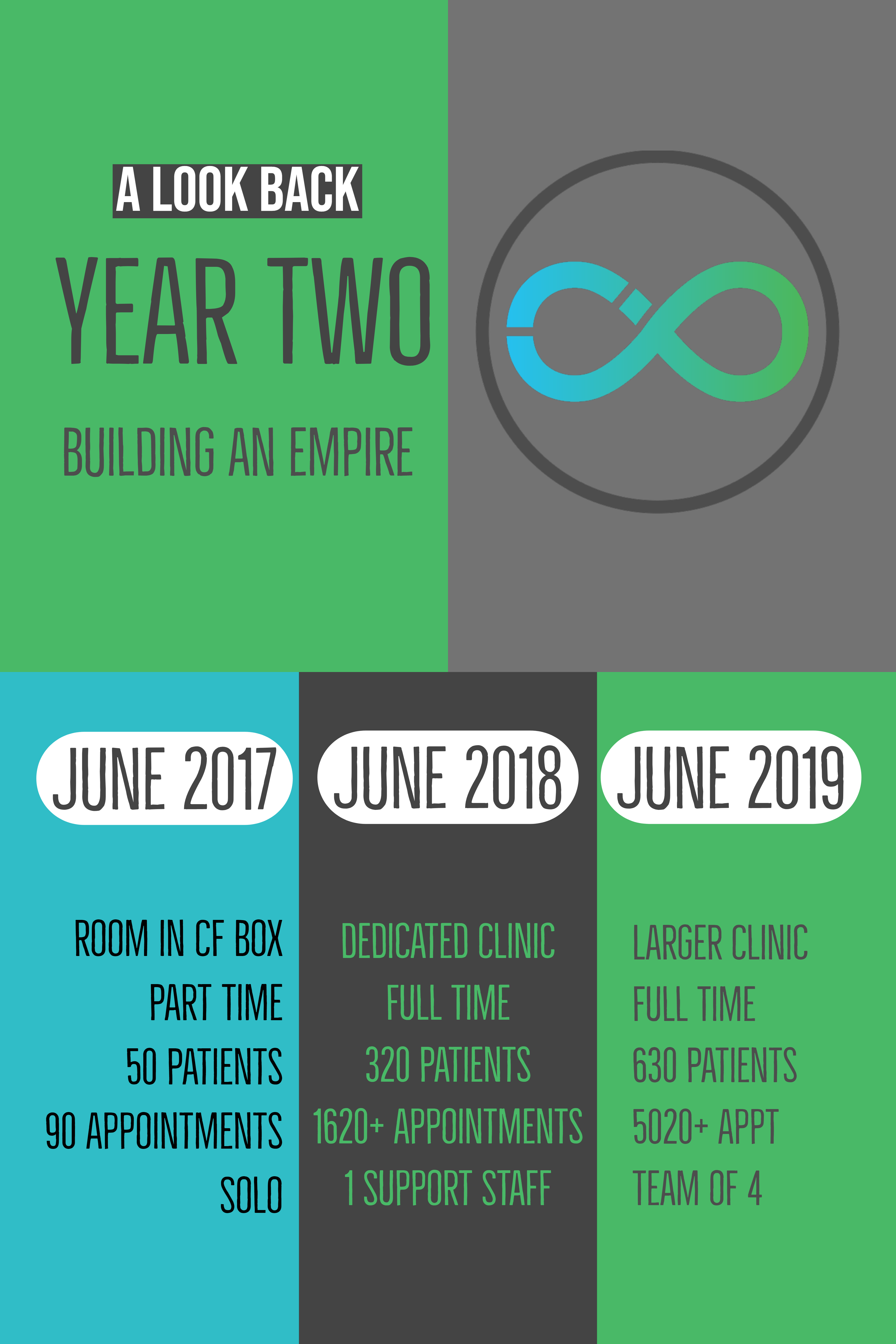
Two years in… It seems like just yesterday I was opening the doors at my first location within CrossFit781. It was a tiny room, just myself and the puppies.
Two years later I have a 6 person team (two dogs included) in a 1,500 square-foot office space. The growth has been substantial but the lessons have been even more significant. Here they are…
1. Find a balance
That email can wait, that text does not have to be answered NOW, that person can be seen in two days and not in your one slot of availability in your 12 hour day TODAY. When in business for yourself, you have to find a balance between work and life. I definitely miss the days of leaving the clinic after a shift and being able to LEAVE THE CLINIC. Those days were gone until I found a balance. Burnout is real… and I have, a few times. Finding a balance is not so easy especially if attention to detail is your specialty (my way of saying I am SUPER anal without admitting I’m SUPER anal). The way I found it was figuring out what exactly was burning me out and adjust it. For me, it was working too many hours straight and having to put in long hours on the weekends. Once I took a good look at my schedule, made some adjustments (with a little help), I was able to breathe a bit easier every day.
If you are dealing with finding a work-life balance, try looking at your day to day duties, prioritize them, delegate what you can, and schedule ample time for the things that take time to complete. You will find that time will magically free up. If you’re like me… you’ll fill it with more stuff that will stress you out, but hey… at least you’re being more productive, right?
2. Add value to everything you do
Being able to add value to other people’s lives has been the mainstay of our success.
What has really been amazing, however, is that I have learned how to add value to other things in life like friendships, family, relationships, even down to how I treat my dogs… if you can make almost everything you do valuable, things just become more fulfilling.
Try doing even mundane tasks to the best of your abilities, it will become more of a habit and less of a hindered effort.
3. Find the importance of customer service…
I have learned SO much about customer service since owning a business. It’s kind of like when you become obsessed with a new car, you see it everywhere? I now notice really GOOD customer service and really POOR customer service. Coffee shops, dentist offices, CVS cashiers, Lowe’s service people, and the folks at Trader Joe’s. I WILL go somewhere again based on my experience as a customer. I find that now knowing how important it is, I have really been able to eliminate a lot of negativity in my life but also know how to handle it when it comes my way.
4. Listen more, talk less
This was a big one. As I began to develop relationships with clients, I realized how important it was to just listen. Most of your questions will be answered without even asking them. By listening, you also begin to learn a lot more about the person you are talking to. Showing interest in a person is a great way to foster a solid relationship. This skill alone has dramatically strengthened my ability to help more people, create more friendships and strengthen the relationships I already possessed.
Try this… With friends and family, respond right away to that text or email, be sure to ask how their day was and what they’re doing over the weekend. Do not say a darn thing about yourself until asked.
5. There are no failures, only lessons.
Throughout the last two years, there were many things that I wished I had done differently. Hindsight is 20/20 and in reality, if I had done them differently, I would not have learned what I now know. I had a few crumbled partnerships, lost some clients, wasted some money, etc, etc… the list goes on. Yet, I see none of these are failures and only as lessons learned. Failure would mean that something ended. Nothing ended here, I just kept learning and moving on.
Look at the last time you considered something a, “failed attempt”. Find ONE thing about that time that could be considered a learning experience.
6. Find your team.
When you are building a business, it is incredibly important to surround yourself with good people. These people must be on the same page, yet be able to bring something to the table that is different than what you can bring. They need to know the value of teamwork as well as how to tell you when you’re being an idiot. Find them, treat them well, respect their needs and aspirations, give them support and great things will come.
Do you have a team? Even if you do not own your own business, look around you, who are your true friends? Does your immediate family serve as your team?
To anyone who thinks that building a small business is not possible, think again. If you have zero business experience and feel that you would not be able to fathom starting your own company, think again. I went to school for physical therapy, not business. I have been lucky enough to have support on the business side, but we learned together, as a team. We grew together and I would not change it for the world.
Are there days that I still wake up saying…
“What if patients stop calling…?”
“If the business fails, I can always get another job…”
…of course there are. But with the team we have, there is no losing sight of continued growth. On to year three…
by Dr. Loni Rodriguez | Aug 2, 2019 | Exercise advice
By Kerry Moynihan
Fit4lifeafter50
Certified Personal Trainer
Suspension training isn’t a new concept. Ancient Greeks used ropes and resistance in their weight training programs, for example. It was effective and efficient exercise then and still a go-to today.
Flash forward to modern day fitness facilities. TRX (Total Resistance eXercise) equipment – that lemony yellow and black roping system – can be found in virtually every gym across the country.
The TRX Suspension Trainer was founded in 2005 by former Navy SEAL and Stanford Business School graduate, Randy Hetrick. The nature of SEAL deployment led Randy to create a space-efficient and training-effective system that fit into closet-sized spaces in ships and submarines. Realizing the need to stay in tip-top warrior fighting shape, Hetrick jerry-rigged parachute slings and random ship repair tools for he and his fellow SEALs, creating the inspiration for his post grad school company. Since its inception, the modern day TRX has evolved into the safe, simple, durable and sleek system we have today.
The beauty of suspension training is its simplicity. You are using your own body weight to develop strength, stability, balance and flexibility. Top to bottom – front to back, all muscles are fair game. For example:
Tricep Extensions
Facing away from the wall, leaning forward with a long/tall body, hold the TRX handles with straight arms away from your shoulders. Bend at your elbows so that your palms are at your temples. Extend slowly at the elbows – feel those triceps!
Pike
Ab time! Push up position with a foot in each TRX stirrup. Brace for a solid core. Raise your derrière up into pike position. Go back down to that starting plank position. And again…
Pistol Squat
Facing the wall, place a TRX handle in each hand. Lean back with a long/tall body while elbows are at your rib cage. Your hands are in the “holding a water bottle” position. Raise your left leg about 6 inches off of the ground, keeping it straight. Squat with the standing leg, extending your arms as you squat – engaging your core the entire time. Stand back up using leg muscles (not pulling with arms). Repeat. Switch sides. This is an advanced one that gets into those glutes and hamstrings.
With suspension training, gravity is your friend and the exercise choices are endless. Questions about options and technique? Chat with a trainer. You’ll be glad that you did!
by Dr. Loni Rodriguez | Jul 19, 2019 | Client Achievements
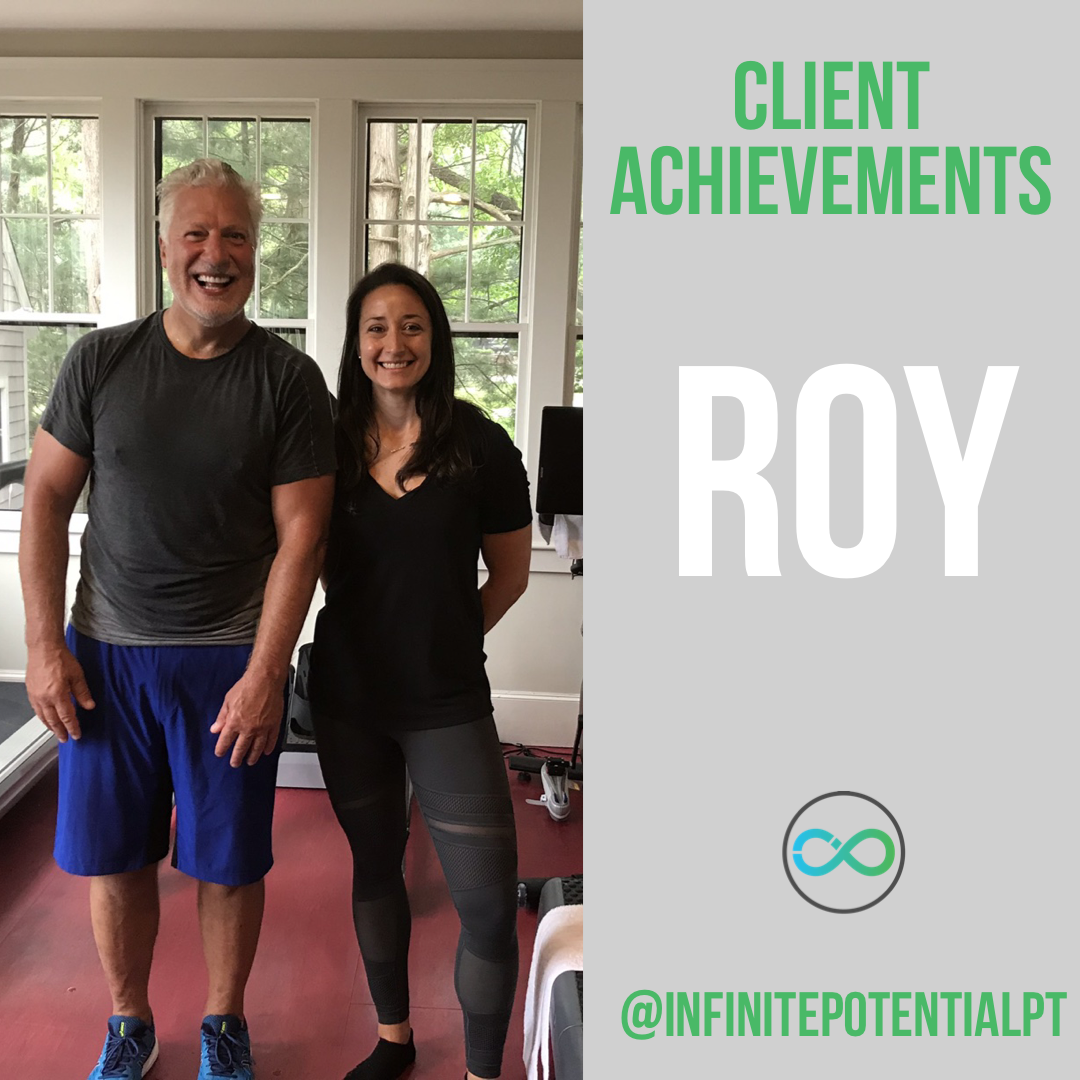
Today we are highlighting Roy, a client who has been working with us for almost a year.
Before you delve into what we had to say about him, Roy was nice enough (and tech savvy enough) to give us a video version of our highlight. Hear Roy’s Story!
Roy was a very active man all his life playing sports as a young boy all the way up through his college years. He remained active after college by regularly working out at the gym, running, and practicing yoga. Despite his activity level, Roy began to develop back pain over the years and it eventually became debilitating. Slowly over time, he began to be in constant pain and discomfort. It ruled his life not only in regards to his workout routine, but also with his day-to-day. Roy had said that he just was not himself when his pain was severe.
Prior to coming to IPPTW he had seen other PT’s, chiropractors, practiced yoga, tried cupping, and acupuncture with varying degrees of relief, however no long-term improvements. I will never forget the first call with Roy. He explained all his concerns with what he was dealing with, what he had tried, what worked short term, what didn’t work at all and what his goals were. I knew that we had some work to do, but I knew that I could help him.
Roy was an excellent client and a true joy to work with. His determination and drive to improve showed each session. I know that sometimes he was hesitant to believe that we could make the improvements that were promised, however he always stuck with it and never gave up. One thing about Roy that set him apart from many is that he was 100% committed to the plan from day one. He will be the first to tell you that he did not buy all of what I was throwing at him, however, with time, the improvements began to creep in he was sold.
When asked about how the treatment helped him he responded with the following:
“I was shocked that Loni was focusing on strengthening my back. As an old but active former athlete, I thought I Knew that stretching was the cure for me but that I just couldn’t get the stretches into the areas that I needed to. I Thought that Loni was going to assist me with that. Instead, she convinced me (over time) that while I was generally fit and strong all over, that my back was weak. Other muscles had taken over for my back and my back muscles had essentially fallen asleep. Loni first woke them up with preliminary strength training through bands, balance and table exercises and then within a few weeks, she decided I was ready to attack these sleepy back muscles with squats, dead lifts, chops, etc. I felt small improvements immediately and after the first month of twice a weeks, I became a true believer.”
Roy went from barely being able to bend over to touch his knees due to unbearable pain and fear of spasm to being able to fold forward without thinking about it. He went from light bodyweight exercise to lifting over 100 pounds.
“My low back felt like one thick block. Had pain in every position. I had no range of motion. I couldn’t bend over and touch my toes. I thought about it 24/7.”
How is his life different? Well, here is what he had to say:
“I work out daily with no back pain and no restrictions on my workout or daily activities. I don’t think about my back at all.”
Front my perspective, I know that he has had some major achievements with tasks around the home. These include being able to garden, move around his boat dock, and carry out all the summer furniture (with the help of his wife – credit to Kristen) without worrying about this back.
Roy is a true IPPTW success story and I know that he will make continued improvements as he stays active going further. He has been able to demonstrate an incredible amount of success and I could not be more proud.
“No matter your prior athletic or workout experience/knowledge, or how many books or articles you have read or YouTubes you have watched, you need to give your over to Loni completely and commit to her (and yourself) for a minimum several months.”
