by Dr. Loni Rodriguez | Mar 12, 2020 | crossfit, Exercise advice, Injury Prevention, Injury Prevention, lifts, Pain Relief
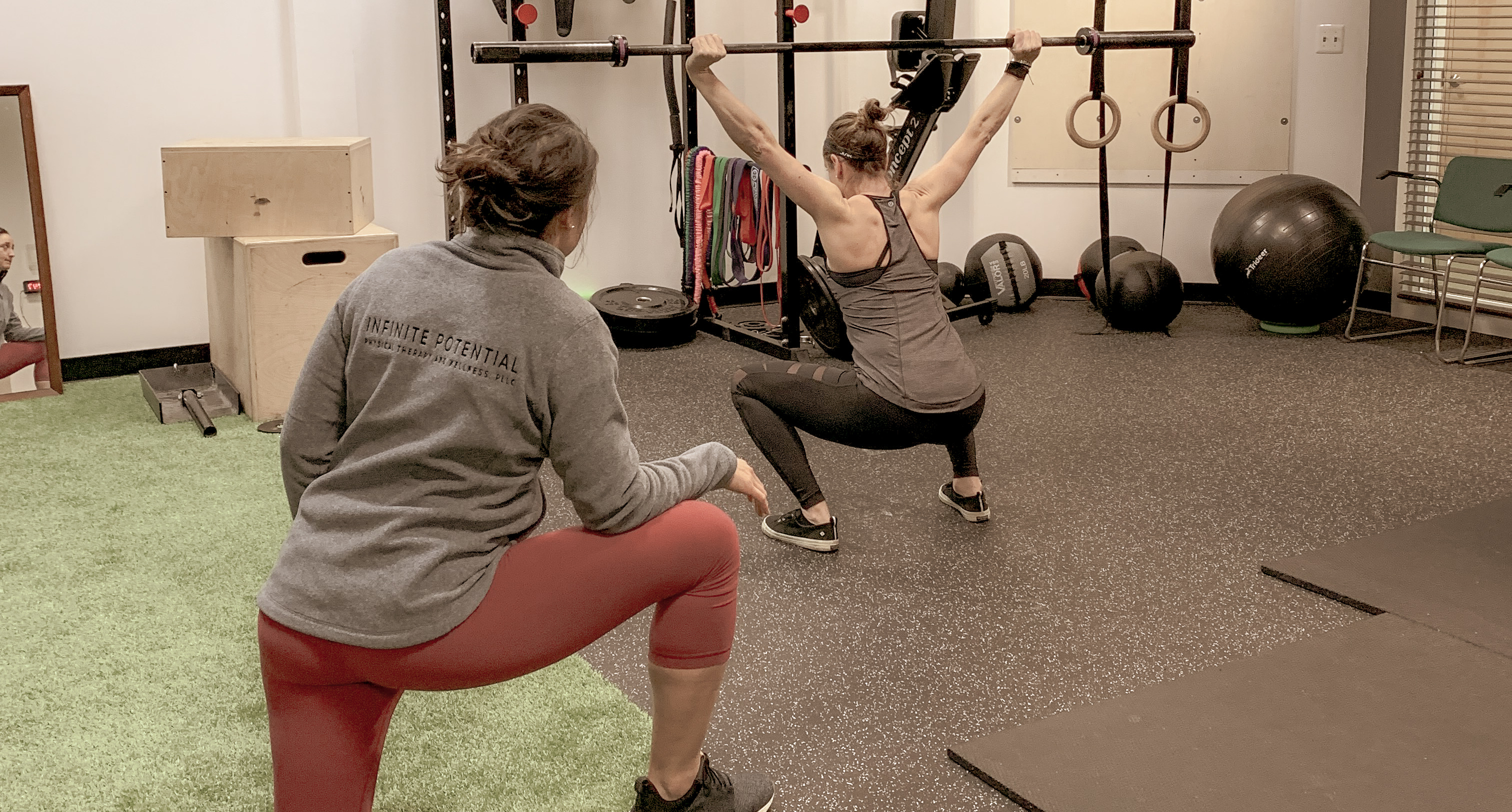
Attention all CrossFit and OrangeTheory (OTF) Members! This article takes you step by step on how to properly frame your return to full gym participation.
I see LOADS of you folks walk through the doors of Infinite Potential PT. It is incredibly important that we help educate the public about how it properly return to the gym or activities you love to do.
This article is not meant to be the be all end all or any sort of medical advise. It is, however, a skeleton plan at how to get yourself from being sidelined to being back to full participation in the gym!
Before I began working with members of CrossFit and OTF, I did not have a solid grasp on what it took to rehab someone in their shoes. Any competent PT knows how the body works and knows how to get most people out of pain. For me 2-3 years ago, the average client I was working with was not asking me to help them get past pain with heavy back squatting or through mile 14 of a 26.2 mile marathon. They were asking for help because of pain with lifting a heavy gallon of milk or putting on their seatbelt. Sure, sometimes the people I see now need that too, but those types of complaints are usually helped early in their rehab process and the larger goals are focused on. Many PT’s, like myself 2-3 years ago, only felt confident helping people wean back to being a participant in a fitness class, but not necessarily taking them the entire way to the end goal of being completely confident in their abilities.
So, what does it take to get yourself back to the old you of being resilient AF and being able to do whatever you want in the gym?
I tell the previous story because it is important to be working with a medical professional that understands not only what you do but HOW to get you back. Below is a step-by-step guide to follow to give you a grasp on what rehab should look like.
Step 1: Establish your long term goals.
This is very important so you can get a meaningful plan in place that can be tracked, monitored, and adjusted.
Each of those goals need to possess a few “SMART” characteristics:
Specific: It has to have a particular subject – ie. Running pain-free vs being active without pain – running is more specific
Measurable: It has to be able to be tracked over time – ie. Running a 5k pain-free vs “running” pain-free is not measurable
Achievable: You have to know your own body – ie. Running a 5k pain-free vs running a marathon pain-free – first off, a marathon is not pain-free but if you have not run a marathon pre-injury, then running one post injury may not be a realistic goal whatsoever.
Relevant: It has to be meaningful to you or you won’t work towards it.
Time sensitive: You need to put a time cap on it – ie. Running a 5k pain-free by September. Putting an end date allows you to set markers along the way and keeps you accountable.
So… sit down and make that goal. This is a step that can NOT be skipped.
Step 2: Establish a starting point.
This is an incredibly important step as this is the “point A” to the “point B”. Without figuring out where to start from, you can’t establish a plan to the end goal!
You want to figure out your exact status with regards to what activity you want to get back to doing. So… Think hard about where you are write it down! It has to be specific.
For example: “I can’t run right now” is not enough. Can you run for 1 minute? 1 mile? 30 seconds?
Figure it out and write it down.
Step 3: Establish your short term goals.
This is really where a PT or other medical professional can help you set some realistic, achievable markers of progress and short-term goals. They can help you understand tissue healing times and normal courses of rehab to best advise you on what to expect based on what you have going on.
For example: If someone is dealing with a long-term diagnosis of a shoulder tendonitis (or condition of a tendon) and wants to be pain-free lifting overhead within a month, the therapist will helpfully give you information on the normal course of rehab. A tendon takes time to heal and change back to a state where it can handle the loads that exercise / life puts on it. That time can range anywhere from 3-12 months depending on many, many, many factors. This is an important time to say that it is important to have a guide familiar with injuries like yours, the goal you want to achieve, and the path to get you there.
The following example sets the stage and understanding of how to set realistic expectations when dealing with an overuse injury.
Appropriate long term goal: “I want to be lifting my previous weights overhead, pain-free within the next 6 months.
A few short-term goals or progress markers based on the above:
- With little to no pain, be able to handle lifting moderate weight with angle modification (ie. Landmine press on an angle vs overhead press with a barbell) within in 4 weeks.
- With little to no pain, be able to handle lifting moderate weight overhead with grip modification using dumbbells within 8 weeks.
Step 4: Establish a plan
This is the tricky part and definitely needs some guidance. I can not get too specific here because every single person is different, but I can play off the example in the previous step to show you what the plan would look like.
The plan must begin with taking the end goal, short-term markers and starting point and figure out what needs to be implemented in order to achieve the short term markers step by step.
The plan must include:
- isolated work / exercise done on the area of injury
- global work done on the surrounding areas to continue to improve supporting strength
- cardiovascular training to maintain fitness and promote tissue healing
- Goal-centered activities such as a return to running program that begins with walking to simulate what they body has to do in order to run
Each of the above are progressed and managed as life happens and changes occur but this is the usual start to any rehab program that I plan.
Step 5: Track the progress
This is the fun part but also most challenging to explain. The rehab process is always up and down and never, or vary rarely, linear. You don’t just keep getting better and better. There are constant ups and downs, setbacks and speed bumps. That all being said, the ups and downs are 100% normal and should be expected. This sets the stage for realistic expectations and reduces the desire to search for more answers or a better plan as the program continues. If someone dealing with injury rehab does not know that pain will constantly resurface in the process or recovery, they will jump ship pretty darn fast.
Does this seem overwhelming? It should! Unless you are a PT who deals with this daily. But even though I see this day in and day out, I still get overwhelmed by cases that are not making the expected process.
That being said, the point of all of this is to expose you to the skeleton of what a proper rehab program should look like. Your program should include very specific activities and exercise routines that are prescribed with your goals in mind.
Not all PT’s are created equal and I am going to put a shameless plug here for my rehab programming. I have taken many CrossFitters and OTF members of all ages and ability levels right back to the point of returning to full class participation. Many of those people were being seen a few days per month or less and the work was being put in consistently outside of our office walls.
Click here to see a scroll through an activity-specific “Return to Competitive CrossFit” home program
Click here to see a scroll through an activity-specific “Return to OTF” home program.
Thank you for reading!
If you are interested in learning more, please do not hesitate to contact us directly. We want to make sure you are informed about how our programs work!
We ALSO offer complimentary consults to do just that (above).
Reach out so you don’t miss out.

by Dr. Loni Rodriguez | Mar 5, 2020 | Injury Prevention, Injury Prevention, knee pain, Pain Relief, Recovery, Running, strength training
Today we are highlighting Lily who has been with us since the Fall of 2019. Lily is a high school crew athlete who was dealing with knee pain that lead her to stop running at practice. The pain crept in seemly out of nowhere and she noticed that it just was not going to go away on it’s own.
“I have been doing crew since 6th Grade and really enjoyed rowing out on the water with my friends. When I joined the High School Crew Team in late August 2019 however, I noticed that my knees would begin to hurt during our warm-up runs and would then prevent me from participating in the other activities in practice. Due to the already existent pain, my knees would then begin to hurt when I was sitting down, often at school. This would prevent me from paying attention to my full abilities in class.”
She was impacted on a daily basis by her symptoms and was at a loss of what to do about it. Being a teen, she felt that she shouldn’t have to deal with pain like she was having.
“I had pain in my knees when I was walking up and down hills or stairs, running, jumping or any form of impact on my knees. I often found that my knee pain would flare up during the day at school.”
After the first session with Lily, I knew that I was working with an incredibly dedicated young lady. It isn’t uncommon for a young client to speak for themselves during the evaluation (versus their parent), but it is truly impressive when it does happen. Lily took the lead and consistently advocated for herself throughout her entire rehab. She was very diligent with her program and communicated with us between sessions like a mature adult.
“Before starting the treatment I did not think that there was any way that my pain and discomfort could be helped. I knew that, after talking to a Orthopaedic Surgeon, nothing could be done to directly treat the symptoms.”
I can’t say there wasn’t any eye rolling, big sighs or, “do we have to?!’s” during sessions, however, Lily worked hard, poured in a ton of effort and always did her best.
“Even though sometimes the treatment is difficult, after every session I feel stronger and my knees do not hurt nearly as much as they did only a few months ago.”
At this point, Lily is in her third and final rehabilitation phase. She has progressed to returned to running, she performs her strength routine at least 2 days per week on her own, and returns to our office for a monthly session to review and progress her home program.
“I can now run, with little to no pain for a relatively long period of time. The treatment has not only strengthened my leg and the other muscles surrounding my knees, but also my core and upper body. This has an incredible advantage when rowing and allows me to participate in all the practices and spend time with my friends and teamates.”
We asked Lily to tell us what others should know about seeking treatment at Infinite Potential PT.
“I believe that if you are prepared to work hard and persevere through the treatment plan that Lori gives you, which can sometimes feel like a challenge (especially when you have other commitments to your studies & crew team, and also want to spend time with friends and family!), you will definitely feel the benefits! Don’t give up – trust that you are strong enough, both physically and mentally, to succeed and become the best that you can!”
Thank you, Lily for your hard work! It was a pleasure to have gotten to know you and help you through this process.

by Pippa Teague, Strength Coach | Oct 17, 2019 | Abdominals, Breathing, Diaphragm, Pain Relief, Uncategorized
By Anna Burns, PT, DPT
Infinite Potential Physical Therapist
One of the simplest things you can do to manage pain is to breathe. Have you ever noticed that when you’re concentrating, exercising, or in pain, you tend to hold your breath? Our diaphragm is directly connected with our nervous system, which is where pain signals are processed. When our nervous system is on high alert with pain, stress, anxiety, or fear, engaging our diaphragm can calm the nervous system from “fight or flight” status to “rest and digest” status, thus decreasing pain and stress levels. It’s one of our best tools to manage pain; no side-effects, no out-of-pocket costs!
For various reasons over the years, we have adopted a couple of different ways of breathing that circumvent the diaphragm. One is breathing with the upper chest; this breath is “emergency” breathing, a very shallow pattern that we perform when we are stressed or scared. Breathing like this only perpetuates the “fight or flight” cycle. Check out this video for an example of Emergency Breathing.
Another way is “belly breathing,” in which we distend our bellies outward on purpose; there’s nothing to breathe with in your belly; your lungs and diaphragm are under your rib cage! While the belly rising is normal with inhalation, it should not be consciously distended. Check out this video for an example of Belly Breathing.
Optimal breathing engages our diaphragm, a large muscle that sits under our lungs and over our stomach. By breathing into this area that touches all aspects of the rib cage, the diaphragm contracts downwards to expand the surface area for oxygen intake in our lungs. When we exhale completely, the diaphragm relaxes upwards to push out the de-oxygenated air in our lungs. To activate your diaphragm, breathe in through your nose. Check out this VIDEO for an example. Visualize a balloon expanding at the bottom of your rib cage as you inhale; breathe in pain-free existence. Exhale slowly through your mouth as completely as you can until you have no air left; breathe out all the pain. Pause for a second, and then inhale again through your nose. Try not to bulge out your belly on purpose or move your spine. In fact, I love practicing this laying on my back. So take a mindful moment (or several!) throughout your day to breathe. It will help quiet your pain signals by calming down your nervous system.

by Dr. Loni Rodriguez | Aug 15, 2019 | Pain Relief
You don’t ALWAYS get pain relief… but you can feel better?
The thing with our treatment style is that are realistic. We MUST be true to you and not blow smoke in mirrors. Life happens, every single person responds differently, how can one guarantee that they will have maximum improvement after walking in their doors? Most people come to us because they are experiencing pain. Can we guarantee pain-free living? NO WAY. Many people DO continue to have pain after completing a course of physical therapy.
Quit searching for a fix and do not let anyone tell you that they will take your pain away, because it is just downright false.
Can your pain improve with the help of a pain-treatment professional? Absolutely.
Does everyone have different pain experiences? Yes.
The biggest question is… what defines “getting better”? The definition is extensive in our world and for the purposes of this email, I will be giving examples in the paragraphs to come.
Are we trying to say that some of you would not experience complete pain-relief but still improve? Yes. This getting better thought process is all about a mindset shift and understanding pain a little bit more.
Here are the top 5 things that you need to know:
#1 Pain is complex and not likely caused by one single factor…
It is extremely rare that pain is caused by one event. Nine times out of 10 people can not pinpoint what they did to initiate their symptoms. There are many factors that relate to pain including sleep, stress, nutrition, hydration, activity volume over time, a change in routine… All of these can collectively cause a pain experience.
#2 Recovery process is up and down…
You WILL continue to experience pain within the rehabilitation process. The fluctuation in symptom severity is completely normal and anticipated. If you can anticipate that you will actually have good and bad days throughout the program, you will not be surprised when the surface.
#3 It takes time…
In most cases, we likely estimate a good 12 weeks before we should be seeing signs of any significant changes. You will see improvements along the way, but not necessarily with substantial pain relief.
#4 Flare ups can be managed in the future…
I can not tell you how many people either ask, “will I have to do these exercises forever?”, OR, “I know this pain came on because I stopped doing my exercises.” OR, “I have kept up with my exercises, but this just came back again and worse than ever.” Teaching you how to manage your own symptoms is our bread and butter. We try and teach each and every client how to manage pain when it comes on day one vs waiting until day 21 to address it. Being able to grab your pain by the horns and steer it in the other direction when it resurfaces is remarkably empowering.
#5 Complete pain relief is unnatural…
The goal of complete pain relief is not realistic and we want you to understand that achieving success with PT is not always about complete relief. It is about knowing how to handle pain when it is happening, what is going on inside (or what is NOT going on inside), how to manage it, and feeling confident to continue to move. Do we want you to feel more comfortable and do we think that is realistic? Of course.
Do me a favor, if you learned something from this or if it reinforced how you feel about PT or pain let us know by shooting us an email.
Thank you for reading!
