
by Dr. Loni Rodriguez | Aug 6, 2018 | Back Pain
Introduction:
Low back pain is one of the leading causes of work-related disability and activity limitations around the world, as well as one of the highest reasons for rising healthcare cost. Startling statistics also have been released in regards to the climbing incidence of chronic low back pain, or pain greater than 12 weeks. From 1996 to 2006, the incidence of people who experience this chronic low back pain climbed from 3.9% to 10.2%. Recent research has also shown that up to 33% of individuals whom have experienced low back pain, experience it again within one year(Delitto, et al).
How can this be? There have been advances in medical technology including improved surgical procedures, imaging techniques, and medications. We would assume the incidence would decrease with all the improvements we have made with regards to treatment. Well, it has not! So, what are we doing?!
Low back pain is widely under-understood and ineffectively managed by many healthcare professionals. I am not saying that people with low back pain are not being helped to a certain degree. What I am referring to is that there ARE effective means of treating low back pain that are WIDELY UNDERUTILIZED. Over the next few weeks, I will be writing about low back pain and explaining some of the most important aspects of the epidemic, talking about symptoms, and some effective treatments. This series is to not only help the general public understand a bit more about what has been proven effective, but also to help remind and / or educate fellow practitioners that a shift in our treatment styles NEEDS to happen. Let’s raise the awareness of the seriousness of this epidemic that is wasting the precious dollars of our healthcare system!
References
Delitto et al. “Clinical Practice Guidelines linked to the international classification of functioning, disability, and health from the orthopedic section of the American Physical Therapy Association”. J Orthop Phys Ther. 2012;42(4):A1-A57
ANATOMY

The back is made up of a web of intricate structures that include the five lumbar vertebrae and the sacrum, the various joints between each vertebrae, ligaments (bone to bone attachments) which serve as supporting structures, wide array of muscles that can span across many vertebrae, discs (everyone loves to talk about their discs) which help provide cushion and mobility, and an intricate weave of nerves and blood vessels.
The anatomy of the low back is important to understand for the sole reason of knowing that there are a TON of structures that are in there! It is impossible to assess these independently and determine if one specific structure is causing someone’s pain.
Next week’s post will focus on explaining the more recent understanding of a more effective treatment approach to low back pain.
Stay tuned folks, KNOWLEDGE IS POWER. EDUCATION IS THERAPEUTIC.

by Dr. Loni Rodriguez | Jul 16, 2018 | Uncategorized

When I tell people I have an assistant, their eyebrows raise and they look impressed. Not going to lie, It is pretty cool to say, “Oh, yes, my assistant will send that to you by the end of the week…”
When I first started the business, I needed to keep that overhead low! I wanted to do EVERYTHING. I was not going to give up the reins and pay anyone else but myself to do the work that needed to get done. I worked countless hours on projects unrelated to patient treatment. I was up late nights making flyers, creating social media posts, sending bills to patients, etc. Many of those things I was not efficient at and took much longer than it should have.
I met Lisa through my practice at Cynergy CrossFit. She was one of my first physical therapy patients. She kept talk all PT with an occasional, “…when you’re ready for help, let me know.” I kept this in mind, but mainly brushed it off because I was managing just fine without help… was I though?
One Thursday morning, as I began to start my session with my first patient at Cynergy, I looked down to find a small trash can. Now, this was not just an ordinary trash can. It was a grey one with my logo on it. I had been using a small Lululemon bag… I needed a trash can! However, it was not on the “C-list” of things to do. I immediately realized who had taken the time to make me a personalized trash can. It was Lisa, and she was hired.
I realized that I valued help like this from someone who cares about their job. She genuinely enjoys putting effort in to help small businesses grow, and help people live a bit more stress-free.. This screen printed trash can job does not amount to a measurable percentage of what she has done for me thus far. She has kept me afloat when life has been challenging, through bookkeeping, helping me find a new office, and teaching me the beginnings of entrepreneurship. She has been my go-to for all things business!
This blog post is not only to give a HUGE shout out to this SOLID assistant and plug Dargie Virtual Solutions, but to introduce all of you to the person you may receive a few emails from. Meet Lisa: support staff number 1.
If you are stressed out with the many things you are juggling in life, a small business, a side hustle? Check out the Services this lady provides. My level of stress has decreased tremendously and I would recommend her services to ANYONE.

by Dr. Loni Rodriguez | Jul 6, 2018 | Uncategorized
The importance of making the connection.
This post is not only directed towards my clients to help you understand my treatment style, but also my fellow providers. As providers, we can not forget WHY we do what we do…
I try to make connections with every client that I come in contact with. The connection I make with someone is one of the most important pieces that leads to a positive prognosis no matter what. When people are in pain, they are looking for answers. They are afraid, and in many cases, in a bit of a depression because of what they are dealing with. Calming that fear, lessening the worry, showing them that I understand and empathize can immediately allow them to open up.
Comfort at FIRST interaction looks like this:
“Hello, nice to meet you”
or on a phone call with, “Hello, what can I help you with? What can I do for you?”
Who are the first people you tell about something important or something of concern in your life? The people closest to you, right? Sometimes it is difficult to express your concerns to providers who do not act like they care or act as if you are just another person walking in their door. I’m not going to lie, personal issues and things I deal with on the day to day have impacted my time with patients. Yet, I try very hard to leave that outside the doors of my office.
The first impression and connection we, as providers, make with a client can push treatment immediately in a positive direction. This was not something that I learned right out of school, however. It took time to understand the power of body language, reactions, and responses. Beginning the initial interaction with getting to know the person as a PERSON can go a long way. Finding a common interest, mutual friend, or simply relating to them in any way can start things off on the right foot.
When it comes to talking about the reason why they are seeking treatment. LISTENING to them is the first step. Hear what they are saying, show them that you understand and can help them. A simple, “Okay, I have seen this before, let me explain to you what I feel you are dealing with…” can go a long way.
Of course, I want to fix every ailment that walks in my door, however, I know that is not possible and fixing is not what I do. My job is to give answers, debunk misconceptions, inform clients about their concerns and empower patients to take control over their symptoms. There is no quick fix… I put the power in the client’s hands.
Providers! These people are looking to YOU as the experts. Make sure that you are giving them your 110% and make them feel comfortable. Listen, pay attention, and respond thoroughly. Ease their fears, don’t heighten them.
Are you looking for someone who will listen to your concerns about pain? Not sure if what you are dealing with is something that can be helped with PT? Find a PT and ask!
Want something answered right NOW?! Click HERE to book your complimentary consult.

by Dr. Loni Rodriguez | Jun 29, 2018 | Uncategorized
As year one comes to a close, I have had time to look back and reflect. What a year it has been! If you had asked me 2 years ago if I thought I would ever want to open my own clinic, I would have laughed and said, “…absolutely not”. I was convinced that I would be working under someone else for the rest of my life versus becoming a small business owner. Little did I know, my future would look very different.
Here is my story…
Many of my patients and friends ask me, “How did you do it?”, or “What made you want to go out on your own?” The answer is easy! I love my career and I felt as though I could be more successful doing things MY way over working under someone else.
The business story is fun to tell… It all started with sticking strangers with needles in my basement… true story. No, but really… I began treating friends, and friends of friends, etc.. at my house. Yes, people who didn’t know me, would come to my house because their friend and trainer, “Meg”, said that I worked miracles. Thanks, Meg
Meg is the well-known and loved head coach at OrangeTheory Fitness in Quincy. Poor Meg had a nagging knee injury that plagued her 2017 Boston Marathon. I met her one day after taking one of her classes and she was interested in this dry needling treatment. I told her that I would love to help her and she adamantly made an appointment. Sure enough, Meg showed up to my house, we went into my newly redone basement and that was it. I was fortunate enough to find a way to help her and she was sold. She told me that I could make a business out of this… the rest is history.
I began receiving calls from people who would say, “I was referred to you by Meg at OTF, I have this issue with my [ENTER PAINFUL AREA] and she said you can help me…” I thank Meg daily for being my first referral source!
Not only was I treating people in my basement, I began helping out the members of Cynergy Crossfit in Hanson. I was fortunate enough to be given the opportunity to come down to their gym on a Sunday morning and give a small talk on dry needling. I did a demonstration and every person wanted me to come back the next week to be treated. I left that day with a sign-up sheet packed with 6 hours of patients to be seen the following weekend.
As patients continued to call and inquire about my services, I started going through the motions of starting a business. I began a ton of research about starting an out-of-network practice. The business model was exactly what I had been looking for. It gave me the opportunity to treat people as people and not numbers. It allowed me a flexible schedule, higher income, and I could bring my dogs to work!
July 1, 2017 I opened the door to my office out of CrossFit 781 in Weymouth. I continued to be part-time at my job in Cambridge, while treating people outside those hours at this new office. My schedule soon filled as I was receiving referrals from other CrossFit gyms in the area including Crossfit Prosperity, CrossFit Fit Factory Kingston and Quincy City CrossFit. Additionally, referrals from OrangeTheory Fitness gyms in Kingston, Quincy, Dedham, and Hingham poured in and the word of mouth referrals increased. Before I knew it, I was faced with going full-time and I made the leap mid-August 2017.
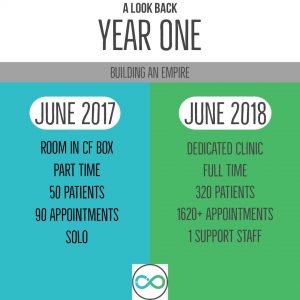
Being a business owner has its pros and cons. There is definitely a huge element of stress! If I don’t work, I don’t make money. If I don’t get things done that need to be done, no one else will (that is unless you have a killer Virtual Assistant that takes care of you). I also had zero business experience prior to this – it has been a learning experience to say the least. I have made some mistakes along the way, but have learned from each one of them. I plan to continue to grow and not give up on my dream of creating a killer PT clinic. I want to continue to serve people in pain the way they deserve to be treated!
Thank you to all my friends and family, patients who have become great friends, multiple CrossFit gyms and OrangeTheory Studios who have welcomed me with open arms and have spread the good word. I could not have done this without you – on to year TWO!

by Dr. Loni Rodriguez | May 10, 2018 | Insurance

“So, do you take insurance?”
This is one of the most common questions that a new patient asks me. My answer is no, I am not contracted by any insurance companies. However, if your plan has out-of-network benefits, your treatment may have the potential to be reimbursed.
Why is this such a common question?
That is an easy answer – because most insurance companies pay for a portion of physical therapy treatment.
What do you know about insurance-based PT?
Having been a therapist for 7 years, I have provided treatment to a wide variety of patient populations within clinics under an insurance-based model. Within this model, there are many rules and regulations that therapists must follow, that are dictated by what the insurance companies will reimburse the clinic. For example, in many cases treatment was more about “getting the patient seen [and billed]”, vs “this patient needs to be seen to continue to progress their treatment plan so they can get back to running”. I continuously felt as though I was just going through the motions and checking the boxes during treatment sessions. I was always taking time away from patient care to do tedious documentation, writing notes to prove to the 3rd-party payers that the patient needed to continue therapy.
Have you ever called a PT clinic for an appointment?
Patient calls: “Hello, my doctor recommended PT, because I hurt my knee running. I have been dealing with this pain for a few months now and I am really starting to worry that it is something that will never go away.”
Receptionist: “Okay, what type of insurance do you have and what is your name and date of birth?”
Wait a minute… what if the person who answered your call asked you about your knee pain? Asked you how you hurt it? What type of training do you do? What are your symptoms like? And told you how they cold help you with the pain.. showing a bit of empathy vs immediately asking what type of insurance you have. They could answer your questions right away and decrease your fear and anxiety about your condition.
Insurance-based models unfortunately have been built by the framework of the rules and regulations of insurance companies. Treatments are dictated by what the insurance companies’ reimbursement rates are. As the therapists working at these offices, we are forced to look at patients as numbers. Now, don’t get me wrong, I understand that it is a business, however, having autonomy as a caring therapist, I would like to primarily see the patient as a “client” and a “person” before I see the dollar sign attached.
Here are some of the benefits of seeing a therapist who is
an out-of-network provider:
- Every treatment session is one-on-one. This is a huge benefit to a patient! Many insurance-based clinics have therapists working with multiple patients at a time and sometimes seen by multiple PT’s throughout their course of care. I want to be able to devote all my attention to one patient at a time. This is where quality care comes into play.
- Multiple areas of the body can be addressed at one time. This is another benefit. I can not tell you how many times I was forced to address only one area of the body within a course of treatment sessions. This has a lot to do with insurance rules. Most insurance companies will not pay for multiple diagnoses being treated at one time. Additionally, with a typical 15 to 30-minute PT follow-up session, multiple areas of the body are not able to be thoroughly addressed. In the out-of-network model, 60-minute treatment sessions are the norm and can successfully address multiple conditions.
- Direct access. The law in Massachusetts allows PTs who hold a Doctorate-level degree to see patients without a doctors’ prescription. Why is this a benefit? You are allowed to call your local out-of-network PT and get an appointment FAST. You can skip the steps of making an appointment with your primary care or orthopedic doctor.
- Extended length of care. What does this mean? I have been in countless situations where patients are cut off from their insurance coverage because PT benefits were exhausted. Due to the fact that insurance rules do not regulate the length of care in an out-of-network clinic, patients can continue treatment until they feel comfortable returning to activities, sport, etc. This also leaves room for maintenance care, a type of treatment that is never covered by insurance.
 Out-of-network providers are striving to bring the autonomous practice into physical therapy. I became a PT because I care about helping people, I care about making a difference in people’s lives. For a long time, I was lost in the hustle of the insurance-based model. Sure, I was going to work every day and making a difference and impacting people’s lives, but treatment length and content was dictated by a higher power, vs being driven by the true needs of the patient. I have become an out-of-network provider to be a part of the shift in healthcare and promote wellness, restorative, and preventative care.
If you have interest in learning more about my practice, please visit www.infinitepotentialptw.com.

Want to book your first treatment session?
Click HERE to book at my Weymouth office or for my Cohasset location within Body Blueprint and Movement Lab. Check out their website at www.bodyblueprintcenter.com!

by Dr. Loni Rodriguez | Mar 31, 2018 | Uncategorized

There are plenty of self treatment strategies and ideas that I give to many of my patients to treat their pain. One of the most important things that every patient should know about PT is the 99:1 Rule. The time spent in the clinic accounts for 1%, The other 99% is the time spent making positive changes on your symptoms. That 99% holds much more value than any time spent with your therapist. Here are some of my favorite tips and tricks to fix neck pain and optimize your 99%.
Constant posture adjustment
Frequently changing positions will be the best way to combat neck stiffness and pain. As stated previously, in Neck Pain Epidemic Part I, “your NEXT posture is your BEST posture.” When you can, just get up from your desk, your airplane seat, or whatever you are sitting on. MOVE! If you just can not get up, simply roll your shoulders, look up, down, left and right. Try it right now…. felt a bit better, huh?
Driving Adjustment
First, sit up with good alignment of your head, neck and shoulders. Be sure you can reach the pedals and steering wheel comfortably(adjust the seat as necessary).
Then, adjust your mirrors to allow yourself to be able to see with them. If you begin to slump, the minute you try to use your mirrors, you will notice that you have lost that posture and will re-adjust.
Work-set up
This is a topic for a whole other discussion, however, desk set-up is KEY. Here are a few things to consider:
- First, If you are constantly performing a repetitive movement with one arm or one side of your body (ie. Using a mouse, reaching for a phone, holding your phone to your ear), your body will eventually create an imbalance and a habit. This can lead to repetitive overuse and possibly pain. Try and switch it up! Use a headset, bring your mouse more in front of your body on a small keyboard shelf, or frequently change the placement of your document holder.
- Second, if your computer height is below eye level, you may be subject to a constant forward head position. This can lead to overload stress on all the muscles on the back side of your neck. Additionally, the distance you are from your keyboard or mouse can lead to straining in that forward position as well. This, my friends can really create chronic neck issues! Try bring your monitor to eye level and sit as close to the keyboard and mouse as possible.
- Third, your chair… As for the height, be sure your feet can touch the ground. As for the armrests, be sure that they are at a height in which your shoulders are not elevated and your elbows can sit at 90 degrees. Finally, the chair should be pulled up close to your keyboard to eliminate straining and reaching forward.
Sleeping Position
Stomach sleeping is strongly discouraged! I do not have a specific pillow recommendation, however I would err towards recommending one that will keep your neck in a more neutral position vs forward or back bent.
Give this a try….
- Place a small towel roll inside your pillow case
- Flip the pillow over
- Sleep with the towel roll closest to you. *You can add additional towels for additional support.
Frequent Chin Retractions
Check out this video HERE >> Chin Retractions
Okay everyone, I know, this is not the most flattering movement in the world, but it is very helpful for treatment of neck pain. It is an exercise that helps the neck and upper back understand where it is in space. It is called kinesthetic awareness! Many who suffer from neck pain lack this level of awareness. When this awareness is lost, our neck does not know where it should hold itself. This can cause muscle tension and strain on structures that should not be strained.
Self Release
Muscle release is a great way to create a short-term decrease in pain. Listed below are the most common areas to release for neck pain. Click on the links to access step-by-step videos on how to perform the self release
Upper Trapezius

SCM (Sternocleidomastoid)

Scalenes

Thoracic Movement
Not only do we want to work on the joint mobility of the thoracic spine, but also the ability to actively move through flexion (or forward bending) and extension (back bending). This area has a huge impact on the cervical spine and needs to be happy and mobile. You can perform thoracic extension over a foam roller followed by banded thoracic flexion / extension on your hands and knees to reinforce the passive mobility with the foam roller.
What can the PT do for me?
- Perform a detailed assessment
If you are dealing with neck pain, it is best to be assessed and treated by a trained professional to be sure your pain is being managed appropriately.
- Provide you with an explanation and reduce your fear and anxiety
As discussed previously, fear and stress can increase and prolong your symptoms! Reduce that fear by seeing a professional who can help you take control of your symptoms. Knowledge is power, my friends!
There are many treatments that can be helpful for the treatment of neck pain. A physical therapist has the ability to perform myofascial release, joint mobilizations, and trigger point dry needling to help decrease your pain.
All neck pain is not the same. The above information are common recommendations and treatment strategies that have been successful with many of my clients. However, what works for some, does not work for all. It is important to be provided with a personalized exercise program. This is the most important part of the rehab routine. If you do not develop a habit of a regular routine, there won’t be a desirable change in your symptoms. Does this seem overwhelming? Sometimes the exercises that are prescribed are not the exercises you are imagining. They are activities that you can do while sitting watching TV, driving, or sitting on a call at work!. The time spend outside the clinic is much more valuable than the 1-hour you spend in the clinic with your PT.
If you are having neck pain and would be interested in a complimentary phone consult, please visit the booking link, BOOK NOW!

by Dr. Loni Rodriguez | Mar 13, 2018 | Neck Pain

One of the most common, generalized questions that I am posed with is, “Is this [enter area of the body] pain normal?” My answer is consistently, “No, however it is common so let’s figure out how to fix it.” Most of the people who I treat want to know if they have something seriously wrong with them, where the pain is coming from, and if their pain can be resolved.
Neck pain is not n
ormal and should not be looked at as something that you just have to live with. Here are some stats:
Incidence and Prevalence
- 1 year incidence of neck pain ranges from 10.4% to 23.1%
- More common in women than in men
- Higher incidence in computer / office workers
- Most prevalent within the age range of 35 – 49 years old.
These statistics are consistent with the patient population that I see in the clinic. The statistics tell us that it is relatively common. What I would like you all to understand is that it does not have to be “normal” and pain does not have to go on forever, despite how long it has been going on already. If you have been experiencing pain for days, months or even years, that means that something needs to change!
Did you know that there is likely something you are doing on a daily basis that is contributing to your symptoms? There are plenty of minor adjustments to your daily life that can have a strong impact on your current symptoms. These will be discussed in detail in The Neck Pain Epidemic Part II: What to do about your neck pain, stay tuned!
Types of Neck Pain
In general, neck pain can be classified into 4 categories. These categories help clinicians determine the best treatment strategies to address the symptoms. The categories are as follows:
- Neck pain with headaches – this type of neck pain can present with a headache. This headache can present in a few different forms. One presentation is called a tension-type headache. This is the one that comes up from the back of the neck, it is painful on both sides and radiates into the back of the head. Another can stem directly from the spine itself. These present more as one sided and are in the temple, ear and sometimes back of the head.

- Neck pain with range of motion limitations – this type of neck pain is when you “slept wrong”, wake up, and can not turn your head. These are more acute cases and usually resolve fairly quickly with some generalized soreness lasting no more than a few days.

- Neck pain with referred pain – this type of pain comes from the cervical spine and refers down into the shoulder, arm, or upper back. This can be caused by a nerve, joint, or a muscle within your neck.

- Neck pain with coordination impairments – this type of neck pain relates to the majority of the population. These are the people who have chronic neck tension and sometimes upper back pain.
- It is important for your neck pain to be addressed as a whole by your doctor or therapist to ensure you are being treated in the most effective manner. All of the above presentations can be treated with physical therapy!
Common Misconceptions
Let’s get something straight. Most who come into my clinic want a diagnosis. They want one or two words to explain their pain. Neck pain, well, pain in general for that matter, should not be named by one or two words. There are always multiple factors that contribute to someone’s symptoms.
Here are a few common misconceptions:
“I have always had bad posture and I know that is why I am in pain.”
This is not the case. First off, no posture is “bad”. However, any position sustained over a long period of time is not recommended. I preach the rule that your NEXT posture is your BEST posture. Constant movement, frequent re-positioning, and awareness of neck and head position in space are the most valuable ways to improve neck pain.
“I have been told that my neck is weak and unstable and it just needs to get stronger”
Strength is a definitely a contributing factor to most neck issues, however, to think that your neck is “weak” is not favorable to a positive outcome. Additionally, neck pain treatment can not be solely about strengthening, there are many other factors involved
“I have a pinched nerve, maybe a slipped disc or something..”
When a nerve is involved, there are very clear cut signs and symptoms. In the majority of cases, this is not the cause. Structural issues such as a these are not common causes of neck pain.
Causes of neck pain
Musculoskeletal
This means that it could be coming from a muscle or a joint. Repeated or sustained postures over time can create overload which exceeds the tissues tolerance. Basically, muscles become overloaded and reach a point in which they can no longer tolerate the position and pain can be experienced
Psychosocial
This is a combination of personal, internal factors as well as external factors. The brain is extremely powerful and can greatly impact the level of pain the patient is experiencing. Three major things to discuss are the topics of fear avoidance, thought viruses, and stress.
What is fear avoidance?

It is avoiding certain movements or activities that are associated with the pain because of fear that it will hurt. The fear that certain movements might hurt or make the pain worse can actually contribute to continued pain. The brain is very smart, it doesn’t allow you to do something that will harm it. It has a very sharp memory as well, and it recalls how it felt to do that movement when pain was experienced in the acute stage. Past that acute stage, there are likely no inflammatory processes going on and the pain that is likely being experienced is based upon the brain’s memory of that painful experience. Because of this, it changes the way we move during that activity and does not allow proper movement to occur. This vicious cycle can contribute to continued symptoms if not addressed appropriately.
What are thought viruses?

These are things that patients are told that instill a sense of uneasiness. These can actually perpetuate a person’s symptoms. They can be certain diagnoses or conditions, as well as activity restriction recommendations.
Prime examples are some of the following:
- “You have bone-on-bone arthritis”
- “Don’t ever think about doing [ENTER FAVORITE SPORT OR ACTIVITY HERE] again.”
- “You have a bulging disc and will need surgery”
- “You are probably going to have pain for the rest of your life, you will just have to deal with it.”
- “You just have a weak and unstable neck”
In the majority of cases, these are not factual and if you are told these things, please take them lightly!
Stressed..?

How does stress play a role? “I carry all my tension up here…” [40 year old, female, office worker patient points to her neck and shoulders] – remember the statistics from before? Completely secondary to the actual neck pain itself, stress plays a major role in neck pain! I am also not referring to just holding your shoulders high creating tension in your neck. I am referring to stress at work, stress at home, stress during traffic, you get it, STRESS. It mentally taxes the brain and can cause actual pain felt in the neck simply related to the stress itself. Muscle tension and pain can decrease through lowering stress levels without ANY form of treatment (ie. massage, dry needling, or exercise).
If you love what you read and want to learn more, please stay tuned for Neck Pain Part II: What to do about your neck Pain
If you are having neck pain and would be interested in a complimentary phone consult, please visit the booking link at https://infinitepotentialptw.janeapp.com/ and book your consult today!

by Dr. Loni Rodriguez | Feb 27, 2018 | Uncategorized
My new location!

The address is 293 Libbey Industrial Parkway, Weymouth, MA 02189. It is a 1-story brick building located just up the street and across the road from CrossFit 781.
You will find the entrance where the blue dot is on the image.
Buidling Directions:
1. Look for the door numbered 300/200 on building 293

2. Enter and take the elevator to the 1st floor

3. Come out of the elevator, turn right and follow the signs down the hallway
4. Take a right at the end of the hall
5. Take an immediate left

If you need to book and appointment use this link.
If you have any questions, please contact me directly at 617-249-4011.

In case you missed them, here are links to my most recent blog posts! Check out some great content on DRY NEEDLING, KNEE PAIN, and INJURY PREVENTION
Be sure to follow me on social media for the most up-to-date content on self treatment strategies and some of my go-to exercises for treatment of all types of injuries!
by Dr. Loni Rodriguez | Jan 24, 2018 | Injury Prevention, Running
“I had some knee pain during my workout class, but I think I’ll just rest and it will go away.”
Most of the patients whom I work with are avid in the fitness world, whether it be Bootcamp, CrossFit, OrangeTheory Fitness, or running. Most everyone comes to me for the treatment of pain in various places throughout their body.
There is usually a common theme and this is how it goes…
“My pain started about a month ago, it was just a little twinge during their workout but then it went away.”
They decided to push through the pain during the next class. After a few days they notice it beginning during every workout, daily activities, sleeping, while caring for their children, working, etc.
“I thought I would just rest for a while and it would go away.”
They decided that rest was the best answer and they stop going to the gym. They start to feel sad that they can not workout, they feel like they are gaining weight, and missing out on the fun with their friends at the gym.
Now, it has been a whole 2 weeks week off from working out and they are ready to get back to it.
“I started class and my knee was fine! It wasn’t until I woke up the next day and realized that the pain was still there.”
They are now in a worse situation…
Their body has moved into a different pain stage. This is the stage when it is more difficult for the symptoms to resolve. You don’t want to find yourself here because it will be more challenging for you to return to your regular, pain-free routine. Even if your pain has subsided, going back to exercise too soon, will also disrupt the ultimate healing process.
Let’s talk a little bit about pain…
Pain is the body’s perception of a threat. That threat is the pain experienced when the initial tissue inflammation occurred, lasting about 72 hours. At that point, the body begins to heal this acute irritation and the pain that continues is no longer true inflammation.
Have you ever tried to take Advil or Motrin for a nagging pain in your knee and it just doesn’t help?
That could be due to the fact that there is no inflammation present causing your symptoms. Research has shown that there is not an actual inflammatory response from the body during the later pain stages – anti-inflammatory meds won’t help!
You do not want to let your pain get to this point. Once pain has occurred, the body’s changes the way it moves. It wants to stay away from something that caused pain before. It will change your running, squatting, snatching, burpee’ing form without you knowing it. This leads to a cascade of compensations that can lead to further issues.
So, what can you do about it?
If you have pain, get it addressed as soon as possible by a physical therapist! Acute pain can be addressed within a few weeks to a month. It can take longer to deal with pain that has been going on for weeks.
What if you do not have pain?
Find out how you can prevent it by…. Seeing your physical therapist! Full body assessments can be looked at like an annual doctors’ visit. What do they really do in a check up? They tell you you’re healthy. Who tells you that you’re moving okay? A physical therapist can help with preventative medicine, not just your primary care doctor!
Feeling like you want to make an appointment? Click HERE to book a complimentary consult at Infinite Potential Physical Therapy and Wellness and find out what we can do for you!

by Dr. Loni Rodriguez | Jan 5, 2018 | Injury Prevention, Running

It is not “normal” to have pain while you run. Many people who have this complaint describe the pain as happening in the beginning of a run, but then it “works itself out”. Others report the pain after a certain number of miles, or just after the run is completed. All of these complaints are signs from your body that something needs to be addressed.
What are the most common running injuries?
- Hip bursitis or tendinitis
- Knee pain (patellofemoral pain syndrome, patellar tendinitis)
- Shin Splints
- Achilles tendinitis
- Plantar Fasciitis
The list above all can be classified as overuse injuries. This means that throughout your training, certain regions of the body have been improperly overworked. This can occur under a few different circumstances.
One cause is a change or increase in training volume that your body is not used to or not ready for. During marathon training, your body takes quite a beating! That is not a reason not to train, however there are plenty of ways to avoid injuries during high volume training.
Another cause can be an imbalance or a faulty movement pattern during your gait cycle. This can be caused by certain muscles not working at properly as you pound the pavement.
What should you to if you are having pain or discomfort while you run?
Make sure you’re recovering well. This is not just about taking rest days! It is very important to drink plenty of water, keep up with your nutrition, get a good amount of sleep and get regular body work done. Body work can include massages or trigger point dry Needling. Body work also includes self treatment techniques such as foam rolling or self trigger point release.
Some of my favorite recommendations for areas to foam roll or release on runners:
- Entire hip and buttocks – this is your whole butt and side of your hip
- Quads (NOT all the way down your IT band) – it is not recommended that you should be foam rolling your IT band, rather you should be working on the muscles around it
- Calves
- Bottom of the feet
Get assessed by your local Physical Therapist. It is very important to get any type of pain evaluated by a professional as most pain will not just go away. There are usually simple things that can be done to quickly decrease the symptoms and resolve the problem. It is also much easier to have success with treatment when an injury is caught early on.
Book a running assessment!

This assessment is performed by a Physical Therapist who will observe your gait and perform a video analysis of your running technique. A running assessment can be a very important tool to be used to help correct mechanics and possibly paint the picture as to why pain may be occurring.
Ready to book an appointment?
Book Now.
Questions? Feel free to contact the office at 617-249-4011 or email loni@infinitepotentialptw.com
