
by Dr. Loni Rodriguez | Mar 5, 2020 | Injury Prevention, Injury Prevention, knee pain, Pain Relief, Recovery, Running, strength training
Today we are highlighting Lily who has been with us since the Fall of 2019. Lily is a high school crew athlete who was dealing with knee pain that lead her to stop running at practice. The pain crept in seemly out of nowhere and she noticed that it just was not going to go away on it’s own.
“I have been doing crew since 6th Grade and really enjoyed rowing out on the water with my friends. When I joined the High School Crew Team in late August 2019 however, I noticed that my knees would begin to hurt during our warm-up runs and would then prevent me from participating in the other activities in practice. Due to the already existent pain, my knees would then begin to hurt when I was sitting down, often at school. This would prevent me from paying attention to my full abilities in class.”
She was impacted on a daily basis by her symptoms and was at a loss of what to do about it. Being a teen, she felt that she shouldn’t have to deal with pain like she was having.
“I had pain in my knees when I was walking up and down hills or stairs, running, jumping or any form of impact on my knees. I often found that my knee pain would flare up during the day at school.”
After the first session with Lily, I knew that I was working with an incredibly dedicated young lady. It isn’t uncommon for a young client to speak for themselves during the evaluation (versus their parent), but it is truly impressive when it does happen. Lily took the lead and consistently advocated for herself throughout her entire rehab. She was very diligent with her program and communicated with us between sessions like a mature adult.
“Before starting the treatment I did not think that there was any way that my pain and discomfort could be helped. I knew that, after talking to a Orthopaedic Surgeon, nothing could be done to directly treat the symptoms.”
I can’t say there wasn’t any eye rolling, big sighs or, “do we have to?!’s” during sessions, however, Lily worked hard, poured in a ton of effort and always did her best.
“Even though sometimes the treatment is difficult, after every session I feel stronger and my knees do not hurt nearly as much as they did only a few months ago.”
At this point, Lily is in her third and final rehabilitation phase. She has progressed to returned to running, she performs her strength routine at least 2 days per week on her own, and returns to our office for a monthly session to review and progress her home program.
“I can now run, with little to no pain for a relatively long period of time. The treatment has not only strengthened my leg and the other muscles surrounding my knees, but also my core and upper body. This has an incredible advantage when rowing and allows me to participate in all the practices and spend time with my friends and teamates.”
We asked Lily to tell us what others should know about seeking treatment at Infinite Potential PT.
“I believe that if you are prepared to work hard and persevere through the treatment plan that Lori gives you, which can sometimes feel like a challenge (especially when you have other commitments to your studies & crew team, and also want to spend time with friends and family!), you will definitely feel the benefits! Don’t give up – trust that you are strong enough, both physically and mentally, to succeed and become the best that you can!”
Thank you, Lily for your hard work! It was a pleasure to have gotten to know you and help you through this process.
by Dr. Loni Rodriguez | Feb 13, 2020 | Exercise advice, Foot Pain, Injury, Running
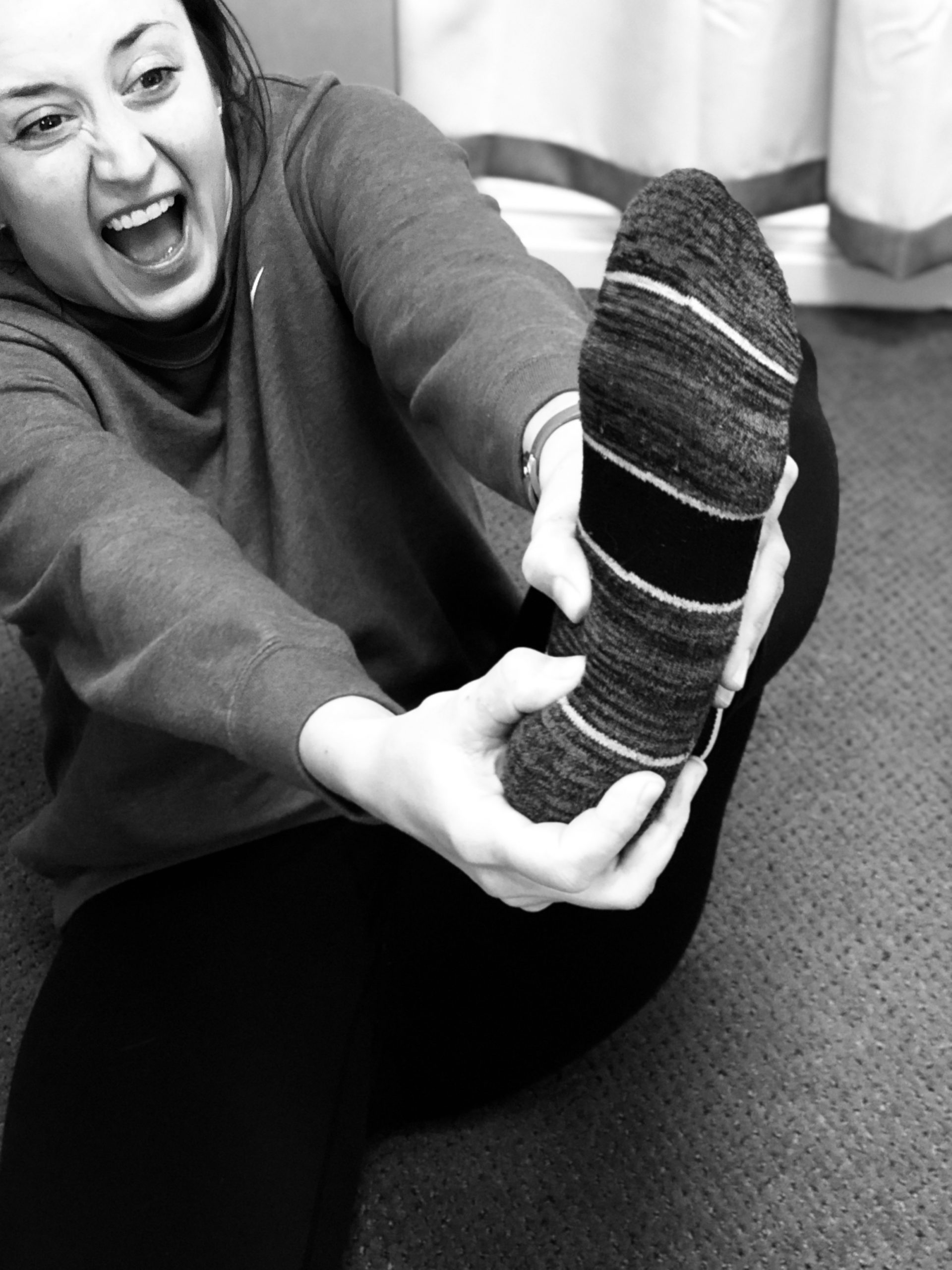
Plantar fasciitis (PF) is a term used to describe inflammation or pain on the bottom of the foot. The plantar fascia is a taught band of tissue that holds the arch of the foot. There are also TONS of layers of muscles on the bottom of the foot that can give pain as well meaning the pain generator is not just the plantar fascia, it can be from muscles as well.
The pain can come in a few different forms – sometimes it’s pain on the heel, sometimes it’s pain on the arch. There are a few other things that “foot pain” could be, but there are a few classic signs of PF:
- Pain that is worse with the first few steps out of bed in the morning
- Pain after a longer time standing, walking, or running
- Pain that seems pin pointed on the bottom of the foot and is sensitive to the touch.
None of the above can rule in or rule out the diagnosis, but many people who come see us for PF pain present with some of the above. The main issue with PF is that it gets stressed every day because we are upright beings and we constantly have to put pressure on the spot that hurts. PF tends also to hang around way too long and when treated improperly, can lead to a very long bout of unnecessary foot pain.
Most people get a flare up from doing a bit more of something that they aren’t use to. How can you get it?
- Running longer
- More hills/inclines
- A change in shoes
- A significant change in terrain (I got it when I went hiking for the first time last season and wore running shoes)
- Doing more of the same activity that you aren’t used to
- Doing more walking in different shoes (walking around the city for the day in flats or flip flips if you aren’t used to it
The most common ways that people manage this type of foot pain is with ice, stretching, rolling the bottom of their foot on a ball, anti-inflammatory medications, and orthotics. While all of those play a role in the recovery process, there are some other things that should be focused on to really make the most out of your rehab.
The initial stage (0-72 hours)…
Gentle stretching, ice, and normal walking around, etc is appropriate especially if it is super irritable. But this really should only last as the sole type of treatment for the first few days of a flare-up. Yes… only for the first few DAYS! This means that more can be done that is much more beneficial if this has been going on for longer than a few days.
Anything but the initial stage (past 48-72 hours)…
You can continue to stretch, ice, ball massage, etc but there is a key component to PF pain that most people don’t address. This is the concept of adding stress to the foot. This would seem counterintuitive, right? Why would we want to stress an already overworked and stressed area of the body? That is actually how rehab works… in many cases our body responds best to adding an appropriate amount of strain to actually get it back to normal. Sometimes, that initial addition of strain gets the area a bit cranky, but as it is repeated that crankiness actually subsides.
This explanation was very brief for the purposes of this article so I want you to keep in mind that every pain experience is different and involve many other factors that affect the treatment outcome. This information can at least set the stage on the idea that there is more to PF pain than ice massage with a frozen water bottle and time off from the treadmill.
Here are some of our go-to PF pain exercises!
- Toes elevated heel raise – This exercise targets the plantar fascia directly to give a combined load stress and stretch.
- Single leg heel raise (modified) – This exercise is imperative for ALL RUNNERS to be performing on the regular. Single leg heel raise strength is incredibly important for runners – you are NEVER on two feet and your calves do a ton of work. They need isolated training and it needs to be hard enough to make gainz. This is a modified version for someone with irritable PF pain, a progression would be to loose the bench and perform with hand-held assist on a chair or wall. This exercise not only strengthens the calves but it also works on the foot muscles as well which can help build and repair the irritated foot!
- Double leg weighted heel raises – This is another staple in anyone’s foot pain program. Double leg her raises work to build up the calf muscles which, as stated above can help build and support the foot as well. The double leg feature allows both calves to work, adding load can help make it challenging enough to make changes.
Lastly… Are you more of a visual / auditory learner? I put a little video together explaining the exercise in the first video! How to help your foot pain
Were you intrigued by this an have more questions? Please reach out!
by Pippa Teague, Strength Coach | Nov 11, 2019 | Abdominals, Conditioning, Exercise advice, Personal training, Pushups, Recovery, Running, Shoulders, stool, strength training, Telehealth, Uncategorized, youthtraining
The push up is a very effective body weight movement and one that requires practice to master!
Here is my advice on how to get a push up!
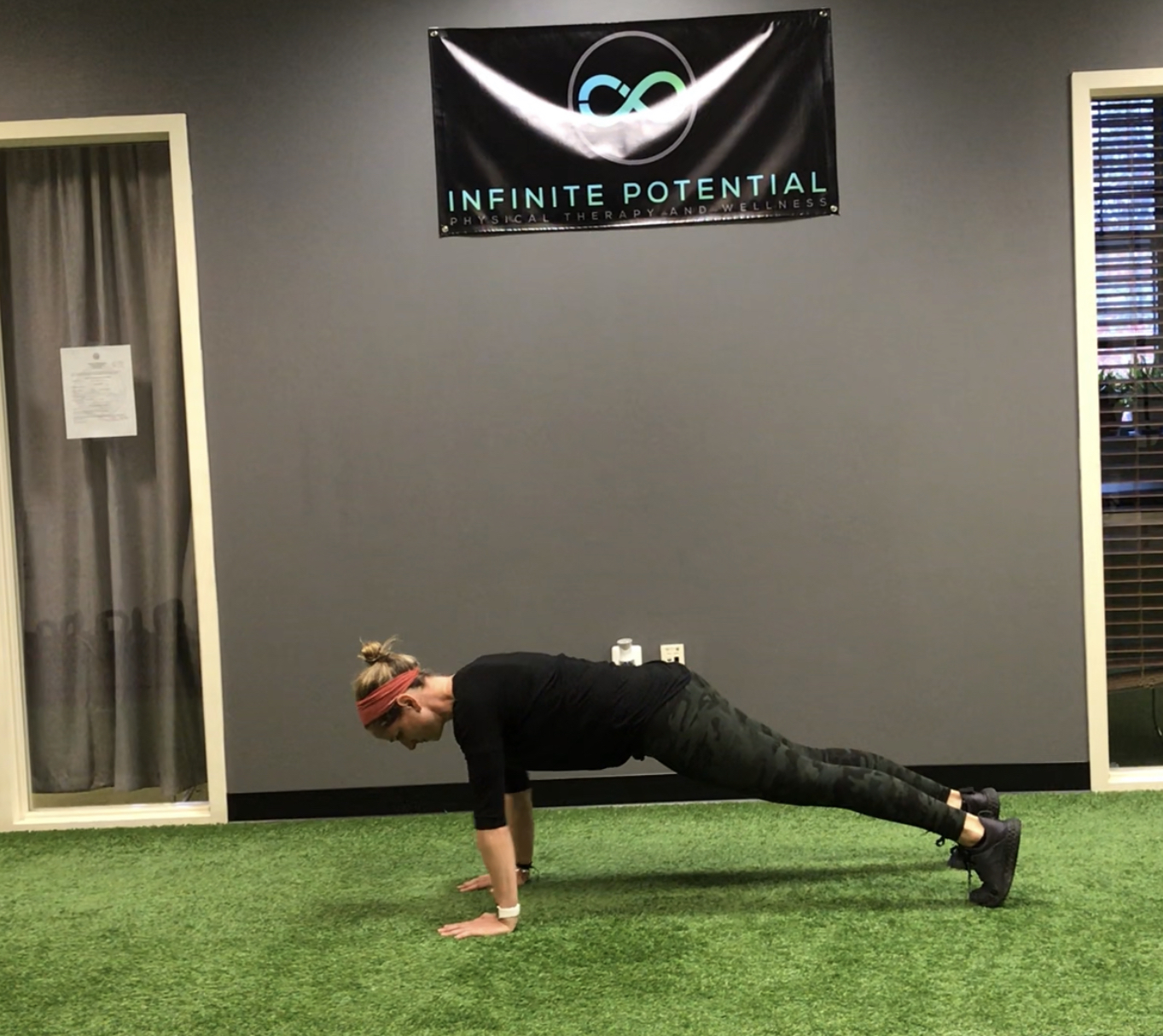
First of all you need to be comfortable in a plank position, so get this position down and aim to hold for 20-30 seconds. Plank from the hands first and then forearms (which is a little more difficult).
Push up descent
Push up to a box (incline)
Next up you can try a push up to a box. Step away from the box and get into a plank position with hands on the box. Slowly lower yourself down maintaining the straight body plank position until your chest makes contact with the box. From here, squeeze and engage the core muscles and push back up to the plank position. Repeat 8-10 reps for 3 sets
Once you have mastered the push-up decline and the push up incline to a box you can move forward to the next steps.
Push up from the knees
Starting on your knees with your hands directly below your shoulders bend the elbows maintaining a straight body position, lowering slowly until your chest touches the floor. Contract your core and press your body back up.
repeat 5-8 reps for 3 sets
When you feel comfortable doing this from the knees you can try your first full push-up!
This time from a high plank position lower yourself to the floor, keeping your elbows tucked in to your side. Contract your core muscles by pulling your belly button to your spine and will pressure through your palms press yourself back up to the high plank position maintaining the straight body position throughout.
by Pippa Teague, Strength Coach | Sep 30, 2019 | Conditioning, Exercise advice, Injury Prevention, Personal training, Recovery, Running, strength training, Uncategorized, youthtraining
by Pippa Teague
Infinite Potential Strength Coach
I would like to start off by giving the research credits to Barbell Medicine and their 3 part series has been summarized below.
Previously a lot of peoples beliefs surrounding youth and resistance training involved some of the following quotes and I still hear some of these coming up today:
“Resistance training stunts growth”
“Kids shouldn’t lift weights-it will damage their growth plates”
Well…both of these statements have been proven to be wrong and we have slowly shifted from that mindset.
Childhood is the time where we need to be focusing on building bone mass and structure by weight bearing activities!
It is ok for kids to weight train and resistance train-in fact, its GOOD for them!
Studies have shown these three important factors to resistance training as a youth
- Resistance training should be essential for aspiring athletes
- Participation early in life correlates to later life
- Those who don’t resistance train are at a higher risk of negative consequences
Developing those skills early in life is very important if we want to remain healthy and fit as we get older.
Today 10 year olds are participating in the same amount of exercise as 60 year olds!
We are failing at getting our youth to exercise the amount that has been recommended – 5-17 year olds should engage in 60 mins of moderate to vigorous activity/day! Only 40% are actually achieving this!
Here is a breakdown of some age ranges and examples of how to include resistance training int their exercise.
Ages 6-8 – FUNdamentals, game oriented exercise, coordination, balance, agility
Ages 10-13 (males ) 9-11 (females) – learning to train, plyometric and free weights with a variety of training
Adolescence 14-18 (males) 12-18 (females) training to train, sport specific plus other training, heavy and slow resistance training
Adulthood Ages 18+ – training to compete, sport specialty, resistance training still an integral part
One study found that strength training reduced injuries three fold over the course of 1 soccer season! It also improved cutting speed and jumping !
Another study looked at females in repetitive sport e.g. running, and found that those youth athletes were 3 times more likely to have a lower bone mineral density than females who did the repetitive sport but also were resistance training.
Resistance training is important not just for youth athletes but for growing children.
Longer programs elicit larger effects and it is important for youth athletes to maintain resistance training alongside their sport for optimal results!
Citation: ‘resistance training for youth part I and part II’
www.barbellmedicine.com
by Pippa Teague, Strength Coach | Sep 19, 2019 | Conditioning, Exercise advice, Injury Prevention, lifts, Personal training, Running, squats, strength training, Uncategorized
By Jenny Gusella
These days there are endless workout options, from spinning to barre to HIIT to personal training, bootcamps, home DVDs and more. There’s also tons of information and scientific research floating around about the benefits of one workout versus the next. With your head spinning from information overload, you finally decide to seek an expert opinion, so you ask a trainer like me, “OK. Tell me the truth. What is the best workout?”
The best workout is the one that you will actually do. Whether it’s because it’s the quickest, or you love the instructor, or your friends go to that gym, or your favorite coffee shop is next door, or because you genuinely love the workout, there is no reason too small if that reason is enough to get you to complete the workout.
The human body is much more simple than we think. Eat food, move around, sleep, repeat tomorrow. Of course, in between those things is an entire life – a career, familial responsibilities, not to mention social pressures, self-doubt, etc. All of those things complicate the basics, but you have the power to uncomplicate fitness. Are you stressed that you don’t have an hour to spare to workout? Simple solution: do a 45 minute workout. Are you dreading doing that 3 mile run you promised yourself you’d do? Simple solution: Don’t do the run. Do some squats, lunges and pushups, or go for a bike ride, or walk your dog.
Yes. I just said, “don’t do the run.” Running in particular is a topic that comes up so often in this line of work. So many of us dread running, and yet force ourselves to do it anyways, as if it’s some sort of requirement. I am here to tell you: YOU DO NOT NEED TO RUN IF YOU DON’T WANT TO. Ever. (Unless you’re being chased.) I am also here to tell you that you do not need to be “a runner” to go on some runs. If you like it, do it, if you don’t, do something else. It truly is that simple. Think about Forrest Gump. Why did he start? “I just felt like running.” Why did he stop? “I’m pretty tired. I think I’ll go home now.”
The next time you find yourself in a workout rut and are about to ditch the gym, ask yourself if there’s maybe another physical activity you’d rather do instead, and try to direct yourself down that route. Don’t worry if your workout doesn’t “scorch the most calories” or “target 90% of your muscles” – just move!
by Pippa Teague, Strength Coach | Sep 9, 2019 | Breathing, Conditioning, Injury, Injury Prevention, Recovery, Running, strength training, Stressrelief, Stretching, Uncategorized, working with injury
The definition of adversity via Webster’s Dictionary:
“Difficulties, misfortune, ill luck, back luck, trouble, difficulty, hardship, distress, disaster, misadvantage, suffering, affliction, sorrow, misery, heartbreak, heartache, wretchedness, tribulation, woe, pain, trauma, torment, torture.” The list goes on.
Adversity can be defined as any of the above. Everyone goes through some sort of adversity. It’s not about what type you deal with, but about how you respond to it.
Do you ever feel alone when you’re dealing with something like this? I am sure of it, we all do. But guess what, you aren’t alone. The feeling of being alone EASILY gets more believable in a world where social media is constantly in our faces. Old friends, co-workers, gym buddies, cousins, acquaintances, celebrities… they all look SO happy on the screen of your phone. But guess what, they probably have shit going on. Don’t forget that.
So… How do you overcome adversity? You can’t just make it go away, you can’t just run and hide and let someone else deal with it, you can’t just forget about it because it absolutely will resurface at some point.
Adversity can be overcome by the way you react to it.
This can be applied to matters BIG and SMALL.
Small example…
Someone is going 40 MPH in the passing lane and you are LATE for work?
Option A: Tailgate them like a MASShole, honk and give them the finger?
OR
Option B: Remain calm and let them realize they are being slow where they will eventually speed up or switch lanes.
Big example…
Someone does something extremely unjust, unreasonable and unfair?
Option A: scream and yell, accuse and verbally abuse?
OR
Option B: Remain calm with them. Do you best to not let your emotions drive your words. Take your feelings to a conversation with a friend where you can say what you want and get some advice.
Take home… We all deal with shit on any given day. The sun still rises in the morning no matter what was dealt the day before. Get up, shake the dust off and keep moving. Use adversity to learn, grow and become stronger. Get your reps in, practice makes perfect so keep working on overcoming those small hardships because when the big ones roll around, you will be ready.
