Welcome back for the resiliency series, ACHILLES EDITION!
Over the next few months (or however long it takes for me to run out of content), I will be covering the most common areas of the body where people have their aches and pains. Each week will cover a specific area that we suggest people work on in order to resist injury.
This will NOT serve as a way to treat an injury or direct medical advice, but it will be a resource that will house the most up-to-date information on how to make yourself stronger and and more… RESILIENT! We ALWAYS suggest you seek medical attention if you feel you need more help.
If you don’t know what the Achilles tendon is then you probably won’t read much further. That is unless you really love to read what I write and want to gain some knowledge 👩🏻⚕️…
The Achilles tendon is a structure that connects your calf muscles to your heel! It serves as a very important structure that we use everyday when we walk, stand, run, climb stairs, etc. It is also a common structure to be torn and the most common population who tear are middle-aged, active men. Those who participate in recreational sports such as tennis, basketball, soccer or any quick start / stop play. I am not saying that it’s a common injury, I am saying that when it does happen, it’s the middle-aged population who suffer more from it. You do NOT want this injury because it can be a long, long road to recovery.
I am going to take you through some of our favorite exercises and ways to prescribe exercises to help strengthen and protect against injuries in this area.
One thing to remember, and this is a common theme in these types of posts, injuries can NOT be 100% prevented by any program, we can only reduce our risk. The best way to reduce our risk is to get stronger!
The key to improving the durability of our tendons is to work on heavy, slow resistance training. This means exercise that uses weight, is performed slowly and is challenging enough to make changes in the actual structures within. What we know from research, which is consistently proven time and time again, that exercises have to be challenging enough to make changes within. We don’t have to pose great challenge with every single exercise we do, but for the ones that we are hoping to make measurable gains with, we must challenge ourselves regularly.
Now, onto the good stuff. Here are a few of our fave exercises to perform to help improve Achilles durability. It is suggested that you begin at a level that you think will be challenging enough, but not so hard that you are sore for days, but sometimes it takes a few sessions to figure out the difficulty level.
We suggest that each of these exercises be performed twice weekly to make measurable changes. We also suggest repetition ranges of 8-10 for 3, challenging sets.
Double leg calf raises off a step
FYI… This exercise can be done with or without shoes. I was trying to be cool without shoes but as the weight goes up, the step will feel more and more sharp and shoes may allow you to go heavier 🙂
This is a great exercise to target the upper calf which has a direct correlation with the Achilles. This can be loaded with a dumbbell, kettlebell, barbell, weight vest…
Soleus heel raise
This is a new one for most (myself included), but a really important muscle in the Achilles connection is the Soleus or lower calf. This one is not the easiest one to set up but you have to find a way to weight your working leg with a bent knee. Some gyms have those seated, bent knee calf raise machines? You can use that!
Double leg Soleus raise off a step
Also can be done with shoes, LOL
This one targets the same muscle group as the previous, but is a little easier to set up. However, I do find that most people get a pretty good quad burn here taking away from the calf work that is intended. You have to keep your knees bent the whole time and then coordinate holding some weight once 8-10 of bodyweight exercise gets to be too easy.
Lastly… getting in some regular jumping is always a great way to train the Achilles to take on the activities that we want to perform in our regular, daily lives! I am referring to things like playing tennis, basketball, playing with kids and grandkids, etc.
Jumping rope
If you aren’t proficient at jumping rope, not to worry. Simply jumping up and down, in place for about 20 seconds for 4 rounds is a perfect place to start!
This concludes our Achilles edition of the Resiliency series. If you learned something, give us a shout! If you know someone who would learn something, pass it along with a share!
Thank you for reading and stay tuned for more next month… topic is TBD.
Jackie came to us over a year ago. She, like many others who come are way are at their wits end with the pain they are dealing with. She was frustrated and willing to do anything to make the pain go away.
Here is her story…
Jackie was dealing with Tennis Elbow and lower back pain for a long time and was ready to do something about it, so she gave us a call.
“I had to reduce my pickle ball playing and found myself avoiding use of that arm and using my left arm instead on many tasks. I lived with chronic back pain and my elbow was sore nearly 24/7..” (She is a ninja on the court…)
It took quite some time, but she made it to the point where the elbow was no longer “a thing” and her back was really making strides in the right direction.
“I now have zero elbow pain. I am not hampered in any way in my physical exercise or limited in what I can do. My body in general is stronger and the exercise program has helped my physical endurance. I am back to running and although my back is sometimes cranky, it is way more infrequent and does not limit me in my daily life.”
We like to pride ourselves on being a different kind of PT so we asked her what she felt set us apart.
This is what she had to say…
“I love the app with the daily exercise program, as well as the accompanying videos to remind me how to do the exercises correctly. I love that there is a place on the app to give feedback, or ask questions and the response time to any questions I have is amazing! Any time that I have a concern with an exercise, or feel that it is uncomfortable in any way Loni is quick to adjust the exercise, or switch it to a different one.”
We change lives, period. Our programs are set to make people successful in every way possible. We don’t just get people back to baseline, because who wants to be baseline…
We asked her how life is different now that she is on this program.
“It has been life changing for me. I recently went skiing in the Austrian Alps and skied all day for a 6 days with no sore muscles or restrictions. I was the only one in my group to not be suffering from sore quads from the long alpine ski runs! It is amazing how strong I’ve become and how my body has responded to the exercise program.”
Keep reading, it gets better!
Given the availability of information in the media, most of us know that strength training can help people live longer, healthier, more active lives. This was a real result that we are so proud of!
“More importantly, I have been dealing with osteoporosis for many years, and have been taking medication up until 1 year ago. I recently had a bone scan and found that my bone mass had not only stabilized, but improved. My doctor was surprised to see this, and realized that it was my daily PT routine with Infinite Potential – the weight bearing exercise – that resulted in the improvement in my bone mass. As I said, it has been life changing!”
Jackie and I discussed that the medication she was on could have also contributed but she expressed that there is no doubt that strength exercise was the missing link that made the difference for her.
“If you are committed to getting stronger and feeling better, I strongly recommend you do this program. It has improved my lifestyle incredibly.”
Jackie has been such a pleasure to work with. She worked incredibly hard and overcame her aches and pains. She learned how to self manage at times and push her comfort zones, which can be challenging at times.
Thank you, Jackie, for trusting the process and continuing to work hard in every aspect of what we do together. I continue to look forward to seeing you make strides towards being as active as hell as you go throughout life!
It’s been quite a while since we did a client highlight so we are well overdue! This marks restart of a fabulous tradition where we highlight client success stories on the regular. People enter our office feeling frustrated and in pain, and over time they typically transition into feeling in control, empowered, and resilient. This series highlight those who are willing to share their stories with us our audience their own words.
Meet Andy
Andy was.. well, in his words, “I’m your typical middle aged white guy, just trying to live a pain-free life.”
Andy dealt with lower back soreness and pain. This led to trouble walking for long distances, and swinging a golf club. It also meant just simply bending to pick something up or rolling in bed, led to a shot of pain.
“My back effected all of my activities, from working out and hiking to simply standing and talking to people. Additionally, I didn’t sleep well…”
Andy ironically has a son who is a PT, which is where his at-home, self-help treatment started. His son reached out to me and told me that I need to see his dad because he felt he needed something more than what he could give him.
“The program pushed my limits. Initially we started slowly with stretching and then started to add weight training and intensity. I experienced some ups and downs with treatment, and some setbacks. But, with Loni’s help, we moved through those issues and now I am virtually symptom free.”
Andy was asked how the program was different than what he had experienced in the past for PT.
“The at home program was very helpful. The mobile app provided me with a structure and enough subtle pressure to keep me stretching and lifting as prescribed. We tweaked the program based on what worked and didn’t work.”
Andy was a great client because he not only trusted the process, but he also was honest about what he felt wasn’t working and what was. He was open to new options and pivoting his plan as long as it was in line with his goals.
“Life is so different without pain. I’m back to “normal” activities without having to think about my limitations, or feel sore afterwards. You notice pain. The good news is that I’m no longer noticing…I’m just doing.”
It is so great when someone finally turns a corner and notices that they, well, don’t notice “it” (their pain) anymore. If you have ever been in pain, you know what I mean.
“Loni was great to work with. She’s very smart, organized, prepared, engaging and fun. I looked forward to treatment sessions, and trusted that her work would lead to a good outcome…which it did!”
He even said I was fun! Look at that.
Andy was a one of a kind patient. He followed the plan, worked diligently on everything we discussed. He evolved both mentally and physically which I feel, was the true turning point to his recovery out of pain. The mental hurdles someone faces when dealing with pain are sometimes enormous and despite some work, he was a true testament this concept. Being his PT, he challenged me. He really made me think about how to approach his back pain and I thank him for being someone who made me a better PT, despite sometimes being a pain in the… 😉 (Just kidding, Andy.)
Thank you, Andy, for being a great client. I look forward to continuing to help you stay pain-free and strong for a lifetime.
Remember our Strength Coach, Pippa? She recently moved on to a new and exciting adventure to join the Curry College Nursing program! She begins her first semester in January 2022!
We do things a bit differently here at Infinite Potential PT. Some of you who are reading this have been here, some of you have not. We want to be sure that you all are either reminded or made aware of the way we roll here at IP. We also think that it’s about time to reintroduce ourselves.
What’s our method?
First, put out the fire. We use manual therapy, light exercise and self at home treatment to help get the pain down.
Second, we find the true cause. Work on improving the root cause of the issue so it can truly heal and improve. We are always continuing to evaluate and re-evaluate to make sure we are on the right path and are uncovering all of the issues.
Third, we create the long-term fix. Most people come in with the goal of never having their problem come back. This is fairly realistic if you are doing the right things along the way. Every patient’s plan progresses towards a long term strength training path to really keep their issue from ever coming back.
What sets us apart from the traditional PT model?
We specialize in working with active people! The majority of our population is active in the gym or in sports. Our clients are motivated individuals who are looking to help the pain that is negatively affecting their ability to do what they love.
We work people. What does not challenge you, does not change you. If you are coming to PT, your goals are likely to get better. If you aren’t pushed a bit, you won’t reach your goals. We use a combination of manual therapy and exercise to help people but love to transition as soon as possible to barbells, dumbbells, and kettlebells.
We work with people from sideline to starting line, from the bedside to the barbell. We know how to take you from feeling your worst to feeling ready to work at your best and beyond. In most traditional models, you are cut off once you can go about your daily life without limitation. That doesn’t work for most of our patients. Many times, pain only happens when you reach that 10th mile on a run, or with that big challenge at the gym. We know how to help you throughout the entire process and won’t stop until you are completely satisfied with how you feel.
Why do we get great results?
We use our knowledge and resources to follow people from the beginning of their pain experience to their path of prevention. Most clients begin as physical therapy clients and end as training clients. We help bridge the gap between rehab and training. The best path to pain prevention is strength training!
What would be your path?
In pain and limited, transitioning to…
Out of pain but still limited, transitioning to…
Stronger but still not 100%, transitioning to…
100% but baseline is BS so you then work with a strength coach to keep the gains rolling so your pain doesn’t come back.
Running injuries are very common, and if you’ve done any type of sustained running for fitness, you probably already know this. The chance of injury during sport for runners is as high as 75%, which is likely due to the repetitiveness of the sport and the high amounts of load experienced by the body. The average runner takes about 5,000 steps on a 30 min run, and every impact with the ground is purposed to create up to 2.5xbody weight. So… we are talking a lot of load.
Medial Longitudinal Arch
Quick anatomy
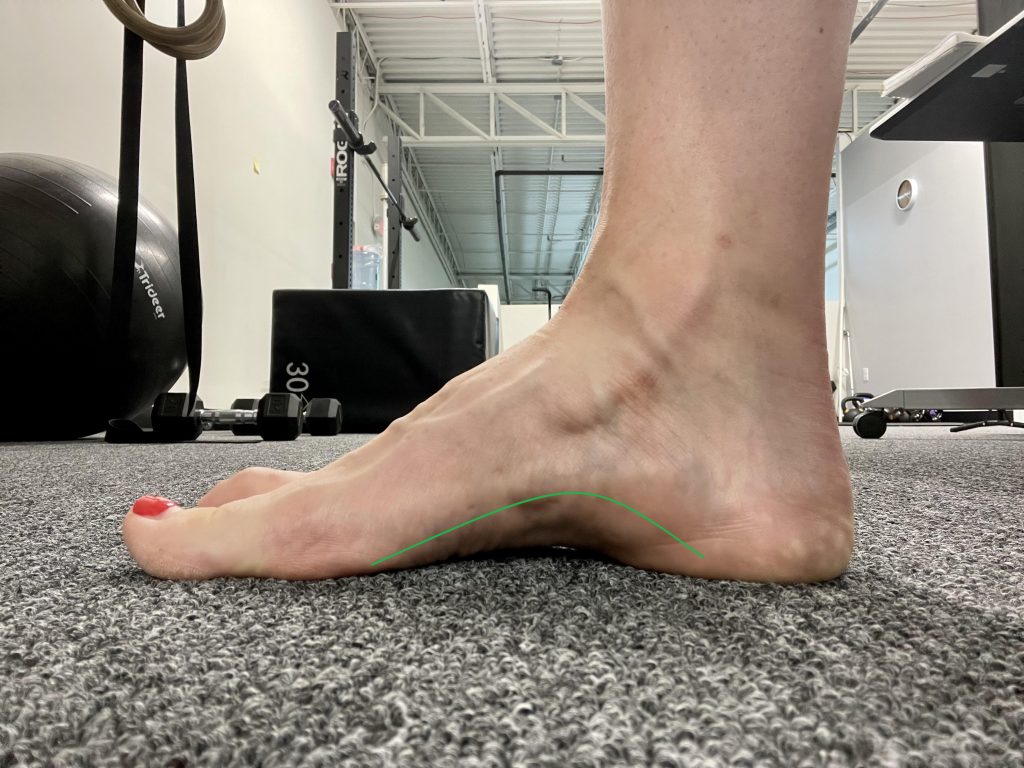
You have 4 layers of 11 muscles in just your foot called your intrinsic foot muscles. Their primary function is to help maintain the medial longitudinal arch of your foot, AKA the arch on the inside of your foot. This arch assists with shock absorption upon initial contact and with springiness upon toe off. These muscles are especially challenged with running because of the increased load through your leg with each impact.
Weakness/instability → OVERpronation→ Less shock absorption→ Predisposition for overuse injury
Here me out, our feet are supposed to pronate, and pronation is not “bad.” It is part of a natural and normal gait cycle. However, if the pronation is uncontrolled or excessive, we lose the ability to absorb shock effectively and to push off due to lack of stability in the foot. This is something that I screen athletes for during gait analysis to see if it is part of the equation (why they are seeing me).
Here on some drills to get you started with some “foot core” training. They best isolate your arch and intrinsic muscles, except for the heel raise because you are using toe muscles that travel up the calf. However, I will almost always have someone try these IN ADDITION to resistance training up the chain (ankle, knee, hip, trunk).
Foot Drills
Toe Yoga
Works on neuromuscular control, which is necessary to establish before strengthening these muscles. You may be surprised at how difficult it is to control the little muscles that pull your big toe upward and press your big toe down into the floor. Practive engaging these muscles without rolling inward/outward. You should see your arch prominently while performing!
Toe Splay
This one is pretty similar to the above exercises with less isolation. Try to focus on bringing your big toe away from your other toes especially, as the muscle that performs this motion plays a key part in arch stability. Initially, I would recommend trying the toe yoga and toe splaying in seated at first, and then progress to standing as able.
Toe elevated heel raise
As mentioned above, this exercise engages muscles in your calf as well, particularly those that flex your toes. Most of the time, this provides a nice stretch at the bottom of the heel raise. We’ve configured this exercises by placing a PVC pipe under a yoga mat secured by a couple of weights. You can also use a broom/mop handle- be creative!.
Forward Lean
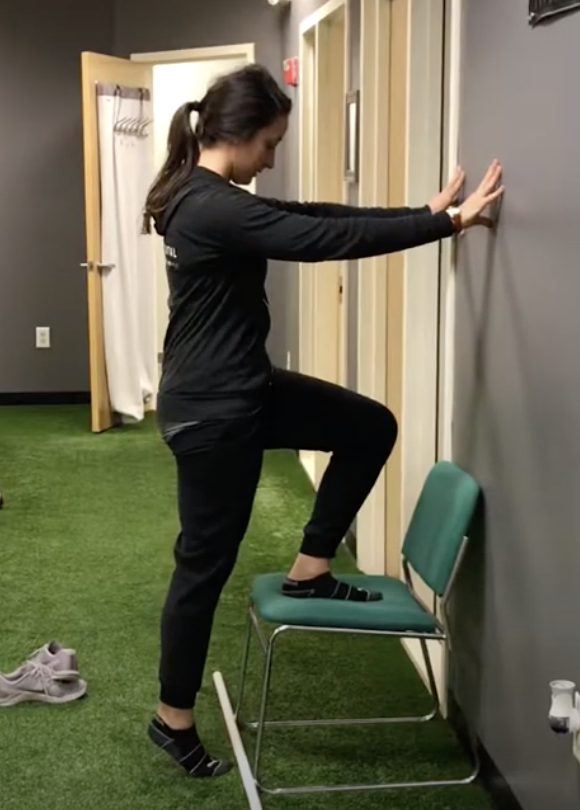
This is good practice for actually running, as this more forward position is normal in running gait. You might find that your arch immediately engages when you start to lean forward. As for the leaning drills, start standing on both legs, and then progress to SL as able. You can use your hands at a wall for support initially.
Give these a try and let us know what you think. It’s a great place to start! As always, if you are dealing with a current injury, it is best to see a physical therapist to be evaluated and given a personalized treatment plan.
It’s no mystery that we are fans of resistance training at IPPTW. And it’s not only because it keeps us strong.There’s a whole lot of other benefits to training with load, and I’m here to dive onto a few…
Improve flexibility
This one might be a little confusing. We don’t typically associate resistance training with flexibility. However, especially when focusing on full range of motion, resistance training will promote flexibility, and has proved in some cases to be superior to static stretching.
Increase bone density
We need to do load bearing resistance training to keep our bones strong, its physics! Especially as we age, it is important to combat bone wasting with lifting in ways that load our skeleton- squats, deadlifts, lunges, push ups, etc. , etc.
Improve BP and Sugars
Compared to other forms of exercise, resistance training proves to be superior for managing bood sugar levels long term. A combination of resistance training and endurance training has shown to lower blood pressure just as much as antihypertensive medications, and in theory, should have longer lasting effects
Sleep More!
Lifting helps us sleep better. In fact, compared to the non lifter, a person who regularly strength trains is less likely to have poor sleep quality. Sleep is so important for so many reasons, but more as it relates to physical therapy and what I do on a daily basis, it is important for managing pain. Sleep deprivation has been linked to higher levels of inflammation and pain, and therefore is a factor when I’m treating an injury.
Improve mental health
Resistance exercise training has been shown to greatly reduce depressive symptoms in adults regardless of health status, total volume of training, or significant improvements in strength. Getting stronger is great for both the physical and mental body.
Aging Well
In addition to balance training and functional exercise, resistance training is one of the most effective types of exercise to age gracefully. By working on making strong muscles, we can help combat and reverse the adverse effects of aging, while preventing future disability and injury! Simply put, strong=less fragile.
Welcome back for the resiliency series, KNEE EDITION!
Over the last year, we have been covering the most common areas of the body where people have their aches and pains. Each week will cover a specific area that we suggest people work on in order to resist injury.
This will NOT serve as a way to treat an injury or direct medical advice, but it will be a resource that will house the most up-to-date information on how to make yourself stronger and and more… RESILIENT! We ALWAYS suggest you seek medical attention if you feel you need more help.
Let’s talk about our knees. Chances are, most of you reading this post have had some type of knee pain at some point if you are active. We use our knees all of the time, including walking, climbing stairs, running, squatting, lunging, etc. Knee pain can have multiple causes, but I’m here to talk about nontraumatic knee pain. It’s often referred to under one umbrella as “patellofemoral pain.” This can refer to a few different things, but all of them refer to a sensitivity of the structure surrounding your knee cap. In my experience, these types of overuse injuries are 100% treatable.
I am going to take you through some of our favorite exercises and ways to prescribe exercises to help strengthen and protect against injuries in this area.
One thing to remember, and this is a common theme in these types of posts, injuries can NOT be 100% prevented by any program, we can only reduce our risk. The best way to reduce our risk is to get stronger!
The key to improving the durability of our tendons is to work on heavy, slow resistance training. This means exercise that uses weight, is performed slowly and is challenging enough to make changes in the actual structures within. What we know from research, which is consistently proven time and time again, that exercises have to be challenging enough to make changes within. We don’t have to pose a great challenge with every single exercise we do, but for the ones that we are hoping to make measurable gains with, we must challenge ourselves regularly.
Now, onto the good stuff. Here are a few of our fave exercises to perform to help improve knee durability. It is suggested that you begin at a level that you think will be challenging enough, but not so hard that you are sore for days, but sometimes it takes a few sessions to figure out the difficulty level.
We suggest that each of these exercises be performed 3-4 weekly to make measurable changes. We also suggest repetition ranges of 8-10 for 3, challenging sets.
Basic air squat
One medical myth is that you should not let your knees go past your toes when you squat. PLEASElet your knees go over your toes during a squat. You are missing out on the added benefits of performing a full depth squat- increased muscle tone in your quadriceps, in addition to your inner thigh and gluteal muscles! When you are injured, a squat can seem like an impossible task, so we may work with modifying this movement based on your sensitivity.
Step down
Seems easy, right? You likely do this every day if you have to walk up and down stairs to get where you are going. You can make this exercise harder by increasing the time over tension (think holding for 20 sec, or slowing down the movement to a snail’s pace) or adding weight!
Hamstring curls
I’ve mostly listed quad-dominant exercises here, as your quad is the muscle that directly passes through your knee cap. However, it is important to maintain balance with strength training, so I had to include a great posterior chain exercise as well. Maintaining strong hamstrings is also an important part of injury prevention to maintain a good quad:hamstring strength ratio.
Lunges
Lunges are more of a unilateral exercise, which is great for targeting differences in strength from you left to your right side. You can perform lunges in both the sagittal plane (front and back) and in the frontal plane (left and right) as pictured above.
Box Jump
Great for improving power and speed in your quadriceps! This explosive motion is great for improving performance.
This concludes our Knee edition of the Resiliency series. If you learned something, give us a shout! If you know someone who would learn something, pass it along with a share!
Thank you for reading and stay tuned for future posts…..
So you get hit with a case of back pain… What is the first thing you do? Everyone’s response is different! If you have had it before, you try what worked last time. If you have never had it and it is bad enough you may resort to running to the ER, resting on the couch, taking medication? Calling the doctor?
Lower back pain is one of THE MOST COMMON areas of pain that people experience AND one of the most common things that I treat. Most people in their lifetime experience it at least once.
In the world of pain management, it is one of the diagnoses that is treated with the least amount of efficacy… AKA what is most commonly being used for treatment is old school and doesn’t have great outcomes! Doctors are over prescribing medications, still recommending rest, and referring for MRI’s. This treatment is completely outdated and can actually harm people more than it can help! Some doc’s are up on the research, but many aren’t…
The most recent pain management guidelines for doctors states that MRI’s are ONLY indicated to rule out things like cancers, tumors, or fractures. They should only be used if ANY one of those things are suspected. It is NOT indicated for people who have a non-traumatic onset of lower back pain.
I like to rely on research to direct my treatment strategies. I let the pros do the work, I read what they find and the rest is history. The most updated way to handle back pain begins in physical therapy and is surrounded by specific exercise. The faster someone can get into the hands of a PT, the better their outcome. That is what the research tells us!
Why is that?
Back pain responds best to movement and physical therapists are movement specialists.
So… to make a statement based on the title of this blog post, “Back pain to day, what to do tomorrow…”. Timing is everything. Please call your local PT office and request an appointment.
In the meantime…
Find movements that you CAN do! Find the ones that make you feel better (ie. bending forwards, backwards, bridging on the floor, etc)
Try NOT to stay in one spot for too long (ie. on the couch or in your desk chair)
If you can manage continuing to workout, DO IT! Making workout modifications in order to get a little sweat on is very important.
Honestly, I am just trying to spread the word and teach you about the things that work. I want to help people realize that they will fair BETTER in the long run if they go to PT FIRST.
Do you know someone who just started with some back pain? Maybe they have had it for a while? Send this their way.
If you have been following over the past few months, we have been covering a handful of topics that help you learn how to become more resilient. Most of which surround the concept that resistance training is your ticket to longevity and long term resilience in life!
But what if you don’t really want to lift weights? What if you have gotten hurt from weightlifting before or just feel that it is not the right fit for you? Does that mean you are destined for failure? Destined to be a sorry case cooped up in a nursing home for the latter half of life?
No way…
What do you do if the above describes YOU but you would like to feel better, last longer, be capable of more things and be better at life? (My definition of resilience).
The key to being resilient is putting yourself under stressors that eventually elicit the change you are hoping to see. You want to apply it over and over again until it becomes less stressful, almost easy if you will. If you want more change, you apply it again, but in a more challenging scenario… Here are a few examples.
Example 1: Person 1 wants to be able to handle life’s stress with less internal turmoil. Person 1 uses the incoming stress as lessons versus barriers, utilizing the growth mindset. Over time, the turmoil that was once a result of a life’s stress no longer comes on with as much vengeance as it did prior to the growth mindset application.
Example 2: Person 2 wants to have less knee pain after long runs. Person 2 sees a PT who tells them that they need stronger tendons to withstand the long runs. Person 2 begins to apply resistance training principals that are slightly challenging but do-able to that said tendon, creating strength over time. Person 2 now can run with little to no knee pain now that things are a bit stronger.
Example 3: Person 3 wants to stay active for a lifetime but does not want to lift weights. Person 3 knows the benefits of weightlifting but has a previous experience that made her realize that her body is not build for that “type of thing”. Person 3 sees a healthcare and performance specialist who is able to find a baseline level of strength and build from there. Person 3 begins with a fews weeks of bodyweight exercise. It was challenging at first but now has become much easier. Person 3 realizes that she does need to add weights to her routine to keep up the progress. A few months later, Person 3 now lifts weights 3 days per week and feels better than ever. Person 3 did NOT think that weightlifting was for her, but was fortunate to have been gradually introduced as it changed her life for the better.
Exercise is the best way to gain and maintain longevity. Period. The type of exercise recommended is both in the realm of resistance and cardiovascular training. If you are unsure about strength training, it’s all about starting… well… where you start? and all starting points are different…
Every exercise routine has a starting point and your starting point is based upon your goals, what you believe in, what your body can handle, and science. Why science? Science tells us that if we gradually add resistance training (bodyweight, bands, or weights) into a person’s regular routine, they will see positive changes including less disease, less pain, and better life.
Adding resistance training can begin with bodyweight exercises, like Person 3 from the above example. (Who is a real person I may add). It should transition into more challenging work when you are ready and with proper instruction from a coach.
The point of all of this? If you have some form of aversion to weight lifting, you are not alone! There is a time an a place to add heavy weights and it may not be where you should start when it comes to a resiliency plan!
Last post I tried to set the stage, light the fire, get you all jazzed up to start strength training but didn’t give you any of the tools to begin.
DISCLAIMER: These are instructions for someone who has never strength trained before or has minimal experience. It is advised that you proceed with caution, go easy and follow the recommendations.
“Where should I start?”
Simple and Consistently.
“You said it should be hard, how do I know it is challenging enough?” I want you to feel like you are giving effort. Run through the program provided below twice per week for two weeks. If it did not tire you out or make you sore at all, you have to progress. Resistance training can and will make you sore, but not so sore that you can’t climb the stairs, sit on the toilet and are limping while you walk.
“What exercises should I do?”
I am going to review the main components of a resistance training routine for a beginner. These require no equipment at all and can be performed at home. You can begin all of these with 2-3 sets of 10-12 repetitions, 2 days per week.
Hip thrust
This is a great exercise for the legs and lower back. It is a VERY important area to strengthen in order to lift, carry, go on long walks, prevent falls… the list goes on.
Push up with assist
Push-ups are a standard movement to get good at. The problem is, most people can not do even one! It’s a tough one… That being said, there are many ways to get stronger at them and this is one. This movement is very important for a handful of reasons but one major reason is that if you fall, you want to be able to get back up!
Air Squat
This is one of the most foundational movements known to the world of resistance training. You can not go wrong here! This is an un-weighted squat but can be a very effective way to build up leg strength, help your knees and your lower back!
Plank
The plank… another foundational movement! This is a FULL BODY move that works everything! This is an exercise that not only helps you gain a stronger core, but it is great for shoulder strengthening, lower back and knee health. This would be one that is performed for time, suggested at 3 sets of 15-20 seconds for beginners.
Reverse lunge
Now… This one is a bit advanced but I love it. There are many people who are not able to perform this move as shown in the video. That being said, it can be easily made less challenging by holding onto something like a door handle, door frame, kitchen counter, etc… This move works on balance, strength and coordination. If you are someone who can not get up from a kneeling position without your hands, this exercise is a must!
Suitcase carry/ march
This is one that many don’t know about but is is incredibly beneficial! Have you ever struggled at carrying in the groceries? Been challenged by dragging a heavy bag of leaves across the yard? Felt the strength of your grip disintegrate? The suitcase carry works all of the above. This would be an exercise also performed for time if you are marching, or distance if you are walking. I would suggest 3 sets of 20 seconds per arm – hold a gallon of water, fill a grocery bag with canned goods…?
Step up
This one is fairly obvious but I’ll give you some examples as to WHY it’s important. How often do we carry things up and down stairs? (Often). You never want to lost the ability to do that! You also want to keep your knees, hips and lower back’s healthy, too? Of course.
Try these out… See what’s challenging, see what’s easy and make adjustments accordingly. Resistance training should be a part of your life forever if you plan to live long and healthy. It doesn’t have to be fancy to be effective.