
by Pippa Teague, Strength Coach | Sep 19, 2019 | Conditioning, Exercise advice, Injury Prevention, lifts, Personal training, Running, squats, strength training, Uncategorized
By Jenny Gusella
These days there are endless workout options, from spinning to barre to HIIT to personal training, bootcamps, home DVDs and more. There’s also tons of information and scientific research floating around about the benefits of one workout versus the next. With your head spinning from information overload, you finally decide to seek an expert opinion, so you ask a trainer like me, “OK. Tell me the truth. What is the best workout?”
The best workout is the one that you will actually do. Whether it’s because it’s the quickest, or you love the instructor, or your friends go to that gym, or your favorite coffee shop is next door, or because you genuinely love the workout, there is no reason too small if that reason is enough to get you to complete the workout.
The human body is much more simple than we think. Eat food, move around, sleep, repeat tomorrow. Of course, in between those things is an entire life – a career, familial responsibilities, not to mention social pressures, self-doubt, etc. All of those things complicate the basics, but you have the power to uncomplicate fitness. Are you stressed that you don’t have an hour to spare to workout? Simple solution: do a 45 minute workout. Are you dreading doing that 3 mile run you promised yourself you’d do? Simple solution: Don’t do the run. Do some squats, lunges and pushups, or go for a bike ride, or walk your dog.
Yes. I just said, “don’t do the run.” Running in particular is a topic that comes up so often in this line of work. So many of us dread running, and yet force ourselves to do it anyways, as if it’s some sort of requirement. I am here to tell you: YOU DO NOT NEED TO RUN IF YOU DON’T WANT TO. Ever. (Unless you’re being chased.) I am also here to tell you that you do not need to be “a runner” to go on some runs. If you like it, do it, if you don’t, do something else. It truly is that simple. Think about Forrest Gump. Why did he start? “I just felt like running.” Why did he stop? “I’m pretty tired. I think I’ll go home now.”
The next time you find yourself in a workout rut and are about to ditch the gym, ask yourself if there’s maybe another physical activity you’d rather do instead, and try to direct yourself down that route. Don’t worry if your workout doesn’t “scorch the most calories” or “target 90% of your muscles” – just move!
![Making It As A Marine: Fitness Is A Must]()
by Pippa Teague, Strength Coach | Aug 26, 2019 | Exercise advice, Marines, Military training, Personal training, Pushups, Running, squats, strength training, Uncategorized
By Kerry Moynihan
Our United States Marine Corps is consistently challenged with both physical fitness and combat fitness testing throughout their careers. It’s through this sustained physical effort that our Country’s Marines maintain peak combat ready shape.
What is the difference between the Combat Fitness Test (CFT) and Physical Fitness Test (PFT)? Great question and one that I posed to my son, PFC Pat O’Hearne, who recently graduated from USMC Recruit Training at Parris Island, SC. Here’s the 4-1-1.
PFT: attire is shorts, t shirt and sneakers (go-fasters in Marine parlance).

In order to be a Marine at all you must pass an initial strength test. This ensures that you are fit enough to even begin recruit training. The understanding is that you will improve greatly from here. Basic standards: 2 unassisted pull-ups, 44 crunches in 2 minutes and a mile and a half run in under 13:30.
Over the course of 13 weeks of boot camp, fitness sessions are designed to improve those initial numbers. Body weight training is predominant in a timed, circuit style format. Circuit: pull-ups, inverted crunches, knee tucks, inverted push-ups, pull-up burpees, box jumps, tricep dips, 40 lb. ammo can lifts (push press), back extensions, lunges and squats. All at max effort, 2 minutes per station.
Speed Training: 40 yard wind sprints 8 to 10 times.
Throughout the duration of basic training there are 5 total long distance hikes with weighted packs for endurance. Hikes range from 3 to 12 miles with a final 15 mile hike prior to graduation hoisting an 80lb pack.
The final PFT prior to graduation requires a MINIMUM of 3 unassisted pull ups, 50 crunches, and 3 mile run in 28 minutes.
CFT: Max effort in boots, camo pants and t-shirt.
There are 3 events for Combat Fitness which are all specific to warfare.
1) 880m Sprint: (2 laps around the track) with the goal of completing it as quickly as possible. Max time 3:48.
2) Ammo Can Lift: 30lb can lifted at a minimum 45 times in two minutes.
3) Maneuver Under Fire: A timed event. This is a 300 yard shuttle run with combat related exercises. Here’s the format: a ten yard low crawl, 10 yard high crawl, zigzag run to the end where your partner must be lifted and dragged 10 yards, drop him and fireman carry him back to the starting point. After unloading your partner you lift two 30lb each ammo cans, run straight for 20 yards, zigzag for 30 yards, drop the ammo cans, lift a grenade (lacrosse ball in training) throw it into the “square zone” 15 yards away, drop for 5 push-ups, raise the ammo cans again and zigzag sprint for 30 yards and then sprint in a straight line for the final 20 yards to the finish. All must be completed in a max time of 3:29. 2:04 is considered a perfect score.
Every Marine, regardless of age, is annually tested with the PFT and CFT. As one ages, the standard times and numbers required do adjust but are equally challenging. We can rest assured that our USMC is continuously physically and mentally prepared for work on our behalf. I, for one, am eternally grateful.
by Pippa Teague, Strength Coach | Jun 25, 2019 | Brain health, Conditioning, Exercise advice, lifts, Pushups, Running, squats, strength training, Uncategorized
By Kerry Moynihan
Certified Personal Trainer
Fit 4 Life After 50
Visualize this: You walk into a room. You are on the hunt… on the hunt for your glasses. You search high. You search low. They are on the top of your head.
Next scenario: You open the fridge with purpose: “What in the name of all that is holy was I looking for? Wait, wait…it will come to me!”
Sound familiar? Happens to the best of us.
Our lives are chock full of responsibility- work, children, parents, household. We are juggling it all. Why wouldn’t brain fog be a byproduct?! Why don’t we practice self care by exercising body and brain to make our everyday tasks more manageable? Medical evidence substantiates the fact that we should!
It goes without saying that regular exercise builds muscle, improves metabolism, and maintains bone health. It improves mood, encourages better sleep, and puts us on the path to better physical health.
Beyond that, a study out of the University of British Columbia cites that CONSISTENT AEROBIC exercise boosts the hippocampus. That’s the part of our miraculous brain that involves memory and learning. Their recommendation: 120 – 150 minutes of moderate exercise weekly. That’s exercise that gets your heart pumping and your sweat on. Power walk, dance, stair climb, swim – do whatever fuels your aerobic passion to keep you on that consistent path. And with any new routine, play it safe and check in with your health care professional prior to beginning.
Our brains are beautiful and complex. According to this study, the brain benefits of exercise are directly related to reduced inflammation, reduced insulin resistance and the release of chemicals in the brain that encourage the health of brain cells.
It’s a “no brainer.” Exercise is where it’s at for life-long body and brain health.
![Making It As A Marine: Fitness Is A Must]()
by Pippa Teague, Strength Coach | Jun 10, 2019 | Back Pain, Exercise advice, Injury, Injury Prevention, lifts, squats, strength training, Uncategorized, working with injury

By Loni Rodriguez DPT
Low back pain is an extremely common condition that many people are faced with on a daily basis and the incidence is climbing. From 1996 to 2006, the number of people who experienced low back pain increased from 3.9% to 10.2%. Recent research has also shown that up to 33% of individuals who have experienced low back pain experience it again within one year.
How can this be?
There have been significant advancements in medical technology including improved surgical procedures, imaging techniques, and medications. With these advancements, however, the incidence of low back pain continues to increase.
What are we doing wrong?!
One main underlying issue is the misconceptions surrounding the topic of low back pain. These misconceptions can lead to poor treatment outcomes, fear of movement, incorrect diagnoses, and worsening symptoms. The discussion today will help debunk some of these misconceptions and will better educate YOU on this low back pain epidemic.
Misconception #1: My back hurts, I should rest.
I don’t recommend anyone take complete rest from their activity. In every case of low back pain, there are specific activity modification recommendations that can be made. I will never tell someone to completely rest!
These modifications are specific to each person – it is recommended that you seek medical advice to find out what the right path is when you are dealing with pain.
Not convinced? Let’s hear Roy’s Story
Misconception #2: I should not lift weights because it is bad for my back.
One of the most effective ways to treat low back pain is strength training. Strength training creates full body resiliency. The most beneficial weight training exercises involved in low back pain rehabilitation programming include squatting, deadlifting, carrying, pressing, and pulling. All of these exercises help strengthen the muscles throughout the entire body including the lower back, which help to decrease pain and improve activity tolerance. Just like the previous recommendation, if you have low back pain do not think that jumping into these exercises without supervision is a good idea. Seek advice from a trusted professional!
Misconception #3: My back pain is from the chair I sit in at work.
Most of the time, back pain and the type of chair you sit in do not correlate. In some cases, the amount of time sitting and the lack of time spent up and moving are bigger contributors to symptoms. As stated before, movement is medicine, especially in the case of low back pain – when in doubt, just get up and move as frequently as you can.
Misconception #4: My back is stiff, I probably should be stretching more.
A stiff back does not always mean that it has to be stretched. A lot to times, stiffness is a perception of being tight and it is your body’s way of telling you that it needs some attention. Low back stiffness can be helped with frequent, active movement, versus stationary, passive stretching. This type of stretching does serve a purpose, but is not the most effective way of helping your stiff back. Here is a quick video to a great routine that you can perform on your own to “loosen” your lower back!
Misconception #5: I know where my pain is coming from, I have a disc herniation.
Disc herniations are not proven to be the cause of back pain. In most cases, disc herniations are not causing the symptoms. Especially when the pain has been going on for a while. This condition can be considered part of the normal aging process! The percentage of people with disc herniations increases with age and most of the people with herniations do not have pain! Please quit blaming your pain on a condition that can be considered the gray hair of the spine.
If you would like more information on back pain, or any pain for that matter, please visit www.infinitepotentialptw.com. On this website there is a plethora of free information and content, as well as a forum to ask questions.
References
Delitto et al. “Clinical Practice Guidelines linked to the international classification of functioning, disability, and health from the orthopedic section of the American Physical Therapy Association”. J Orthop Phys Ther. 2012;42(4):A1-A57

by Dr. Loni Rodriguez | Dec 17, 2018 | Exercise advice, Injury Prevention, lifts, Running, running help, squats, strength training
Why should runners strength train? PART II

Again, this post was inspired by Chris Johnson, my GO-TO for all things running!
For more information about Chris and some of the amazing content he has to offer, visit his website at Chris Johnson PT.
In the last post, we covered some of the benefits of strength training and the specific importance of this practice for runners. In this second piece, I will cover some of the most important and effective exercises that a runner’s strength training routine should include.
Dynamic Warm Up
This is often neglected by runners because it is easy just to get out and run. We want to allow adequate perfusion of blood to the necessary tissues and prepare the nervous system for the run itself. There is also likely too much time spent on unnecessary stretching. This stretching has little to no effect on injury prevention or preparing for the run.
Here are two recommended exercises that can be included in a dynamic warm up:
Hugging knee to chest
Quad stretch with overhead reach
The March
It is important for a runner to demonstrate solid single leg balance. Marching provides training for single leg balance that simulates running. It also allows for training of shortened stride length which can help reduce the risk of running related injuries.
Here are two recommended marching exercises:
Baseline marching with or without weights
Prisoner March
Lateral Toe Tap
This exercise is important to train the glute muscles. The glutes play a large role at reducing running related injuries, as they are large contributors to the activity of running itself. This exercise directly targets those glutes, challenges single leg balance and simulates running as it is an upright activity.
Here are two recommended lateral toe tap exercises:
Lateral toe taps with band
Single leg stance hip abduction
Step up (7-8” step)
This exercise challenges single leg stance just like the demands of life. It is important to focus on control, coordination, and timing with this one. It is NOT an exercise that should be challenging on the muscles but more on balance, quality, and form.
Here are two recommended step up exercises:
Standard step up
Fluid step up
The Bridge
This exercises is one of the most basic yet it is very important. It is also performed without equipment. It works on glutes, hamstrings, calves, low back, and abdominals
It is great for preventing knee pain in runners.
Here are two recommended bridge exercises:
Standard bridge
Bridge march
The Plank
This is NOT just a core exercise. It challenges the lateral hip musculature which is very important for runners. It is recommended to not jump too quickly into unstable surface work as you want to master these first.
Here are two recommended plank exercises:
Standard plank arms bent with or without knee taps
Standard plank arms straight with or without knee taps
Calf Raise
Calves can not be overlooked in training for the lower body as they are the powerhouse for distance running. Calf exercises can create tissue resiliency and build capacity to tolerate the demands of the sport and resistance to injury.
Here are two recommended calf exercises:
Isometric double leg calf raise
Isometric single leg calf raise
Squat
The squat is the most fundamental strength training exercise that is involved in everyday life. It has the ability to create full body resistance to running-related injuries.
Here are two recommended squat exercises:
Air squat
Goblet Squat
Loaded Carry
Life demands that we carry stuff. So why not train it? Loaded carries play a primary role in working with runners of all ages and abilities as it is important to get acquainted with being tall and upright.
Here is a recommended carry exercise:
Farmers carry march
Deadlift
This exercise, along with the squat is one of the most important functional exercises that every human should perfect. It is also extremely important for injury prevention. The correct form is crucial and introductory exercises for this movement are important to perfect.
Here are a few deadlift exercises to introduce you to to the movement:
Hip hinge with PVC
KB Deadlift
WANT MORE?!?!?!?!?
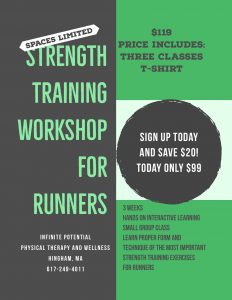
Interested in live group training that covers this content?
We will be hosting a 3-part series workshop held on 3 consecutive Wednesday’s in January from 6:30-7:30pm
JANUARY 9th, 16th, and 23rd.
This workshop will be located at our brand new office on 1 Derby Street in Hingham. Space is limited so please sign up ASAP!
Email Loni through loni@infinitepotentialptw.com or call 617-249-4011 x 700 for ANY and all questions!
Sign up through this link– choose the 6:30pm class on January 9th. Follow the prompts to complete registration.
 @

by Dr. Loni Rodriguez | Nov 19, 2018 | Back Pain, Exercise advice, Injury, Injury Prevention, knee pain, lifts, squats, working with injury
What to do when you are having pain during a workout?
Have you ever just left the gym or class when pain starts to occur? How annoying is that?! First off, you didn’t get a workout in, second, you might have hurt yourself… I hope not, and third, what do you do now? Should you go back to the gym tomorrow? Take a week off?
I really would like this post to come across the right way. I am by no means, telling you it is okay to push through any significant pain while exercising. What I would like to do is to provide a guideline of what to do when pain comes on during a workout.
Before I get into the guideline, there is one major exception:
*If you actually feel like you had an injury, as in, there was an EVENT that caused your pain, please stop exercising and seek medical attention*
Eg.
- if you fall off the treadmill, and feel a pop or snap in a joint followed by severe pain
- if you hit your head
- if something occurs and you notice immediate swelling and pain
…you get the point
What this guideline is NOT…
- A way to treat your pain
- A way to continue to exercise multiple sessions in a row without seeing guidance from a medical provider
- A way to avoid formally dealing with your injury
Point being… please seek medical advice to really help your issue!
In the meantime, I want you to be able to have some understanding of how to allow training to continue despite some pain vs taking time off.
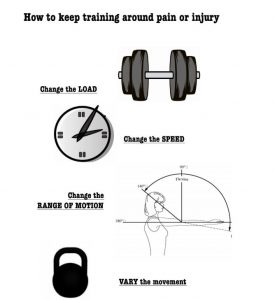
First… reduce the weight
- Try using a lighter weight, but continue the movement as prescribed.
- If the reps continue to be painful…
Next… slow it down
- Keep the weight and try using performing the movement slowly.
- If the reps continue to be painful…
Next… change the range of motion
- Keep the weight, return to a normal speed and limit how far you go into the movement being performed.
Finally… vary the movement
- There are various ways to perform different exercises.
- You can continue to get the same training effect while performing the movement in a slightly different way.
Here are a few examples of how you can vary the workout if you are experiencing pain during specific movements:
Knee pain with squatting?
- Reduce the load
- Alter the tempo – 3 seconds down, 3 seconds up
- Reduce the range of motion – Squat to a box or a bench
- Change the movement – go from front squats or goblet squats to a back squat
Back pain with deadlifting?
- Reduce the load
- Alter the tempo – try a quick lift from the floor and a slow lower
- Reduce the range of motion – Lift from an elevated surface (blocks or plates)
- Change the movement – go from a barbell to a hex bar or kettlebell
Use this to help keep yourself training, but PLEASE… also seek medical advice. There are many other things to be done in order to get you back to being pain-free during workouts… most of the time, it’s more exercise! Not rest.
