by Pippa Teague, Strength Coach | May 14, 2019 | Back Pain, Injury, Injury Prevention, knee pain, Ladies, lifts, Neck Pain, Running, running help, strength training, Uncategorized, working with injury
By Loni Rodriguez,
Physical Therapist
Do you know what fires me up more than anything? It’s hearing a story from a client that begins with… “I felt like the doctor did not understand where I was coming from.”
You may not know this story, but I dealt with hip and low back pain for just over 2 years when I was going through graduate school. It came on gradually while running one day on the treadmill. It was sharp, came on strong and would not let go. It gradually persisted and ultimately led me to have to stop running all together. It derailed me and created a borderline depression around the fact that I was unable to exercise like I had wanted to. I went from running almost every day to dealing with persistent hip pain that I would feel first thing in the morning and be with me until the minute I went to bed. I would wake up wondering if it would just go away…
How I was going to be able to go out with friends? Sit at a baseball game? Go shopping? Play football with friends on the beach? It consumed me.
I went to a plethora of doctors and physical therapists, had injections, saw specialists and was convinced that my hip required surgery because one MRI found a cartilage tear. I was constantly searching for answers to the cause of my symptoms and coming up short time and time again. Fast forward 7 years, symptoms have improved dramatically and I no longer deal with persistent pain. I feel stronger and more resilient than ever… so what can I contribute it to? That is a question I do not have the answer to… yet, but is not the point of my story. I am not going to tell you I have the magic answer to solve all persistent pain like this… But I am damn sure I know what would have helped me along the way.
Looking back on this, I realized one common piece that I was missing. I didn’t have a healthcare provider that told me that I was going to get through this and they were going to guide me… that is all I wanted, someone to tell me they would lead me on a path to feeling better and more confident in my hip.
At 21 I had one person – a doctor, surgeon and low back pain specialist tell me that I was going to be dealing with pain for the rest of my life. I remember crying in my car after the session, not because I thought he was right, but because I knew he was wrong. I was more upset because I knew he was going to be giving that same screwed up advice to all the other poor souls in the waiting room. I knew that I had a better understanding of pain and did not want to take that answer as my fate.
I wanted someone to listen to my entire story and not seem like the details were obsolete. I remember creating a pain log to show one of my providers and they didn’t even look at it. Finally, overtime I gradually improved and found my way of returning to exercise – running, lifting weights, competing in CrossFit and running races without even thinking about my hip or low back. This took time and hard work, but I made it.
This is not how an experience with a medical professional should be. You should 110% be involved in your own plan and be guided in that direction.
Have you ever had an experience with this? Have you ever been a fly on the wall in this situation with a family member? How many times have you or someone you know had to accompany a family member at a doctors appointment because you do not remember what they said.
I would love to hear YOUR story…
It does not have to be like this! Seek other advice from someone who listens.
Thank you for taking the time to read and have an awesome rest of the week!
by Dr. Loni Rodriguez | Dec 17, 2018 | Exercise advice, Injury Prevention, lifts, Running, running help, squats, strength training
Why should runners strength train? PART II

Again, this post was inspired by Chris Johnson, my GO-TO for all things running!
For more information about Chris and some of the amazing content he has to offer, visit his website at Chris Johnson PT.
In the last post, we covered some of the benefits of strength training and the specific importance of this practice for runners. In this second piece, I will cover some of the most important and effective exercises that a runner’s strength training routine should include.
Dynamic Warm Up
This is often neglected by runners because it is easy just to get out and run. We want to allow adequate perfusion of blood to the necessary tissues and prepare the nervous system for the run itself. There is also likely too much time spent on unnecessary stretching. This stretching has little to no effect on injury prevention or preparing for the run.
Here are two recommended exercises that can be included in a dynamic warm up:
Hugging knee to chest
Quad stretch with overhead reach
The March
It is important for a runner to demonstrate solid single leg balance. Marching provides training for single leg balance that simulates running. It also allows for training of shortened stride length which can help reduce the risk of running related injuries.
Here are two recommended marching exercises:
Baseline marching with or without weights
Prisoner March
Lateral Toe Tap
This exercise is important to train the glute muscles. The glutes play a large role at reducing running related injuries, as they are large contributors to the activity of running itself. This exercise directly targets those glutes, challenges single leg balance and simulates running as it is an upright activity.
Here are two recommended lateral toe tap exercises:
Lateral toe taps with band
Single leg stance hip abduction
Step up (7-8” step)
This exercise challenges single leg stance just like the demands of life. It is important to focus on control, coordination, and timing with this one. It is NOT an exercise that should be challenging on the muscles but more on balance, quality, and form.
Here are two recommended step up exercises:
Standard step up
Fluid step up
The Bridge
This exercises is one of the most basic yet it is very important. It is also performed without equipment. It works on glutes, hamstrings, calves, low back, and abdominals
It is great for preventing knee pain in runners.
Here are two recommended bridge exercises:
Standard bridge
Bridge march
The Plank
This is NOT just a core exercise. It challenges the lateral hip musculature which is very important for runners. It is recommended to not jump too quickly into unstable surface work as you want to master these first.
Here are two recommended plank exercises:
Standard plank arms bent with or without knee taps
Standard plank arms straight with or without knee taps
Calf Raise
Calves can not be overlooked in training for the lower body as they are the powerhouse for distance running. Calf exercises can create tissue resiliency and build capacity to tolerate the demands of the sport and resistance to injury.
Here are two recommended calf exercises:
Isometric double leg calf raise
Isometric single leg calf raise
Squat
The squat is the most fundamental strength training exercise that is involved in everyday life. It has the ability to create full body resistance to running-related injuries.
Here are two recommended squat exercises:
Air squat
Goblet Squat
Loaded Carry
Life demands that we carry stuff. So why not train it? Loaded carries play a primary role in working with runners of all ages and abilities as it is important to get acquainted with being tall and upright.
Here is a recommended carry exercise:
Farmers carry march
Deadlift
This exercise, along with the squat is one of the most important functional exercises that every human should perfect. It is also extremely important for injury prevention. The correct form is crucial and introductory exercises for this movement are important to perfect.
Here are a few deadlift exercises to introduce you to to the movement:
Hip hinge with PVC
KB Deadlift
WANT MORE?!?!?!?!?
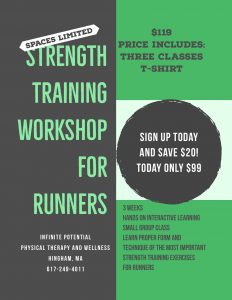
Interested in live group training that covers this content?
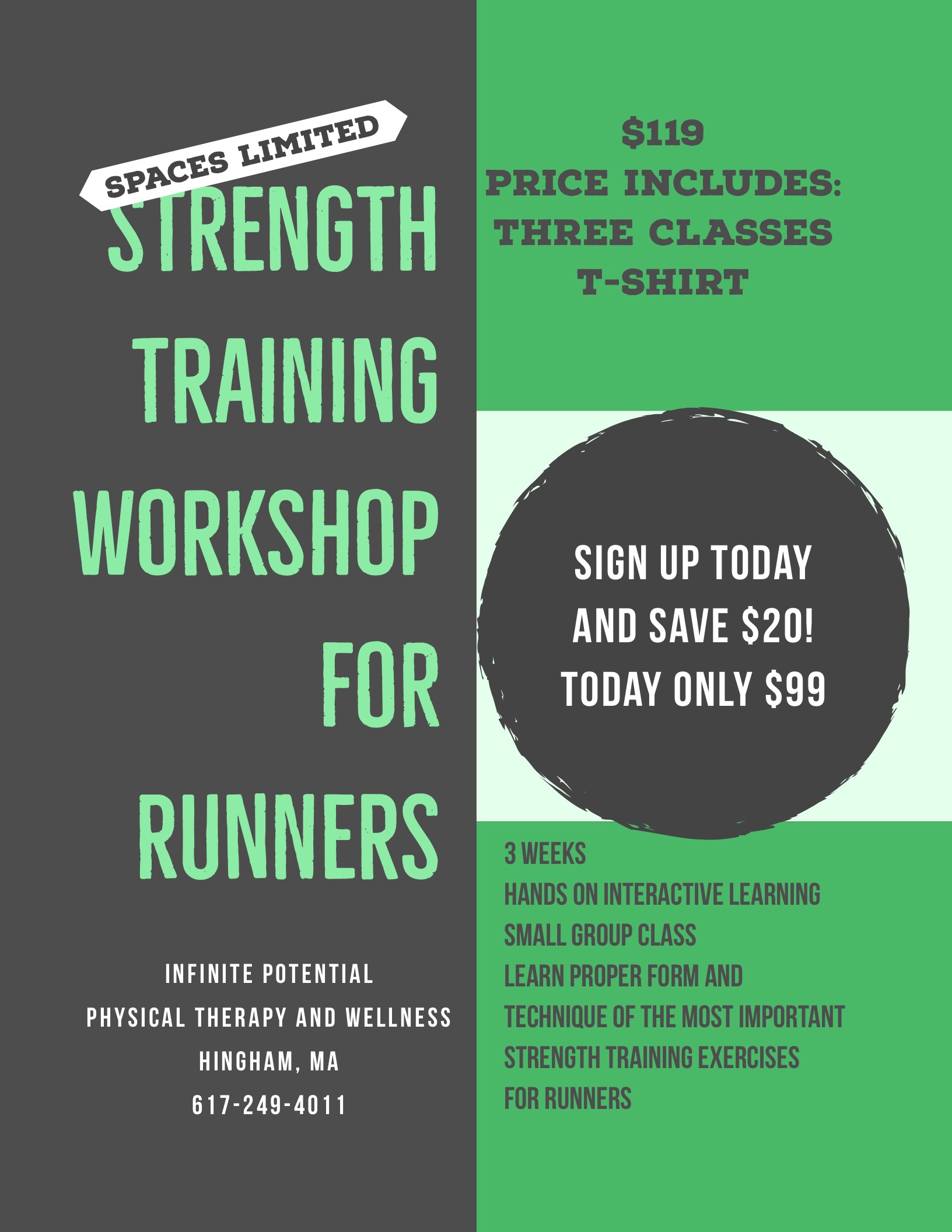
We will be hosting a 3-part series workshop held on 3 consecutive Wednesday’s in January from 6:30-7:30pm
JANUARY 9th, 16th, and 23rd.
This workshop will be located at our brand new office on 1 Derby Street in Hingham. Space is limited so please sign up ASAP!
Email Loni through loni@infinitepotentialptw.com or call 617-249-4011 x 700 for ANY and all questions!
Sign up through this link– choose the 6:30pm class on January 9th. Follow the prompts to complete registration.
 @
by Dr. Loni Rodriguez | Dec 11, 2018 | Exercise advice, Injury Prevention, Running, running help, strength training
Why should runners strength train? PART I
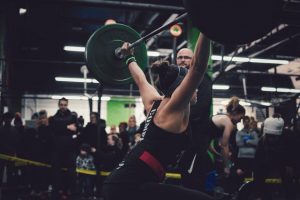
The following is a very brief overview of Chris Johnson’s book, Running on Resistance. For more information about Chris and some of the amazing content he has to offer, visit his website at Chris Johnson PT.
Strength training is an integral part of any regular exercise routine. Here are some major benefits of this fundamental practice:
- Builds cardiovascular health
- Improves body image
- Improves flexibility
- Improves full body resiliency and resistance to injury
For runners, not only are you focused on the above, but for more competitive runners, there is a focus on performance. There is an element of excitement when we improve our mile time or come back for a run feeling refreshed.
Here are some of the running specific benefits that strength training can provide:
- Improve capacity
- Increase running economy
- Increase speed
- Delay fatigue onset
Body weight exercises are a great entry into resistance training, yet additional resistance with the use of weighted equipment will provide the necessary stimulus to gain strength. However, to reduce the risk of injury from strength training, a general periodization program should be followed. There are various programs out there and have been proven to be effective. The major areas of interest when choosing a program are exercise selection, recommendations for load, repetition count, and rest periods. Each of these should be well understood and planned before initiating a program.
Here are some general recommendations
- Exercises need to be individualized to the person’s goals and exercise history
- Initially, 2-3 sets of 8-12 reps of bodyweight movement. Progressed then to weighted routine as form and comfort improves
- Single leg exercises need little to no rest
- Two-legged exercises require a rest of 1-2 minutes recommended
- Frequency is most effective at about two days per week for 12 weeks on days of lower volume running or drill/tempo days
Stay tuned for Part II, where I will review the most important and effective exercises for runners to add into their regular routine.
WANT MORE?!?!?!?!?
Interested in live group training that covers this content?
We will be hosting a 3-part series workshop held on 3 consecutive Wednesday’s in January from 6:30-7:30pm
JANUARY 9th, 16th, and 23rd.
This workshop will be located at our brand new office on 1 Derby Street in Hingham. Space is limited so please sign up ASAP!
Email Loni through loni@infinitepotentialptw.com or call 617-249-4011 x 700 for ANY and all questions!
Sign up through this link– choose the 6:30pm class on January 9th. Follow the prompts to complete registration.
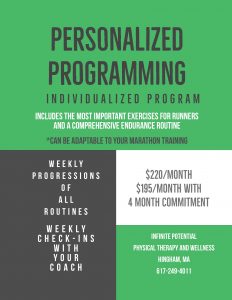
Are you interested in personalized programming?
It is a great way to safely and effectively implement this strength training program that was touched upon in the workshop.
HINT >>>> Most of it will be addressed in more detail in the 3-part series in January!
However, for a more personalized approach, the remote programming is a great way to be sure that you are doing EVERYTHING you need to do to improve your running performance and reduce your injury risk.
Email Loni through loni@infinitepotentialptw.com or call 617-249-4011 x 700 for ANY and all questions!