
by Dr. Loni Rodriguez | Mar 5, 2020 | Injury Prevention, Injury Prevention, knee pain, Pain Relief, Recovery, Running, strength training
Today we are highlighting Lily who has been with us since the Fall of 2019. Lily is a high school crew athlete who was dealing with knee pain that lead her to stop running at practice. The pain crept in seemly out of nowhere and she noticed that it just was not going to go away on it’s own.
“I have been doing crew since 6th Grade and really enjoyed rowing out on the water with my friends. When I joined the High School Crew Team in late August 2019 however, I noticed that my knees would begin to hurt during our warm-up runs and would then prevent me from participating in the other activities in practice. Due to the already existent pain, my knees would then begin to hurt when I was sitting down, often at school. This would prevent me from paying attention to my full abilities in class.”
She was impacted on a daily basis by her symptoms and was at a loss of what to do about it. Being a teen, she felt that she shouldn’t have to deal with pain like she was having.
“I had pain in my knees when I was walking up and down hills or stairs, running, jumping or any form of impact on my knees. I often found that my knee pain would flare up during the day at school.”
After the first session with Lily, I knew that I was working with an incredibly dedicated young lady. It isn’t uncommon for a young client to speak for themselves during the evaluation (versus their parent), but it is truly impressive when it does happen. Lily took the lead and consistently advocated for herself throughout her entire rehab. She was very diligent with her program and communicated with us between sessions like a mature adult.
“Before starting the treatment I did not think that there was any way that my pain and discomfort could be helped. I knew that, after talking to a Orthopaedic Surgeon, nothing could be done to directly treat the symptoms.”
I can’t say there wasn’t any eye rolling, big sighs or, “do we have to?!’s” during sessions, however, Lily worked hard, poured in a ton of effort and always did her best.
“Even though sometimes the treatment is difficult, after every session I feel stronger and my knees do not hurt nearly as much as they did only a few months ago.”
At this point, Lily is in her third and final rehabilitation phase. She has progressed to returned to running, she performs her strength routine at least 2 days per week on her own, and returns to our office for a monthly session to review and progress her home program.
“I can now run, with little to no pain for a relatively long period of time. The treatment has not only strengthened my leg and the other muscles surrounding my knees, but also my core and upper body. This has an incredible advantage when rowing and allows me to participate in all the practices and spend time with my friends and teamates.”
We asked Lily to tell us what others should know about seeking treatment at Infinite Potential PT.
“I believe that if you are prepared to work hard and persevere through the treatment plan that Lori gives you, which can sometimes feel like a challenge (especially when you have other commitments to your studies & crew team, and also want to spend time with friends and family!), you will definitely feel the benefits! Don’t give up – trust that you are strong enough, both physically and mentally, to succeed and become the best that you can!”
Thank you, Lily for your hard work! It was a pleasure to have gotten to know you and help you through this process.

by Pippa Teague, Strength Coach | Oct 10, 2019 | Abdominals, Conditioning, Exercise advice, Injury Prevention, knee pain, Ladies, lifts, Personal training, Recovery, strength training, Uncategorized, working with injury, youthtraining
Lunges are a great unilateral movement to work not only the muscles involved but also work balance and stability.
They can be done with little space required
-difficulty can be added by including weight- kettlebell or dumbbells
Here are some lunge variations:
The reverse lunge
- start with the feet hip width apart and facing forwards
- with your back remaining straight take one foot backwards, allowing both knees to bend as the back knee touches the ground lightly
- push off the back foot keeping the front foot firmly planted
- drive through the heel and return the leg beside the other
Repeat on the other side
this works the glutes, quads and hamstrings and is also a great way to improve knee stability
Alt reverse lunge
Lateral Lunge
We often forget to move laterally. Lateral movement is great for stabilizing the hips and works your inner thigh and glutes.
- start with your feet together
- Step out wide to the side, transferring the weight over to the side you just stepped with, keeping both feet planted on the ground and facing forwards
- sit back into a squat position and go as low as you feel you are able to
- drive through your foot and return to the starting position
Repeat on the other side
Lateral lunges w/ kb
Static (split squat) Lunges
During this movement the feet remain in the same position (static)
This movement is great for those of us who are not so good with balance when moving and is the least challenging of all the lunges. Static lunges help build balance and strength from a stationary position.
Muscles worked are your thighs and glutes
- Start in a split stance- hip width apart with one leg in front of the other
- Lift onto the toes of your back foot and lower that knee down to the ground allowing the front knee to bend also to a 90 degree angle parallel to the ground
- Press through the heel of your front foot and straighten the legs back up.
- Keep your torso upright. Most of your weight should be felt through the front leg
Repeat 8-10 reps and then switch to the other leg
Split Squat w/ kb
Alternating jump lunges
Similar to the reverse lunge but with an element of power and plyometric transition with a jump from one lunge position to the other by switching feet in the air
This exercise challnges the same muscles as the regular reverse lunge but also adds a cardiovascular effect by increasing the heart rate and helps burn more calories.
tips to help your jumping lunge
- master the basic lunges first-reverse lunges and walking lunge
- aim for soft landings, avoid landing hard on your knee
- chest and torso stays upright
- be light on your feet and try to spring through the ball of your feet to gain some air time
- you can increase the difficulty by increasing reps, jumping higher and spending less time on the ground
Alt jump lunges
Try some lunges today and let us know how you get on!
Happy lunging !
by Pippa Teague, Strength Coach | May 14, 2019 | Back Pain, Injury, Injury Prevention, knee pain, Ladies, lifts, Neck Pain, Running, running help, strength training, Uncategorized, working with injury
By Loni Rodriguez,
Physical Therapist
Do you know what fires me up more than anything? It’s hearing a story from a client that begins with… “I felt like the doctor did not understand where I was coming from.”
You may not know this story, but I dealt with hip and low back pain for just over 2 years when I was going through graduate school. It came on gradually while running one day on the treadmill. It was sharp, came on strong and would not let go. It gradually persisted and ultimately led me to have to stop running all together. It derailed me and created a borderline depression around the fact that I was unable to exercise like I had wanted to. I went from running almost every day to dealing with persistent hip pain that I would feel first thing in the morning and be with me until the minute I went to bed. I would wake up wondering if it would just go away…
How I was going to be able to go out with friends? Sit at a baseball game? Go shopping? Play football with friends on the beach? It consumed me.
I went to a plethora of doctors and physical therapists, had injections, saw specialists and was convinced that my hip required surgery because one MRI found a cartilage tear. I was constantly searching for answers to the cause of my symptoms and coming up short time and time again. Fast forward 7 years, symptoms have improved dramatically and I no longer deal with persistent pain. I feel stronger and more resilient than ever… so what can I contribute it to? That is a question I do not have the answer to… yet, but is not the point of my story. I am not going to tell you I have the magic answer to solve all persistent pain like this… But I am damn sure I know what would have helped me along the way.
Looking back on this, I realized one common piece that I was missing. I didn’t have a healthcare provider that told me that I was going to get through this and they were going to guide me… that is all I wanted, someone to tell me they would lead me on a path to feeling better and more confident in my hip.
At 21 I had one person – a doctor, surgeon and low back pain specialist tell me that I was going to be dealing with pain for the rest of my life. I remember crying in my car after the session, not because I thought he was right, but because I knew he was wrong. I was more upset because I knew he was going to be giving that same screwed up advice to all the other poor souls in the waiting room. I knew that I had a better understanding of pain and did not want to take that answer as my fate.
I wanted someone to listen to my entire story and not seem like the details were obsolete. I remember creating a pain log to show one of my providers and they didn’t even look at it. Finally, overtime I gradually improved and found my way of returning to exercise – running, lifting weights, competing in CrossFit and running races without even thinking about my hip or low back. This took time and hard work, but I made it.
This is not how an experience with a medical professional should be. You should 110% be involved in your own plan and be guided in that direction.
Have you ever had an experience with this? Have you ever been a fly on the wall in this situation with a family member? How many times have you or someone you know had to accompany a family member at a doctors appointment because you do not remember what they said.
I would love to hear YOUR story…
It does not have to be like this! Seek other advice from someone who listens.
Thank you for taking the time to read and have an awesome rest of the week!

by Dr. Loni Rodriguez | Nov 19, 2018 | Back Pain, Exercise advice, Injury, Injury Prevention, knee pain, lifts, squats, working with injury
What to do when you are having pain during a workout?
Have you ever just left the gym or class when pain starts to occur? How annoying is that?! First off, you didn’t get a workout in, second, you might have hurt yourself… I hope not, and third, what do you do now? Should you go back to the gym tomorrow? Take a week off?
I really would like this post to come across the right way. I am by no means, telling you it is okay to push through any significant pain while exercising. What I would like to do is to provide a guideline of what to do when pain comes on during a workout.
Before I get into the guideline, there is one major exception:
*If you actually feel like you had an injury, as in, there was an EVENT that caused your pain, please stop exercising and seek medical attention*
Eg.
- if you fall off the treadmill, and feel a pop or snap in a joint followed by severe pain
- if you hit your head
- if something occurs and you notice immediate swelling and pain
…you get the point
What this guideline is NOT…
- A way to treat your pain
- A way to continue to exercise multiple sessions in a row without seeing guidance from a medical provider
- A way to avoid formally dealing with your injury
Point being… please seek medical advice to really help your issue!
In the meantime, I want you to be able to have some understanding of how to allow training to continue despite some pain vs taking time off.
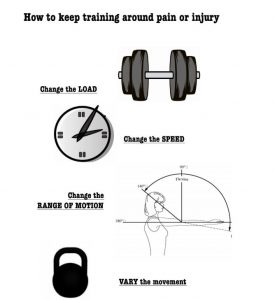
First… reduce the weight
- Try using a lighter weight, but continue the movement as prescribed.
- If the reps continue to be painful…
Next… slow it down
- Keep the weight and try using performing the movement slowly.
- If the reps continue to be painful…
Next… change the range of motion
- Keep the weight, return to a normal speed and limit how far you go into the movement being performed.
Finally… vary the movement
- There are various ways to perform different exercises.
- You can continue to get the same training effect while performing the movement in a slightly different way.
Here are a few examples of how you can vary the workout if you are experiencing pain during specific movements:
Knee pain with squatting?
- Reduce the load
- Alter the tempo – 3 seconds down, 3 seconds up
- Reduce the range of motion – Squat to a box or a bench
- Change the movement – go from front squats or goblet squats to a back squat
Back pain with deadlifting?
- Reduce the load
- Alter the tempo – try a quick lift from the floor and a slow lower
- Reduce the range of motion – Lift from an elevated surface (blocks or plates)
- Change the movement – go from a barbell to a hex bar or kettlebell
Use this to help keep yourself training, but PLEASE… also seek medical advice. There are many other things to be done in order to get you back to being pain-free during workouts… most of the time, it’s more exercise! Not rest.
