
by Pippa Teague, Strength Coach | Jul 15, 2019 | Conditioning, Exercise advice, Fasttwitch, fiber, Personal training, strength training, Uncategorized
Pippa Teague NASM CPT, WS
Infinite Potential Strength Coach
If you participate in a sport that requires quick fast movements such as jumping, quick change of directions, sprinting, leaping, throwing etc you will need to spend some of your training time focusing on the development of your fast twitch muscle fibers.
There are generally two types of muscle fiber – type I – slow twitch and type II-fast twitch. Fast twitch can further be broken down into type IIa and type IIb. Genetics play a role in which muscle fibers you have more of but training in a certain way can make these different types more efficient.
Slow twitch muscle fibers use oxygen and can go for a long time without tiring- think long distance runners. Fast twitch muscle fibers use anaerobic energy and are better at creating shorter bursts of strength or speed e.g sprints, high jump etc.
Type IIa are more of a hybrid fiber in that they have characteristics of both slow and fast twitch fibers. Type IIb produces the highest rate and quickest speed of contraction but it fatigues much faster, so doesn’t last as long as the other two.
It is impossible change the quantity of muscle fibers in your body but you can train to become a more fast twitch athlete.
Here are a list of exercises that work those fast twitch muscle fibers. Include these in your training regime if you want to work that explosive power.
- box jumps
- power cleans
- snatches
- bench press
- agility drills-ladder, hurdles
- squats
- kettlebell swings
- air dyne sprints
- battle ropes
As well as training quick movements with lighter weights, don’t forget to work on the strength of those large power muscles- quads, glutes, hamstrings. Larger muscles and strength will also help recruit those fast twitch fibers…….do your squats!

by Pippa Teague, Strength Coach | Jun 28, 2019 | Conditioning, Exercise advice, Personal training, strength training, Uncategorized
By Jenny Gusella
Certified Personal Trainer, @jennykgoose
There are tons of great ways to stay in shape, whether you go it alone creating your own workouts or watching online videos, take a group fitness class, or work one-on-one with a personal trainer. Personal training is among the more foolproof ways to reach your goals because of the individualized attention and accountability it provides, but is it the right choice for you? The following guidelines will help you decide if you’re on the fence.
- Is fitness a priority for you? We are all busy. Even the most dedicated fitness fanatic will have times where staying in shape slips on their priority list. Take a moment to weigh how important your fitness goals are to you, and if you think you’re willing to regularly fit workouts into your schedule (and budget!) then hiring a personal trainer could be something to consider.
- Do you have a semi-regular schedule? The advantage of group classes is that they take place with or without you, so it’s easy to pop in whenever you have a free hour. Personal training will be more structured. If you know your schedule will be somewhat regular, allowing you to meet at least weekly, then personal training may be a good option.
- Are you unsure of your form or have a history of injury? For those with little to no past gym experience it can be intimidating and overwhelming to join a group fitness class. It’s more difficult to get one-on-one attention in a larger group, and you may find that you feel like you can’t take full advantage of the workout because you’re feeling a little lost on how to perform the exercises. Personal training is a surefire way to brush up on your form, learn what weights you are capable of using, and also learn about ways to strengthen up any muscular weaknesses you have. This is perhaps the biggest advantage of personal training.
If you answered yes to one or more of the questions above, maybe personal training is the way to go. No matter what your situation, if you are considering hiring a personal trainer the easiest thing to do would be to set up a meeting to talk about your goals, schedule and history, and see if you align well with that trainer. Just like any relationship, you’ll click better with some trainers than others and it may take a bit of searching to find someone right for you.
by Pippa Teague, Strength Coach | Jun 25, 2019 | Brain health, Conditioning, Exercise advice, lifts, Pushups, Running, squats, strength training, Uncategorized
By Kerry Moynihan
Certified Personal Trainer
Fit 4 Life After 50
Visualize this: You walk into a room. You are on the hunt… on the hunt for your glasses. You search high. You search low. They are on the top of your head.
Next scenario: You open the fridge with purpose: “What in the name of all that is holy was I looking for? Wait, wait…it will come to me!”
Sound familiar? Happens to the best of us.
Our lives are chock full of responsibility- work, children, parents, household. We are juggling it all. Why wouldn’t brain fog be a byproduct?! Why don’t we practice self care by exercising body and brain to make our everyday tasks more manageable? Medical evidence substantiates the fact that we should!
It goes without saying that regular exercise builds muscle, improves metabolism, and maintains bone health. It improves mood, encourages better sleep, and puts us on the path to better physical health.
Beyond that, a study out of the University of British Columbia cites that CONSISTENT AEROBIC exercise boosts the hippocampus. That’s the part of our miraculous brain that involves memory and learning. Their recommendation: 120 – 150 minutes of moderate exercise weekly. That’s exercise that gets your heart pumping and your sweat on. Power walk, dance, stair climb, swim – do whatever fuels your aerobic passion to keep you on that consistent path. And with any new routine, play it safe and check in with your health care professional prior to beginning.
Our brains are beautiful and complex. According to this study, the brain benefits of exercise are directly related to reduced inflammation, reduced insulin resistance and the release of chemicals in the brain that encourage the health of brain cells.
It’s a “no brainer.” Exercise is where it’s at for life-long body and brain health.
by Pippa Teague, Strength Coach | Jun 20, 2019 | Conditioning, Exercise advice, Injury Prevention, strength training, Uncategorized
Pippa Teague
IPPTW strength coach, NASM CPT
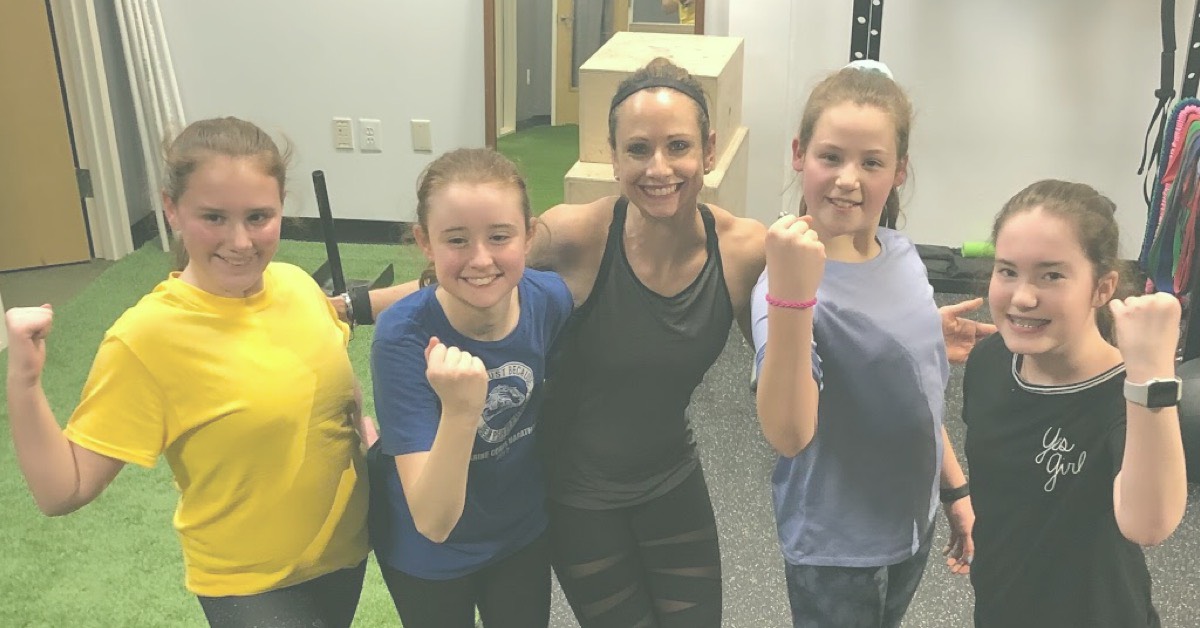
I’ve been working with kids now for over 15 years, mostly as a figure skating coach but most recently as a personal trainer/ strength coach for both specific sport performance gains and also general health gains.
I love seeing how the improvements translate from off the ice to on the ice.
For young athletes who want to excel in their chosen sport, some form of strength and conditioning is essential and specific needs can be met with a personal trainer to zone in on areas that they are struggling or need to improve on.
As well as improving specific sports performance implementing some form of strength and conditioning at a young age will help the following:
- Builds healthy, strong bones and muscles (which in turn will prevent injuries down the line).
- Encourages a healthy lifestyle and educates them to continue to live this way into their adulthood
- Better nutrition and exercise decreases the chance of having to deal with obesity and diabetes in later years
- Reduces stress and releases endorphins (the happy hormone)
- Gives them a sense of achievement and confidence decreasing depression
Strength and conditioning doesn’t have to be going to the gym and lifting weights unless you have sport specific needs or goals. Getting kids to workout out can be as easy as going for a bike ride, exploring a hiking trail, visiting a local rock climbing place, playing back yard games, swimming etc and the list goes on.
The more they enjoy what they are doing and the people they do it with they will “work” hard!
Working with kids definitely keeps me on my toes but it’s definitely my favorite clientele to work with
![5 Misconceptions Surrounding Low Back Pain]()
by Pippa Teague, Strength Coach | Jun 10, 2019 | Back Pain, Exercise advice, Injury, Injury Prevention, lifts, squats, strength training, Uncategorized, working with injury

By Loni Rodriguez DPT
Low back pain is an extremely common condition that many people are faced with on a daily basis and the incidence is climbing. From 1996 to 2006, the number of people who experienced low back pain increased from 3.9% to 10.2%. Recent research has also shown that up to 33% of individuals who have experienced low back pain experience it again within one year.
How can this be?
There have been significant advancements in medical technology including improved surgical procedures, imaging techniques, and medications. With these advancements, however, the incidence of low back pain continues to increase.
What are we doing wrong?!
One main underlying issue is the misconceptions surrounding the topic of low back pain. These misconceptions can lead to poor treatment outcomes, fear of movement, incorrect diagnoses, and worsening symptoms. The discussion today will help debunk some of these misconceptions and will better educate YOU on this low back pain epidemic.
Misconception #1: My back hurts, I should rest.
I don’t recommend anyone take complete rest from their activity. In every case of low back pain, there are specific activity modification recommendations that can be made. I will never tell someone to completely rest!
These modifications are specific to each person – it is recommended that you seek medical advice to find out what the right path is when you are dealing with pain.
Not convinced? Let’s hear Roy’s Story
Misconception #2: I should not lift weights because it is bad for my back.
One of the most effective ways to treat low back pain is strength training. Strength training creates full body resiliency. The most beneficial weight training exercises involved in low back pain rehabilitation programming include squatting, deadlifting, carrying, pressing, and pulling. All of these exercises help strengthen the muscles throughout the entire body including the lower back, which help to decrease pain and improve activity tolerance. Just like the previous recommendation, if you have low back pain do not think that jumping into these exercises without supervision is a good idea. Seek advice from a trusted professional!
Misconception #3: My back pain is from the chair I sit in at work.
Most of the time, back pain and the type of chair you sit in do not correlate. In some cases, the amount of time sitting and the lack of time spent up and moving are bigger contributors to symptoms. As stated before, movement is medicine, especially in the case of low back pain – when in doubt, just get up and move as frequently as you can.
Misconception #4: My back is stiff, I probably should be stretching more.
A stiff back does not always mean that it has to be stretched. A lot to times, stiffness is a perception of being tight and it is your body’s way of telling you that it needs some attention. Low back stiffness can be helped with frequent, active movement, versus stationary, passive stretching. This type of stretching does serve a purpose, but is not the most effective way of helping your stiff back. Here is a quick video to a great routine that you can perform on your own to “loosen” your lower back!
Misconception #5: I know where my pain is coming from, I have a disc herniation.
Disc herniations are not proven to be the cause of back pain. In most cases, disc herniations are not causing the symptoms. Especially when the pain has been going on for a while. This condition can be considered part of the normal aging process! The percentage of people with disc herniations increases with age and most of the people with herniations do not have pain! Please quit blaming your pain on a condition that can be considered the gray hair of the spine.
If you would like more information on back pain, or any pain for that matter, please visit www.infinitepotentialptw.com. On this website there is a plethora of free information and content, as well as a forum to ask questions.
References
Delitto et al. “Clinical Practice Guidelines linked to the international classification of functioning, disability, and health from the orthopedic section of the American Physical Therapy Association”. J Orthop Phys Ther. 2012;42(4):A1-A57
by Pippa Teague, Strength Coach | Jun 3, 2019 | Exercise advice, lifts, strength training, Uncategorized
By Jenny Gusella
Certified Personal Trainer, @jennykgoose
If you’re looking for a way to switch up your fitness routine, you may not need any new equipment, or even any new moves — the key to unlocking new strength gains could be in the speed in which you perform the very same exercises. Slowing down your movement during the eccentric portion of the move can dramatically increase the intensity, leading to a tougher sweat session.
First, let’s talk about eccentric vs. concentric movement. The eccentric portion of any movement can be thought of as the “lowering” motion, i.e. lowering down into your squat or lunge, lowering the weights downward in a bicep curl, or lowering the weights toward the ground in a bent over row. The concentric portion of the movement is the “upward” motion. So, any time you slow down the eccentric portion of the movement, you are essentially slowing the weight (or yourself) on the descent to the ground. And, as it turns out, fighting gravity is hard work!

(Image: SportsScience.co)
How do you get started putting eccentric work into your fitness routine? Try changing the tempo of just 1 of your exercises for the day. Doing eccentric work may leave you feeling extra sore the next day, so it’s important to start with a small volume of work, and then you could always expand from there.
Eccentric work is helpful not only to gain strength, but it’s also a great way to train if you are short on equipment. A 45 pound kettlebell may not seem very challenging for ten goblet squats, but if you slow the eccentric part of those squats down to three seconds per rep, that kettlebell is suddenly going to feel a lot heavier!
In short: slowing things down is a quick way to make easy moves harder.
Happy lifting!
