by Pippa Teague, Strength Coach | Nov 11, 2019 | Abdominals, Conditioning, Exercise advice, Personal training, Pushups, Recovery, Running, Shoulders, stool, strength training, Telehealth, Uncategorized, youthtraining
The push up is a very effective body weight movement and one that requires practice to master!
Here is my advice on how to get a push up!
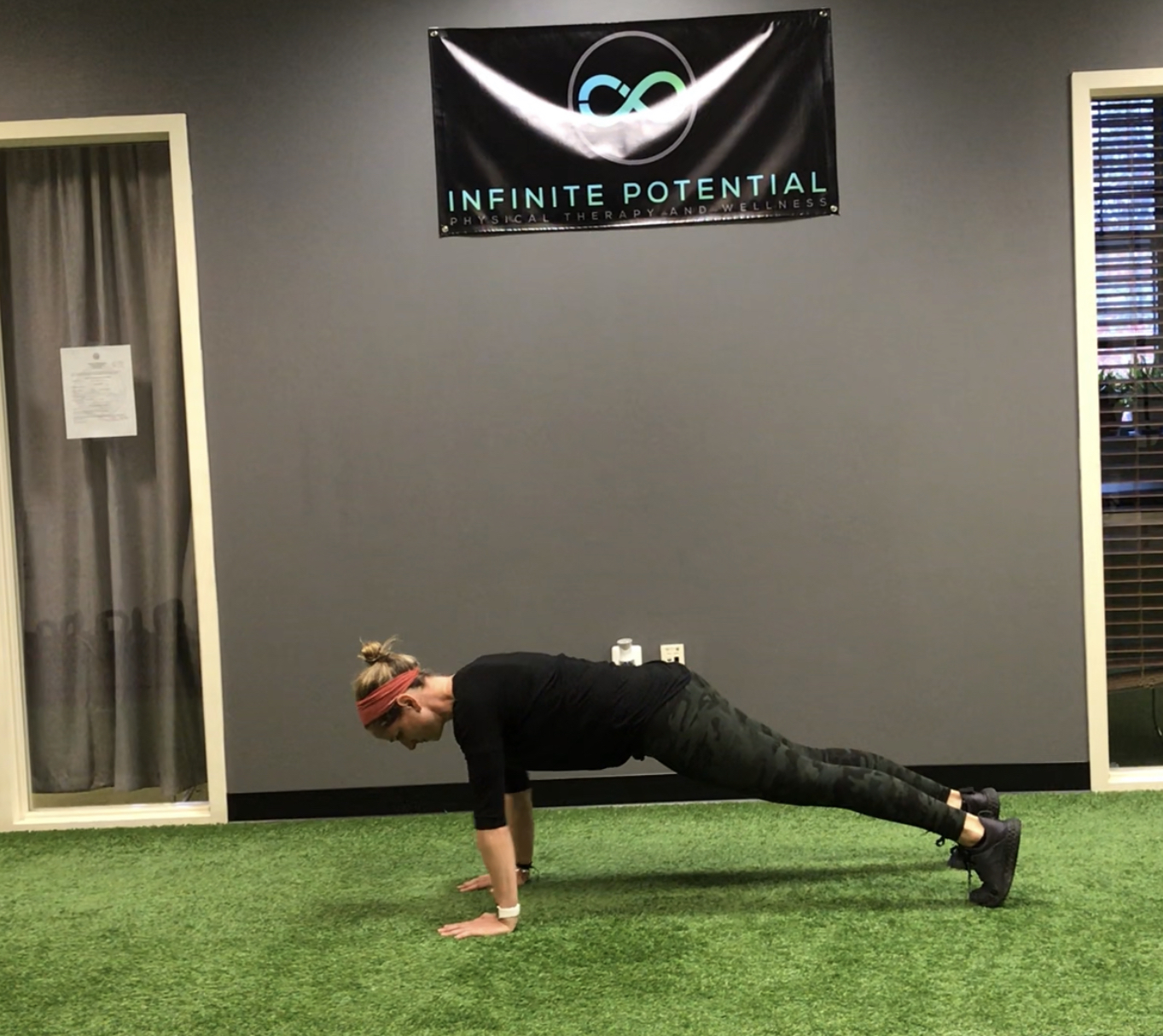
First of all you need to be comfortable in a plank position, so get this position down and aim to hold for 20-30 seconds. Plank from the hands first and then forearms (which is a little more difficult).
Push up descent
Push up to a box (incline)
Next up you can try a push up to a box. Step away from the box and get into a plank position with hands on the box. Slowly lower yourself down maintaining the straight body plank position until your chest makes contact with the box. From here, squeeze and engage the core muscles and push back up to the plank position. Repeat 8-10 reps for 3 sets
Once you have mastered the push-up decline and the push up incline to a box you can move forward to the next steps.
Push up from the knees
Starting on your knees with your hands directly below your shoulders bend the elbows maintaining a straight body position, lowering slowly until your chest touches the floor. Contract your core and press your body back up.
repeat 5-8 reps for 3 sets
When you feel comfortable doing this from the knees you can try your first full push-up!
This time from a high plank position lower yourself to the floor, keeping your elbows tucked in to your side. Contract your core muscles by pulling your belly button to your spine and will pressure through your palms press yourself back up to the high plank position maintaining the straight body position throughout.
![Making It As A Marine: Fitness Is A Must]()
by Pippa Teague, Strength Coach | Aug 26, 2019 | Exercise advice, Marines, Military training, Personal training, Pushups, Running, squats, strength training, Uncategorized
By Kerry Moynihan
Our United States Marine Corps is consistently challenged with both physical fitness and combat fitness testing throughout their careers. It’s through this sustained physical effort that our Country’s Marines maintain peak combat ready shape.
What is the difference between the Combat Fitness Test (CFT) and Physical Fitness Test (PFT)? Great question and one that I posed to my son, PFC Pat O’Hearne, who recently graduated from USMC Recruit Training at Parris Island, SC. Here’s the 4-1-1.
PFT: attire is shorts, t shirt and sneakers (go-fasters in Marine parlance).

In order to be a Marine at all you must pass an initial strength test. This ensures that you are fit enough to even begin recruit training. The understanding is that you will improve greatly from here. Basic standards: 2 unassisted pull-ups, 44 crunches in 2 minutes and a mile and a half run in under 13:30.
Over the course of 13 weeks of boot camp, fitness sessions are designed to improve those initial numbers. Body weight training is predominant in a timed, circuit style format. Circuit: pull-ups, inverted crunches, knee tucks, inverted push-ups, pull-up burpees, box jumps, tricep dips, 40 lb. ammo can lifts (push press), back extensions, lunges and squats. All at max effort, 2 minutes per station.
Speed Training: 40 yard wind sprints 8 to 10 times.
Throughout the duration of basic training there are 5 total long distance hikes with weighted packs for endurance. Hikes range from 3 to 12 miles with a final 15 mile hike prior to graduation hoisting an 80lb pack.
The final PFT prior to graduation requires a MINIMUM of 3 unassisted pull ups, 50 crunches, and 3 mile run in 28 minutes.
CFT: Max effort in boots, camo pants and t-shirt.
There are 3 events for Combat Fitness which are all specific to warfare.
1) 880m Sprint: (2 laps around the track) with the goal of completing it as quickly as possible. Max time 3:48.
2) Ammo Can Lift: 30lb can lifted at a minimum 45 times in two minutes.
3) Maneuver Under Fire: A timed event. This is a 300 yard shuttle run with combat related exercises. Here’s the format: a ten yard low crawl, 10 yard high crawl, zigzag run to the end where your partner must be lifted and dragged 10 yards, drop him and fireman carry him back to the starting point. After unloading your partner you lift two 30lb each ammo cans, run straight for 20 yards, zigzag for 30 yards, drop the ammo cans, lift a grenade (lacrosse ball in training) throw it into the “square zone” 15 yards away, drop for 5 push-ups, raise the ammo cans again and zigzag sprint for 30 yards and then sprint in a straight line for the final 20 yards to the finish. All must be completed in a max time of 3:29. 2:04 is considered a perfect score.
Every Marine, regardless of age, is annually tested with the PFT and CFT. As one ages, the standard times and numbers required do adjust but are equally challenging. We can rest assured that our USMC is continuously physically and mentally prepared for work on our behalf. I, for one, am eternally grateful.
by Pippa Teague, Strength Coach | Jun 25, 2019 | Brain health, Conditioning, Exercise advice, lifts, Pushups, Running, squats, strength training, Uncategorized
By Kerry Moynihan
Certified Personal Trainer
Fit 4 Life After 50
Visualize this: You walk into a room. You are on the hunt… on the hunt for your glasses. You search high. You search low. They are on the top of your head.
Next scenario: You open the fridge with purpose: “What in the name of all that is holy was I looking for? Wait, wait…it will come to me!”
Sound familiar? Happens to the best of us.
Our lives are chock full of responsibility- work, children, parents, household. We are juggling it all. Why wouldn’t brain fog be a byproduct?! Why don’t we practice self care by exercising body and brain to make our everyday tasks more manageable? Medical evidence substantiates the fact that we should!
It goes without saying that regular exercise builds muscle, improves metabolism, and maintains bone health. It improves mood, encourages better sleep, and puts us on the path to better physical health.
Beyond that, a study out of the University of British Columbia cites that CONSISTENT AEROBIC exercise boosts the hippocampus. That’s the part of our miraculous brain that involves memory and learning. Their recommendation: 120 – 150 minutes of moderate exercise weekly. That’s exercise that gets your heart pumping and your sweat on. Power walk, dance, stair climb, swim – do whatever fuels your aerobic passion to keep you on that consistent path. And with any new routine, play it safe and check in with your health care professional prior to beginning.
Our brains are beautiful and complex. According to this study, the brain benefits of exercise are directly related to reduced inflammation, reduced insulin resistance and the release of chemicals in the brain that encourage the health of brain cells.
It’s a “no brainer.” Exercise is where it’s at for life-long body and brain health.

by Pippa Teague, Strength Coach | Apr 30, 2019 | Exercise advice, Pushups, strength training, Uncategorized
By Jenny Gusella, ACE, CFSC, Personal Trainer and Orangetheroy Fitness Coach
Push-ups are a staple of any workout program from youth to adulthood. You don’t need any equipment, you can do them anywhere, and they are easy to modify them to make them simpler as well as more advanced. However, according to anecdotal evidence I’ve gathered from my clients, push-ups are among the more dreaded of the exercises we do. Reasons range from “I’ve just never been able to do them” to “I feel so weak, I can’t even do one” to “Can’t I just do them from my knees?”
Usually, in life, when a situation isn’t going the way we want, we make an effort to fix it. We aim to improve our situation so we can move on and be happier. If you are someone who dreads push-ups, we can fix your situation, and, if you progress properly, it will feel empowering, not defeating.
Why fix it? First of all, it’s one of the best bang-for-your-buck exercises out there, working your chest, arms, core and even your legs all at once – if you have it in your arsenal, you open up opportunity for greater strength gains. Second of all, push-ups are revealing themselves to be a great indicator of cardiovascular health. A recent study published in the JAMA Network open found that men who could do more push-ups were less likely to experience cardiovascular issues, with those who could do 40 or more seeing the greatest risk reduction. That’s not to say if you just get good at push-ups your heart will become healthy, but practicing some push-ups and seeing where you need improvement may inspire you to pick up a more complete fitness routine (including push-ups, of course!) which will ultimately lead to a healthier heart.
Now, let’s meet you where you’re at to determine how to tackle these push-ups! Find which statement below applies to you, start there, then work your way down as you get more proficient. When you practice push-ups, try to aim for 3 sets of around 8-12 reps.
1. “I cannot hold the top of a push-up” If you can’t hold a high plank (from your hands) then you will not yet be able to perform a push-up, so let’s start there. Try holding a plank for 10 seconds. Make sure your wrists are right under your shoulders, your back is flat enough to hold a mug of coffee on top, and your butt isn’t way up in the air. Increase your plank hold by 5 seconds every few days. By the time you can hold a plank for 30 straight seconds, you’re ready to move on.
2. “I cannot do 1 full push-up” Let’s start by elevating your hands. Find something like a bureau, set yourself up in a plank position with your hands on the edge, and perform a push-up with your chest coming all the way to touch the bureau. Was that easy? Then find a lower piece of furniture, maybe your dining room table, or a coffee table. The lower your hands are, the more difficult the push-up will be. Once you find an elevation that’s challenging for about 8-10 reps (but you can complete it) then find a lower piece of furniture!
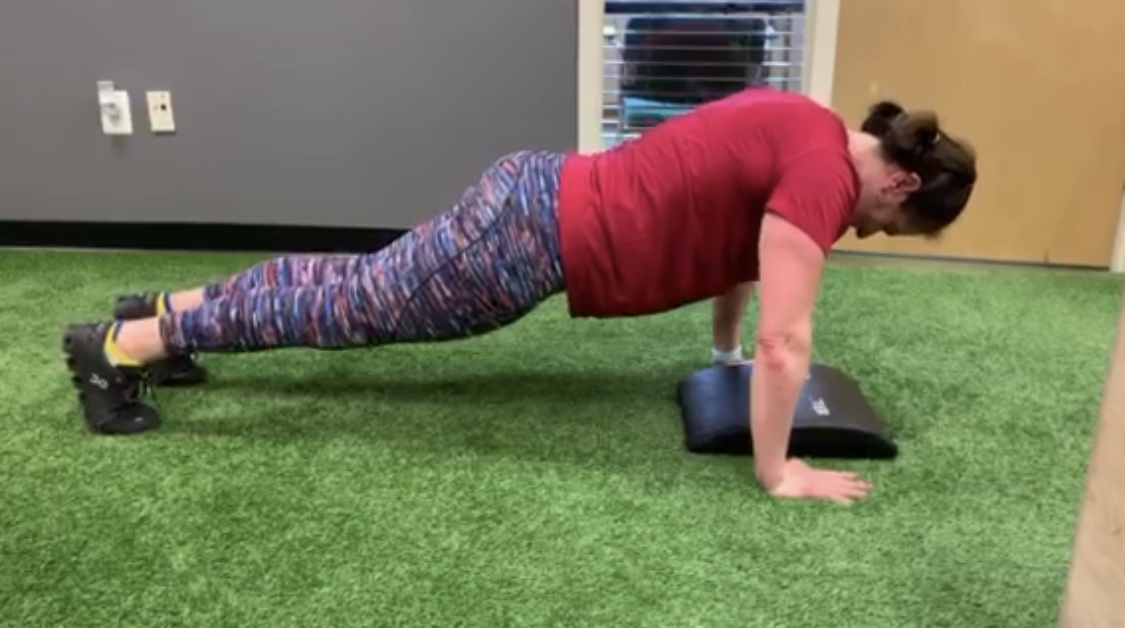
3. “I can do a couple but my form really falls apart” Let’s go back to basics. A perfect push-up should start as a perfect plank, then when you lower down, your chest and your hips lower at the exact same rate, and your elbows stay tucked in at least 45 degrees to your body. Keep your eyes looking a few inches in front of you so your head doesn’t drop. Your chest should be able to touch a small pad on the ground below you. Practice doing as many perfect ones as you can, and then do the rest of your push-ups back at step 2 with your hands elevated.
4. “I’m happy with how many push-ups I can do” That’s great! Some fun ways to make them more challenging could be: slow down the tempo, lower to the count of “3…2…1”. Elevate your feet, make sure to stay in that perfect plank. When you push up, jump your hands up into the air. Or try doing push-ups on just 1 foot.
Last step: add some fun music to your routine! Might I suggest “Push It” by Salt-n-
