by Dr. Loni Rodriguez | Nov 25, 2019 | Personal training
By: Kerry Moynihan, Certified Personal Trainer
Fit4LifeAfter50.com
It’s that holiday gift giving time of year. Be a super Santa in your fitness fan’s life by placing something special under the tree. Here are some at home equipment ideas for your Christmas shopping list:
- TRX HOME2 SYSTEM: $169.95
Suspension trainers allow you to use your own body weight to build muscle and strength. The TRX system (Total Resistance eXercise) is at the top of the market. Your at-home system can be suspended in the door frame for a convenient and mobile workout.
- AB DOLLY: $79.99
The Ab Dolly roller system builds core galore. Exercises range from upper body rollouts to lower body knee pulls – allowing you to target all major muscle groups. It isn’t nicknamed “Satan’s Skateboard” for no reason. Ab Dolly exercises are challenging and effective.
- RESISTANCE BANDS: $10.00
These loopy latex bands are effective, stretchy, portable and perfect for stocking stuffing. They can be used for a range of exercises from glute & hip activation to shoulder, arm and back work. If your fitness fan is a traveler, these are the pick – easily packable.
- FOAM ROLLER: $14.99
Foam rollers aid with muscle stiffness and loosen muscular knots. Perfect gift for those plagued by post-exercise soreness. Rolling improves range of motion and helps with muscle fatigue. This is sure to be a fan favorite.
- EXERCISE BALL/YOGA BALL: $19.88
This uber durable elastic ball comes with a pump to blow it up to approximately 30 inches. It’s major benefit is that due to its instability, it recruits more muscle, allowing for super efficient, effective and challenging exercises like: push-ups, wall squats, crunches, roll-outs, to name just a few. Plus, the color options make this a festive and fun gift.
- BOMBAS PERFORMANCE SOCKS: $15.00 +
Like working out on a cloud! Bombas use the softest of yarns to create comfortable, cozy, anti-microbial and moisture-wicking socks. Added to that, the Bombas company believes in a “one purchased – one donated” philosophy. So far over 25 million clothing items have been donated to homeless shelters and organizations thanks to Bombas customers and the Company’s sense of community. That’s a seasonal win/win.
Wishing you a wonderful season of family, friends, fun and fitness! 🎁
by Pippa Teague, Strength Coach | Nov 11, 2019 | Abdominals, Conditioning, Exercise advice, Personal training, Pushups, Recovery, Running, Shoulders, stool, strength training, Telehealth, Uncategorized, youthtraining
The push up is a very effective body weight movement and one that requires practice to master!
Here is my advice on how to get a push up!
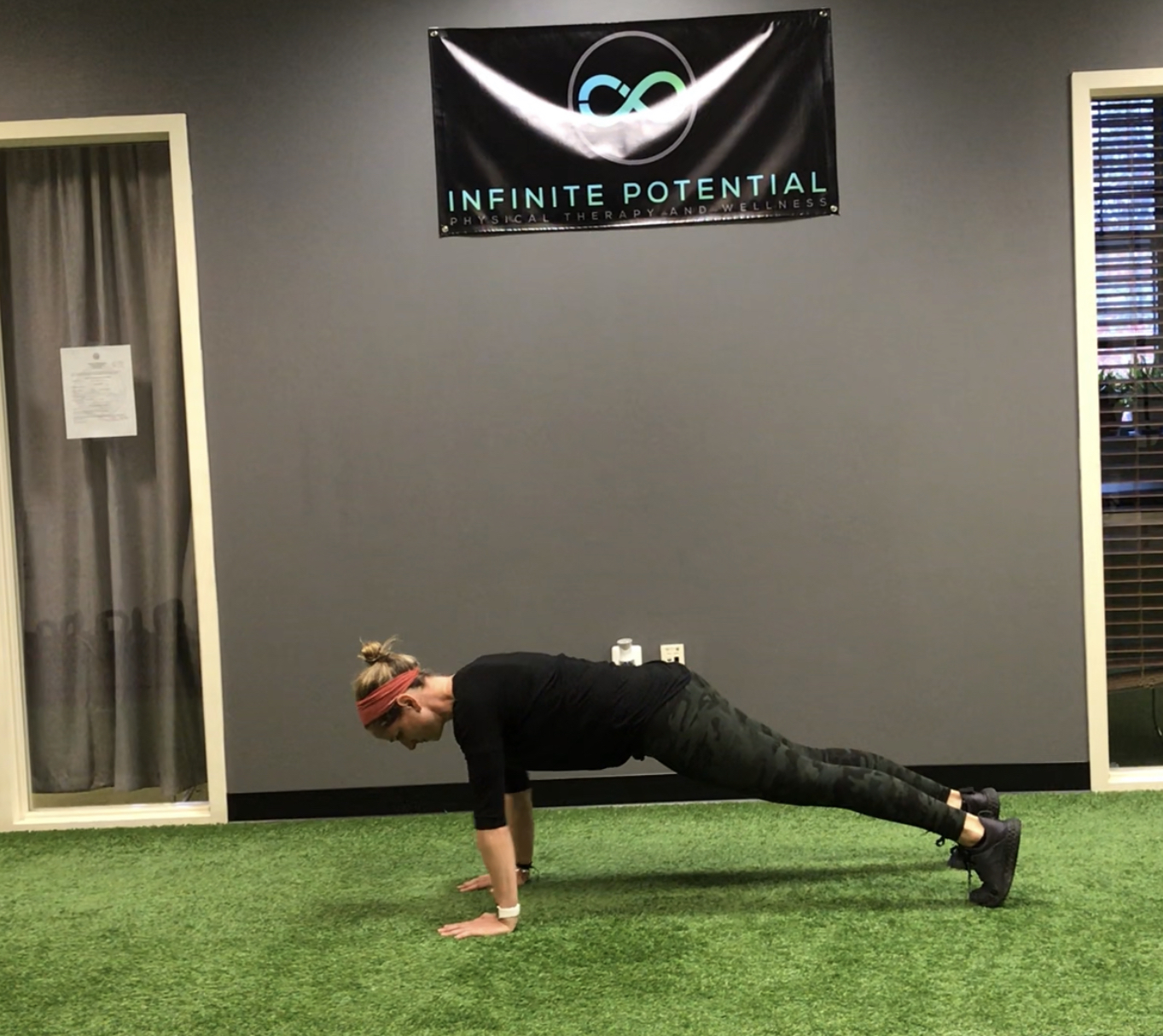
First of all you need to be comfortable in a plank position, so get this position down and aim to hold for 20-30 seconds. Plank from the hands first and then forearms (which is a little more difficult).
Push up descent
Push up to a box (incline)
Next up you can try a push up to a box. Step away from the box and get into a plank position with hands on the box. Slowly lower yourself down maintaining the straight body plank position until your chest makes contact with the box. From here, squeeze and engage the core muscles and push back up to the plank position. Repeat 8-10 reps for 3 sets
Once you have mastered the push-up decline and the push up incline to a box you can move forward to the next steps.
Push up from the knees
Starting on your knees with your hands directly below your shoulders bend the elbows maintaining a straight body position, lowering slowly until your chest touches the floor. Contract your core and press your body back up.
repeat 5-8 reps for 3 sets
When you feel comfortable doing this from the knees you can try your first full push-up!
This time from a high plank position lower yourself to the floor, keeping your elbows tucked in to your side. Contract your core muscles by pulling your belly button to your spine and will pressure through your palms press yourself back up to the high plank position maintaining the straight body position throughout.

by Pippa Teague, Strength Coach | Oct 14, 2019 | Back Pain, Exercise advice, Injury, Injury Prevention, Personal training, Recovery, strength training, Uncategorized
By Loni Rodriguez, DPT
Having an animal in pain is really scary.
They can’t talk, they can’t tell you what makes it hurt, how severe it is, how it makes them feel, or what makes them feel better.
You can’t ask questions like, “Does eating make the pain worse?”
Or… “Has this been going on for a long time, you just haven’t done anything about it?”
You must rely on watching their body language and for signs of distress. But man, to base your plan of attack on a dogs sign of pain is really challenging.
It is hard because when you see these said signs (shivering, whimpering, panting), you want to try not to freak out and run to the emergency room. Sometimes, things like this just go away on their own. Also, everyone knows how expensive the vet can be and you are 110% at their mercy which means you have to have a trusted source for care.
Gracie (our 5 year-old Long-haired Dachshund) had suddenly began to show signs of distress one day. The signs would fluctuate, but she just was not herself and we made the decision to take her to the vet. After some blood testing and ruling out the real serious things, she was diagnosed with lower back pain. Now, Dachshunds are known for back issues because of their bodies, but she’s 5 years-old! She does love to play, jump and run but has had no prior history of this…
The vet’s treatment plan was high-dose anti-inflammatory medications and ‘crate’-rest for 2 weeks. I asked about physical therapy, I knew that “doggy” chiropractors existed but they didn’t have any resources for us. Nevertheless, we took the docs recommended plan and headed home. Mommy went into PT-mode.
I texted and messaged Instagram friends all over the country to see who knew what I could do for my dog with low back pain. Soon enough, responses poured in and I was in contact with one of the best animal chiropractors! (Social media is WILD). We spoke briefly on the phone and not to my surprise, the vet’s recommendations were pretty poor and she explained that it was a very ancient school of thought. I needed to find myself a local chiropractor for my pup…
A few days went by, Gracie was looking a bit better but still was well below 100%. She was not really eating, not wanting to leave her crate very much (even though that is what was recommended, I left the crate door open). She really was just feeling like crap. During this time, we also have Mr. Tucker (our other pup) right by her side cleaning her ears, eyes and mouth like a caring little bro – the CUTEST thing ever.

A few more days went by, still not looking up for our furry baby. One morning I woke up to get ready to go to OrangeTheory and took Gracie out to pee. She seemed like she had a little pep in her step without showing signs of distress so I was happy. That was until I took her outside and she stumbled and fell over on her hind legs while going to the bathroom. Her back legs were not working normally! That was it, to the vet ER I went at 5:30 am. Even though I could tell she was not in as much pain, I needed to get her looked at.
After waiting patiently and going through with the evaluation with the ER doc, they cleared her for severe loss of function via some testing and diagnosed her with MILD disc herniation and recommended HIGHER-dose pain medication for 6 weeks and complete crate rest (for 6 more weeks).
WHAT?!
But she wasn’t in pain? She was actually happy and seeing some improvements? If you clear the big scary diagnoses and say the leg weakness is a sign of a mild disc herniation then why the 6 weeks of bed rest and super high does pain meds that will knock her out?!
Could ANY of this be similar to a human? (I asked, and they said sort of but not really…) They said that if I did not follow these recommendations, I could be looking at severe negative effects and possibly needing surgery…
This seemed WAYYYY too close to some recommendations made to patients in the past who have made amazing strides without heavy meds, rest, or surgery.
Again, I reached out to the trusted chiro and she said PLEASE find a local doc. So… that is what I did. The SAME day that I brought her to the ER, she was seemingly better so I think she was gradually improving in regards to discomfort and pain, but her leg weakness and lack of coordination continued to be present. I absolutely wanted another opinion. I found a doctor of doggy chiropractic medicine that the other chiropractor approved of. We were seen for an appointment and all of my worries and thoughts of having to rest and medicate her were gone. He agreed with some mild disc-related pain, but explained that dogs are self-limiting. They will do as much activity as their bodies can handle. Yes, I needed to keep her from jumping, playing hard with her brother and limit how MUCH play… but to let her play and be normal. He did some gentle work on her and off we went.
Movement was medicine and she is now close to 100% after about a week.

Now… what did I learn from this experience?
It is really hard to trust ANYONE when your loved one is going through pain. You want what is best, but are not sure who’s recommendations to follow.
I need to continue to be very mindful of how I approach education and treatment recommendations for my clients. I found myself reflecting on how I have approached recommendations to patients. I am confident in what I tell people to do, but they HAVE to be confident themselves before they will follow what I have recommended. Even though I really did trust the original “virtual” chiropractor, I was faced with significantly different conflicting recommendations by an ER doctor… I am SO glad that I did not follow the original recommendations.
Find a medical professional that you trust. Find that medical provider that you really feel has your best interest in mind, has the resources to allow you to make your OWN informed decision on how you would like to proceed, AND has enough humility to admit when they may not know exactly what to recommend, but know someone who can help.
If this story resonated with you, please let us know leave a comment below or shoot us an email. If you are a current client and see Gracie in the office on the regular, give her a hug! She is a happy pup who loves attention.
Looking for the doggy chiropractor? Get in touch and I’m happy to share 🙂

by Pippa Teague, Strength Coach | Oct 10, 2019 | Abdominals, Conditioning, Exercise advice, Injury Prevention, knee pain, Ladies, lifts, Personal training, Recovery, strength training, Uncategorized, working with injury, youthtraining
Lunges are a great unilateral movement to work not only the muscles involved but also work balance and stability.
They can be done with little space required
-difficulty can be added by including weight- kettlebell or dumbbells
Here are some lunge variations:
The reverse lunge
- start with the feet hip width apart and facing forwards
- with your back remaining straight take one foot backwards, allowing both knees to bend as the back knee touches the ground lightly
- push off the back foot keeping the front foot firmly planted
- drive through the heel and return the leg beside the other
Repeat on the other side
this works the glutes, quads and hamstrings and is also a great way to improve knee stability
Alt reverse lunge
Lateral Lunge
We often forget to move laterally. Lateral movement is great for stabilizing the hips and works your inner thigh and glutes.
- start with your feet together
- Step out wide to the side, transferring the weight over to the side you just stepped with, keeping both feet planted on the ground and facing forwards
- sit back into a squat position and go as low as you feel you are able to
- drive through your foot and return to the starting position
Repeat on the other side
Lateral lunges w/ kb
Static (split squat) Lunges
During this movement the feet remain in the same position (static)
This movement is great for those of us who are not so good with balance when moving and is the least challenging of all the lunges. Static lunges help build balance and strength from a stationary position.
Muscles worked are your thighs and glutes
- Start in a split stance- hip width apart with one leg in front of the other
- Lift onto the toes of your back foot and lower that knee down to the ground allowing the front knee to bend also to a 90 degree angle parallel to the ground
- Press through the heel of your front foot and straighten the legs back up.
- Keep your torso upright. Most of your weight should be felt through the front leg
Repeat 8-10 reps and then switch to the other leg
Split Squat w/ kb
Alternating jump lunges
Similar to the reverse lunge but with an element of power and plyometric transition with a jump from one lunge position to the other by switching feet in the air
This exercise challnges the same muscles as the regular reverse lunge but also adds a cardiovascular effect by increasing the heart rate and helps burn more calories.
tips to help your jumping lunge
- master the basic lunges first-reverse lunges and walking lunge
- aim for soft landings, avoid landing hard on your knee
- chest and torso stays upright
- be light on your feet and try to spring through the ball of your feet to gain some air time
- you can increase the difficulty by increasing reps, jumping higher and spending less time on the ground
Alt jump lunges
Try some lunges today and let us know how you get on!
Happy lunging !
by Pippa Teague, Strength Coach | Sep 30, 2019 | Conditioning, Exercise advice, Injury Prevention, Personal training, Recovery, Running, strength training, Uncategorized, youthtraining
by Pippa Teague
Infinite Potential Strength Coach
I would like to start off by giving the research credits to Barbell Medicine and their 3 part series has been summarized below.
Previously a lot of peoples beliefs surrounding youth and resistance training involved some of the following quotes and I still hear some of these coming up today:
“Resistance training stunts growth”
“Kids shouldn’t lift weights-it will damage their growth plates”
Well…both of these statements have been proven to be wrong and we have slowly shifted from that mindset.
Childhood is the time where we need to be focusing on building bone mass and structure by weight bearing activities!
It is ok for kids to weight train and resistance train-in fact, its GOOD for them!
Studies have shown these three important factors to resistance training as a youth
- Resistance training should be essential for aspiring athletes
- Participation early in life correlates to later life
- Those who don’t resistance train are at a higher risk of negative consequences
Developing those skills early in life is very important if we want to remain healthy and fit as we get older.
Today 10 year olds are participating in the same amount of exercise as 60 year olds!
We are failing at getting our youth to exercise the amount that has been recommended – 5-17 year olds should engage in 60 mins of moderate to vigorous activity/day! Only 40% are actually achieving this!
Here is a breakdown of some age ranges and examples of how to include resistance training int their exercise.
Ages 6-8 – FUNdamentals, game oriented exercise, coordination, balance, agility
Ages 10-13 (males ) 9-11 (females) – learning to train, plyometric and free weights with a variety of training
Adolescence 14-18 (males) 12-18 (females) training to train, sport specific plus other training, heavy and slow resistance training
Adulthood Ages 18+ – training to compete, sport specialty, resistance training still an integral part
One study found that strength training reduced injuries three fold over the course of 1 soccer season! It also improved cutting speed and jumping !
Another study looked at females in repetitive sport e.g. running, and found that those youth athletes were 3 times more likely to have a lower bone mineral density than females who did the repetitive sport but also were resistance training.
Resistance training is important not just for youth athletes but for growing children.
Longer programs elicit larger effects and it is important for youth athletes to maintain resistance training alongside their sport for optimal results!
Citation: ‘resistance training for youth part I and part II’
www.barbellmedicine.com

by Pippa Teague, Strength Coach | Sep 23, 2019 | Conditioning, Exercise advice, Personal training, strength training, Uncategorized
By Kerry Moynihan
Personal Trainer
It happens to the best of us. Once in awhile you lose that pep in your step on the way to the gym. The question then becomes, “How do I re-energize?” Try coordinating gym time with a good workout buddy. Exercise “dates” keep us accountable, getting us into the gym when motivation is on the slide.
Now that you’re there, that extra motivation can help you achieve those fitness goals. When you’re enjoying that fitness partnership it’s gratifying to go the extra mile, complete that extra rep, try that new machine, focus on that perfect form. Friendly competition ups that personal game.
It goes without saying that your ideal partner should be someone you enjoy spending time with. That will keep the commitment consistent. Also, he or she will ideally share a similar schedule to avoid those unfortunate last minute cancellations. Consistency is key. And what can be better than sharing spotting duties with a personal cheerleader.
Where to start? Ask your trainer or the gym fitness professional for an introduction to a fellow gym member who’s seeking some outside motivation, too. Or, reach out to friends. It’s a great way to catch up with people you’ve lost contact with when life gets a bit hectic. Lastly, have a fitness minded co-worker? You may have similar interests and schedules that would make buddying up the perfect match.
Exercise is important. It should also be enjoyed. An exercise partnership will get you out of that gym rut: challenging your mind, muscle and motivation.
