
by Dr. Loni Rodriguez | Mar 5, 2020 | Injury Prevention, Injury Prevention, knee pain, Pain Relief, Recovery, Running, strength training
Today we are highlighting Lily who has been with us since the Fall of 2019. Lily is a high school crew athlete who was dealing with knee pain that lead her to stop running at practice. The pain crept in seemly out of nowhere and she noticed that it just was not going to go away on it’s own.
“I have been doing crew since 6th Grade and really enjoyed rowing out on the water with my friends. When I joined the High School Crew Team in late August 2019 however, I noticed that my knees would begin to hurt during our warm-up runs and would then prevent me from participating in the other activities in practice. Due to the already existent pain, my knees would then begin to hurt when I was sitting down, often at school. This would prevent me from paying attention to my full abilities in class.”
She was impacted on a daily basis by her symptoms and was at a loss of what to do about it. Being a teen, she felt that she shouldn’t have to deal with pain like she was having.
“I had pain in my knees when I was walking up and down hills or stairs, running, jumping or any form of impact on my knees. I often found that my knee pain would flare up during the day at school.”
After the first session with Lily, I knew that I was working with an incredibly dedicated young lady. It isn’t uncommon for a young client to speak for themselves during the evaluation (versus their parent), but it is truly impressive when it does happen. Lily took the lead and consistently advocated for herself throughout her entire rehab. She was very diligent with her program and communicated with us between sessions like a mature adult.
“Before starting the treatment I did not think that there was any way that my pain and discomfort could be helped. I knew that, after talking to a Orthopaedic Surgeon, nothing could be done to directly treat the symptoms.”
I can’t say there wasn’t any eye rolling, big sighs or, “do we have to?!’s” during sessions, however, Lily worked hard, poured in a ton of effort and always did her best.
“Even though sometimes the treatment is difficult, after every session I feel stronger and my knees do not hurt nearly as much as they did only a few months ago.”
At this point, Lily is in her third and final rehabilitation phase. She has progressed to returned to running, she performs her strength routine at least 2 days per week on her own, and returns to our office for a monthly session to review and progress her home program.
“I can now run, with little to no pain for a relatively long period of time. The treatment has not only strengthened my leg and the other muscles surrounding my knees, but also my core and upper body. This has an incredible advantage when rowing and allows me to participate in all the practices and spend time with my friends and teamates.”
We asked Lily to tell us what others should know about seeking treatment at Infinite Potential PT.
“I believe that if you are prepared to work hard and persevere through the treatment plan that Lori gives you, which can sometimes feel like a challenge (especially when you have other commitments to your studies & crew team, and also want to spend time with friends and family!), you will definitely feel the benefits! Don’t give up – trust that you are strong enough, both physically and mentally, to succeed and become the best that you can!”
Thank you, Lily for your hard work! It was a pleasure to have gotten to know you and help you through this process.
by Pippa Teague, Strength Coach | Nov 11, 2019 | Abdominals, Conditioning, Exercise advice, Personal training, Pushups, Recovery, Running, Shoulders, stool, strength training, Telehealth, Uncategorized, youthtraining
The push up is a very effective body weight movement and one that requires practice to master!
Here is my advice on how to get a push up!
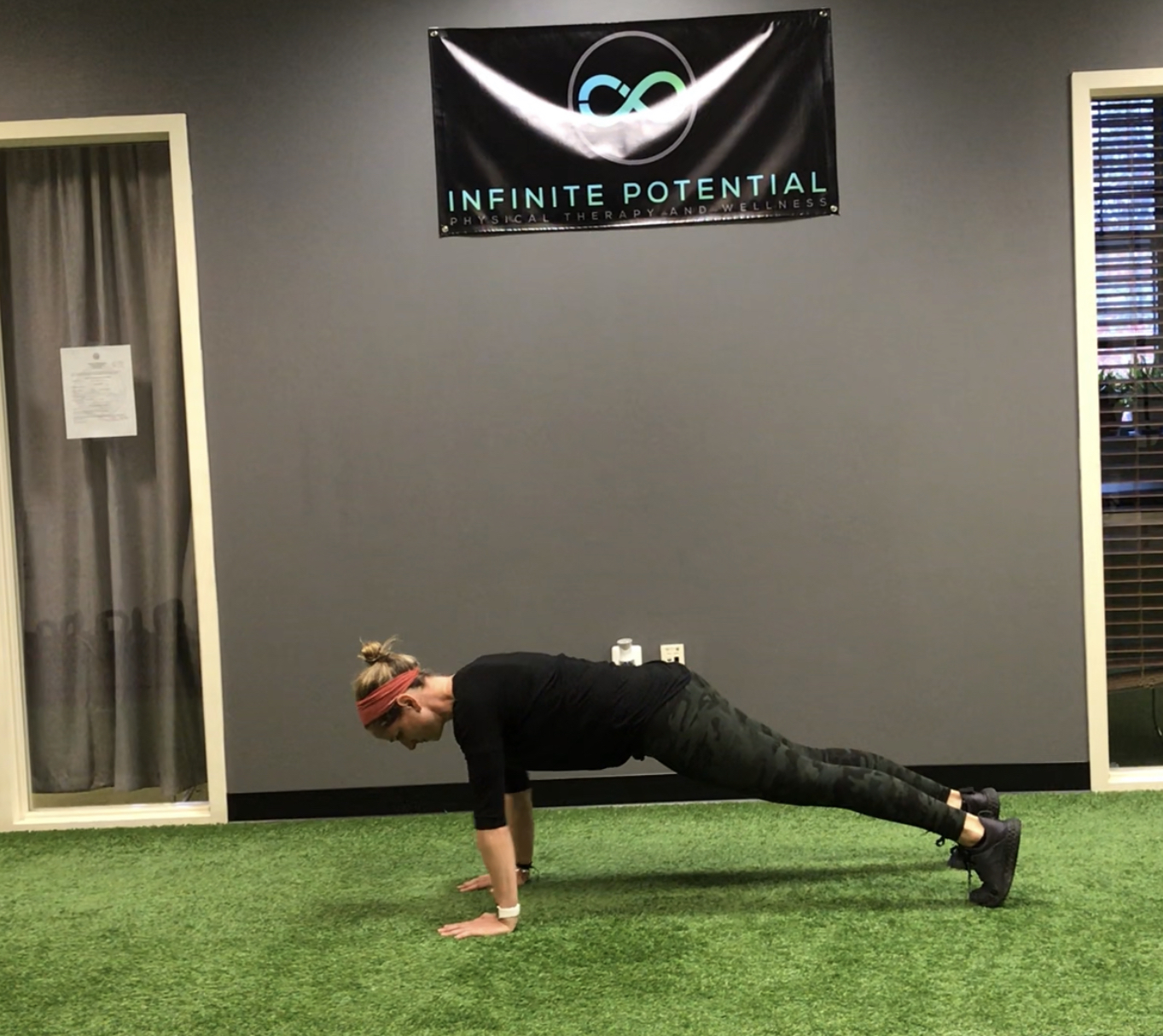
First of all you need to be comfortable in a plank position, so get this position down and aim to hold for 20-30 seconds. Plank from the hands first and then forearms (which is a little more difficult).
Push up descent
Push up to a box (incline)
Next up you can try a push up to a box. Step away from the box and get into a plank position with hands on the box. Slowly lower yourself down maintaining the straight body plank position until your chest makes contact with the box. From here, squeeze and engage the core muscles and push back up to the plank position. Repeat 8-10 reps for 3 sets
Once you have mastered the push-up decline and the push up incline to a box you can move forward to the next steps.
Push up from the knees
Starting on your knees with your hands directly below your shoulders bend the elbows maintaining a straight body position, lowering slowly until your chest touches the floor. Contract your core and press your body back up.
repeat 5-8 reps for 3 sets
When you feel comfortable doing this from the knees you can try your first full push-up!
This time from a high plank position lower yourself to the floor, keeping your elbows tucked in to your side. Contract your core muscles by pulling your belly button to your spine and will pressure through your palms press yourself back up to the high plank position maintaining the straight body position throughout.

by Pippa Teague, Strength Coach | Oct 14, 2019 | Back Pain, Exercise advice, Injury, Injury Prevention, Personal training, Recovery, strength training, Uncategorized
By Loni Rodriguez, DPT
Having an animal in pain is really scary.
They can’t talk, they can’t tell you what makes it hurt, how severe it is, how it makes them feel, or what makes them feel better.
You can’t ask questions like, “Does eating make the pain worse?”
Or… “Has this been going on for a long time, you just haven’t done anything about it?”
You must rely on watching their body language and for signs of distress. But man, to base your plan of attack on a dogs sign of pain is really challenging.
It is hard because when you see these said signs (shivering, whimpering, panting), you want to try not to freak out and run to the emergency room. Sometimes, things like this just go away on their own. Also, everyone knows how expensive the vet can be and you are 110% at their mercy which means you have to have a trusted source for care.
Gracie (our 5 year-old Long-haired Dachshund) had suddenly began to show signs of distress one day. The signs would fluctuate, but she just was not herself and we made the decision to take her to the vet. After some blood testing and ruling out the real serious things, she was diagnosed with lower back pain. Now, Dachshunds are known for back issues because of their bodies, but she’s 5 years-old! She does love to play, jump and run but has had no prior history of this…
The vet’s treatment plan was high-dose anti-inflammatory medications and ‘crate’-rest for 2 weeks. I asked about physical therapy, I knew that “doggy” chiropractors existed but they didn’t have any resources for us. Nevertheless, we took the docs recommended plan and headed home. Mommy went into PT-mode.
I texted and messaged Instagram friends all over the country to see who knew what I could do for my dog with low back pain. Soon enough, responses poured in and I was in contact with one of the best animal chiropractors! (Social media is WILD). We spoke briefly on the phone and not to my surprise, the vet’s recommendations were pretty poor and she explained that it was a very ancient school of thought. I needed to find myself a local chiropractor for my pup…
A few days went by, Gracie was looking a bit better but still was well below 100%. She was not really eating, not wanting to leave her crate very much (even though that is what was recommended, I left the crate door open). She really was just feeling like crap. During this time, we also have Mr. Tucker (our other pup) right by her side cleaning her ears, eyes and mouth like a caring little bro – the CUTEST thing ever.

A few more days went by, still not looking up for our furry baby. One morning I woke up to get ready to go to OrangeTheory and took Gracie out to pee. She seemed like she had a little pep in her step without showing signs of distress so I was happy. That was until I took her outside and she stumbled and fell over on her hind legs while going to the bathroom. Her back legs were not working normally! That was it, to the vet ER I went at 5:30 am. Even though I could tell she was not in as much pain, I needed to get her looked at.
After waiting patiently and going through with the evaluation with the ER doc, they cleared her for severe loss of function via some testing and diagnosed her with MILD disc herniation and recommended HIGHER-dose pain medication for 6 weeks and complete crate rest (for 6 more weeks).
WHAT?!
But she wasn’t in pain? She was actually happy and seeing some improvements? If you clear the big scary diagnoses and say the leg weakness is a sign of a mild disc herniation then why the 6 weeks of bed rest and super high does pain meds that will knock her out?!
Could ANY of this be similar to a human? (I asked, and they said sort of but not really…) They said that if I did not follow these recommendations, I could be looking at severe negative effects and possibly needing surgery…
This seemed WAYYYY too close to some recommendations made to patients in the past who have made amazing strides without heavy meds, rest, or surgery.
Again, I reached out to the trusted chiro and she said PLEASE find a local doc. So… that is what I did. The SAME day that I brought her to the ER, she was seemingly better so I think she was gradually improving in regards to discomfort and pain, but her leg weakness and lack of coordination continued to be present. I absolutely wanted another opinion. I found a doctor of doggy chiropractic medicine that the other chiropractor approved of. We were seen for an appointment and all of my worries and thoughts of having to rest and medicate her were gone. He agreed with some mild disc-related pain, but explained that dogs are self-limiting. They will do as much activity as their bodies can handle. Yes, I needed to keep her from jumping, playing hard with her brother and limit how MUCH play… but to let her play and be normal. He did some gentle work on her and off we went.
Movement was medicine and she is now close to 100% after about a week.

Now… what did I learn from this experience?
It is really hard to trust ANYONE when your loved one is going through pain. You want what is best, but are not sure who’s recommendations to follow.
I need to continue to be very mindful of how I approach education and treatment recommendations for my clients. I found myself reflecting on how I have approached recommendations to patients. I am confident in what I tell people to do, but they HAVE to be confident themselves before they will follow what I have recommended. Even though I really did trust the original “virtual” chiropractor, I was faced with significantly different conflicting recommendations by an ER doctor… I am SO glad that I did not follow the original recommendations.
Find a medical professional that you trust. Find that medical provider that you really feel has your best interest in mind, has the resources to allow you to make your OWN informed decision on how you would like to proceed, AND has enough humility to admit when they may not know exactly what to recommend, but know someone who can help.
If this story resonated with you, please let us know leave a comment below or shoot us an email. If you are a current client and see Gracie in the office on the regular, give her a hug! She is a happy pup who loves attention.
Looking for the doggy chiropractor? Get in touch and I’m happy to share 🙂

by Pippa Teague, Strength Coach | Oct 10, 2019 | Abdominals, Conditioning, Exercise advice, Injury Prevention, knee pain, Ladies, lifts, Personal training, Recovery, strength training, Uncategorized, working with injury, youthtraining
Lunges are a great unilateral movement to work not only the muscles involved but also work balance and stability.
They can be done with little space required
-difficulty can be added by including weight- kettlebell or dumbbells
Here are some lunge variations:
The reverse lunge
- start with the feet hip width apart and facing forwards
- with your back remaining straight take one foot backwards, allowing both knees to bend as the back knee touches the ground lightly
- push off the back foot keeping the front foot firmly planted
- drive through the heel and return the leg beside the other
Repeat on the other side
this works the glutes, quads and hamstrings and is also a great way to improve knee stability
Alt reverse lunge
Lateral Lunge
We often forget to move laterally. Lateral movement is great for stabilizing the hips and works your inner thigh and glutes.
- start with your feet together
- Step out wide to the side, transferring the weight over to the side you just stepped with, keeping both feet planted on the ground and facing forwards
- sit back into a squat position and go as low as you feel you are able to
- drive through your foot and return to the starting position
Repeat on the other side
Lateral lunges w/ kb
Static (split squat) Lunges
During this movement the feet remain in the same position (static)
This movement is great for those of us who are not so good with balance when moving and is the least challenging of all the lunges. Static lunges help build balance and strength from a stationary position.
Muscles worked are your thighs and glutes
- Start in a split stance- hip width apart with one leg in front of the other
- Lift onto the toes of your back foot and lower that knee down to the ground allowing the front knee to bend also to a 90 degree angle parallel to the ground
- Press through the heel of your front foot and straighten the legs back up.
- Keep your torso upright. Most of your weight should be felt through the front leg
Repeat 8-10 reps and then switch to the other leg
Split Squat w/ kb
Alternating jump lunges
Similar to the reverse lunge but with an element of power and plyometric transition with a jump from one lunge position to the other by switching feet in the air
This exercise challnges the same muscles as the regular reverse lunge but also adds a cardiovascular effect by increasing the heart rate and helps burn more calories.
tips to help your jumping lunge
- master the basic lunges first-reverse lunges and walking lunge
- aim for soft landings, avoid landing hard on your knee
- chest and torso stays upright
- be light on your feet and try to spring through the ball of your feet to gain some air time
- you can increase the difficulty by increasing reps, jumping higher and spending less time on the ground
Alt jump lunges
Try some lunges today and let us know how you get on!
Happy lunging !

by Pippa Teague, Strength Coach | Oct 7, 2019 | Abdominals, Back Pain, Client Achievements, Conditioning, Exercise advice, lifts, Recovery, strength training, Uncategorized
Today we are highlighting Michelle who has been with us since August 2018 after dealing with severe lower back and hip pain.
“I was in constant pain in my lower back and afraid that I would have to accept this as a new standard of living for myself. On July 4, 2018, I went to bed with excruciating pain in my lower back and tingling in my leg. I never had this happen in my life and had no idea what to do. The pain came out of nowhere, but now I realize that it was probably building for some time and came to the surface then. I was in my 20s and felt like I was in my 90s because of what I was told by doctors about managing my lower back issues and overall pain levels.”
Upon meeting Michelle, I quickly realized that she was in need of reassurance and was really looking for someone to guide her. She was desperate for answers and did not know where to turn as her symptoms were not just resolving on their own. She was provided with conflicting advice and was not sure who she could trust. This is a major issue that I see in many of my clients and it is my job to help make sense of some of the things that they have been told.
“My struggle affected every part of my daily life. I was always thinking about the pain when I was at work or out with friends and family. I didn’t want it to come back and was afraid that everything I was doing was making it worse whether I was exercising or staying still. I felt out of control in my body. I had no idea what I should do. My doctor told me to wear a neck brace and to essentially stay still. My spine specialist told me that I had a disc herniation in my lower back, which was scary to hear. I was not in a car accident and have always been healthy, so I did not understand why this happened.”
Michelle was in a tough position coming into our office. Many of our patients experience pain that affects their daily life and it is sometimes extremely difficult to manage on their own.
“Loni helped me get to a place where I felt stronger and comfortable in my daily life. I got to a point where I stopped feeling the pain. I gained the confidence to exercise regularly and lift boxes, etc. without being scared to injure myself. I would not be where I am today without Loni and Infinite Potential.”
Michelle has been a pleasure to work with from day one. She has shown endless appreciation for what we have provided and is also very open to new ways of thinking about her pain, alternative approaches to treatment, and has shown willingness to trust the process. Michelle has made consistent progress since beginning with us and has sought care past her original injury committing to strength training since completing her time in physical therapy. Strength training was not a part of her regular routine but she has since adopted the practice as a regular weekly activity. She has made significant progress in the realm of strength, endurance and power achieving goals that she never thought were possible.
We asked Michelle what she wants others to know about her experience with Infinite Potential PT. Here is what she had to say:
“I want others to know that they should go to Infinite Potential (IP)! The business is different than the standard physical therapy at out-patient centers or hospitals, but this is what makes her special and one-of-a-kind. I had been in and out of PT at hospitals before being a client at IP. I was only there for a few weeks (6 at most) and then discharged and my issues would come back. I wasn’t given one-on-one treatment plan like I get here. Loni spends the time to really understand your needs and help you not just for a short time, but for your life. I wish everyone could discover what I’ve found in Infinite Potential. Loni has been life-changing and I will follow her wherever I go. I live closer to the North Shore now and commute to see her weekly! She’s the best!
Our passion at IPPTW is to empower people to realize their full potential. We strive to decrease their fears, help them understand what is going on and what can be done in the long and short term. We want to be YOUR resource for help and feel strongly that we can give you informed guidance to help you make decisions about your health.
If this story spoke to you, or speaks to someone you know, please pass it on. Can you relate to Michelle? Let us know by replying to this email.
by Pippa Teague, Strength Coach | Sep 30, 2019 | Conditioning, Exercise advice, Injury Prevention, Personal training, Recovery, Running, strength training, Uncategorized, youthtraining
by Pippa Teague
Infinite Potential Strength Coach
I would like to start off by giving the research credits to Barbell Medicine and their 3 part series has been summarized below.
Previously a lot of peoples beliefs surrounding youth and resistance training involved some of the following quotes and I still hear some of these coming up today:
“Resistance training stunts growth”
“Kids shouldn’t lift weights-it will damage their growth plates”
Well…both of these statements have been proven to be wrong and we have slowly shifted from that mindset.
Childhood is the time where we need to be focusing on building bone mass and structure by weight bearing activities!
It is ok for kids to weight train and resistance train-in fact, its GOOD for them!
Studies have shown these three important factors to resistance training as a youth
- Resistance training should be essential for aspiring athletes
- Participation early in life correlates to later life
- Those who don’t resistance train are at a higher risk of negative consequences
Developing those skills early in life is very important if we want to remain healthy and fit as we get older.
Today 10 year olds are participating in the same amount of exercise as 60 year olds!
We are failing at getting our youth to exercise the amount that has been recommended – 5-17 year olds should engage in 60 mins of moderate to vigorous activity/day! Only 40% are actually achieving this!
Here is a breakdown of some age ranges and examples of how to include resistance training int their exercise.
Ages 6-8 – FUNdamentals, game oriented exercise, coordination, balance, agility
Ages 10-13 (males ) 9-11 (females) – learning to train, plyometric and free weights with a variety of training
Adolescence 14-18 (males) 12-18 (females) training to train, sport specific plus other training, heavy and slow resistance training
Adulthood Ages 18+ – training to compete, sport specialty, resistance training still an integral part
One study found that strength training reduced injuries three fold over the course of 1 soccer season! It also improved cutting speed and jumping !
Another study looked at females in repetitive sport e.g. running, and found that those youth athletes were 3 times more likely to have a lower bone mineral density than females who did the repetitive sport but also were resistance training.
Resistance training is important not just for youth athletes but for growing children.
Longer programs elicit larger effects and it is important for youth athletes to maintain resistance training alongside their sport for optimal results!
Citation: ‘resistance training for youth part I and part II’
www.barbellmedicine.com
