
by Dr. Loni Rodriguez | Feb 10, 2020 | Abdominals, Back Pain, Flexibility, Injury Prevention
There are so many exercises in the world of fitness that we can not keep up. My advice is to keep hold on some basic moves to make sure that you are covering all your bases.
Today we are going to cover some core exercises that most people don’t do regularly. Why aren’t they doing them? Most people perform core exercises that keep your core in a “stable” or stationary position. Those types of movements are great, but one of the best things we can do is keep our “core” well rounded position (not literally…).
What do I mean by well rounded?
We want to move our bodies in all directions! We want to be able to bend forward, backward, rotate and twist. In order to be able to do so, we have to teach our core to help out.
So what is our core?
It is from your mid chest and upper back down to your mid thigh! That whole thing is your core! I am going to review some of my favorite exercises that hit all of those ares.
What is the benefit of core work?
- Can improve performance! It can help people perform better at their sport or activity and make you stronger and more confident to do household chores like carrying in groceries.
- Can help with pain! Core movements are a staple in many of our rehabilitation programs no matter where someone is experiencing pain.
- Can help flexibility! Have you ever said that you have tight hamstrings? I sure have heard that… guess what? Core exercise can help.
Here is what we recommend…
The straight leg sit up
This is a phenomenal movement that can help strengthen your abdominal muscles and get you more flexible hamstrings. It is so common that people can not do this move! Can you do it?
The back extension
Back extension exercise can help improve low back pain and flexibility. It can also help strengthen the spinal muscles that help support your entire body! If you do not have a ball like in the video, you can use a ottoman or a stack of pillows.
V-up hold
This is a holding exercise that helps the straight leg sit up and hamstring flexibility. Sometimes this can be very challenging for people to hold for any time at all so have low expectations…
Superman hold
Have you ever felt your back feel tired? This is the exercise for you. It can make your back feel like it is working and guess what? That is exactly what we are looking for!
Hip flexor strength with band
This is the top exercise that no one is doing for core! Have you ever felt that you had tight hip flexors? This exercise is for you.
Hip thrusts
This one is by FAR one of my favorite exercises. This is incredibly beneficial to help hip and lower back pain and gain flexibility!
by Pippa Teague, Strength Coach | Nov 11, 2019 | Abdominals, Conditioning, Exercise advice, Personal training, Pushups, Recovery, Running, Shoulders, stool, strength training, Telehealth, Uncategorized, youthtraining
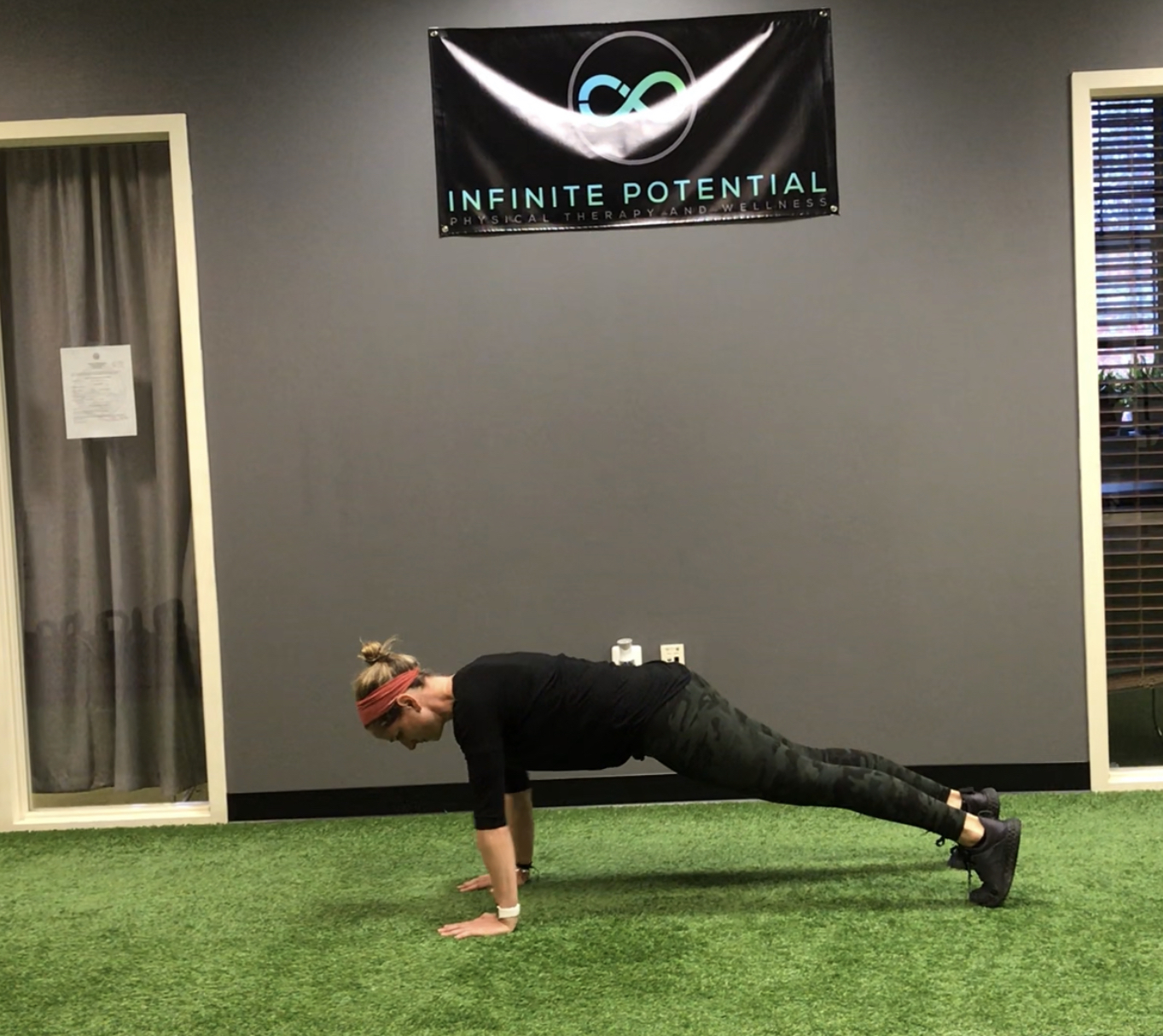
The push up is a very effective body weight movement and one that requires practice to master!
Here is my advice on how to get a push up!
First of all you need to be comfortable in a plank position, so get this position down and aim to hold for 20-30 seconds. Plank from the hands first and then forearms (which is a little more difficult).
Push up descent
Push up to a box (incline)
Next up you can try a push up to a box. Step away from the box and get into a plank position with hands on the box. Slowly lower yourself down maintaining the straight body plank position until your chest makes contact with the box. From here, squeeze and engage the core muscles and push back up to the plank position. Repeat 8-10 reps for 3 sets
Once you have mastered the push-up decline and the push up incline to a box you can move forward to the next steps.
Push up from the knees
Starting on your knees with your hands directly below your shoulders bend the elbows maintaining a straight body position, lowering slowly until your chest touches the floor. Contract your core and press your body back up.
repeat 5-8 reps for 3 sets
When you feel comfortable doing this from the knees you can try your first full push-up!
This time from a high plank position lower yourself to the floor, keeping your elbows tucked in to your side. Contract your core muscles by pulling your belly button to your spine and will pressure through your palms press yourself back up to the high plank position maintaining the straight body position throughout.

by Pippa Teague, Strength Coach | Oct 17, 2019 | Abdominals, Breathing, Diaphragm, Pain Relief, Uncategorized
By Anna Burns, PT, DPT
Infinite Potential Physical Therapist
One of the simplest things you can do to manage pain is to breathe. Have you ever noticed that when you’re concentrating, exercising, or in pain, you tend to hold your breath? Our diaphragm is directly connected with our nervous system, which is where pain signals are processed. When our nervous system is on high alert with pain, stress, anxiety, or fear, engaging our diaphragm can calm the nervous system from “fight or flight” status to “rest and digest” status, thus decreasing pain and stress levels. It’s one of our best tools to manage pain; no side-effects, no out-of-pocket costs!
For various reasons over the years, we have adopted a couple of different ways of breathing that circumvent the diaphragm. One is breathing with the upper chest; this breath is “emergency” breathing, a very shallow pattern that we perform when we are stressed or scared. Breathing like this only perpetuates the “fight or flight” cycle. Check out this video for an example of Emergency Breathing.
Another way is “belly breathing,” in which we distend our bellies outward on purpose; there’s nothing to breathe with in your belly; your lungs and diaphragm are under your rib cage! While the belly rising is normal with inhalation, it should not be consciously distended. Check out this video for an example of Belly Breathing.
Optimal breathing engages our diaphragm, a large muscle that sits under our lungs and over our stomach. By breathing into this area that touches all aspects of the rib cage, the diaphragm contracts downwards to expand the surface area for oxygen intake in our lungs. When we exhale completely, the diaphragm relaxes upwards to push out the de-oxygenated air in our lungs. To activate your diaphragm, breathe in through your nose. Check out this VIDEO for an example. Visualize a balloon expanding at the bottom of your rib cage as you inhale; breathe in pain-free existence. Exhale slowly through your mouth as completely as you can until you have no air left; breathe out all the pain. Pause for a second, and then inhale again through your nose. Try not to bulge out your belly on purpose or move your spine. In fact, I love practicing this laying on my back. So take a mindful moment (or several!) throughout your day to breathe. It will help quiet your pain signals by calming down your nervous system.

by Pippa Teague, Strength Coach | Oct 10, 2019 | Abdominals, Conditioning, Exercise advice, Injury Prevention, knee pain, Ladies, lifts, Personal training, Recovery, strength training, Uncategorized, working with injury, youthtraining
Lunges are a great unilateral movement to work not only the muscles involved but also work balance and stability.
They can be done with little space required
-difficulty can be added by including weight- kettlebell or dumbbells
Here are some lunge variations:
The reverse lunge
- start with the feet hip width apart and facing forwards
- with your back remaining straight take one foot backwards, allowing both knees to bend as the back knee touches the ground lightly
- push off the back foot keeping the front foot firmly planted
- drive through the heel and return the leg beside the other
Repeat on the other side
this works the glutes, quads and hamstrings and is also a great way to improve knee stability
Alt reverse lunge
Lateral Lunge
We often forget to move laterally. Lateral movement is great for stabilizing the hips and works your inner thigh and glutes.
- start with your feet together
- Step out wide to the side, transferring the weight over to the side you just stepped with, keeping both feet planted on the ground and facing forwards
- sit back into a squat position and go as low as you feel you are able to
- drive through your foot and return to the starting position
Repeat on the other side
Lateral lunges w/ kb
Static (split squat) Lunges
During this movement the feet remain in the same position (static)
This movement is great for those of us who are not so good with balance when moving and is the least challenging of all the lunges. Static lunges help build balance and strength from a stationary position.
Muscles worked are your thighs and glutes
- Start in a split stance- hip width apart with one leg in front of the other
- Lift onto the toes of your back foot and lower that knee down to the ground allowing the front knee to bend also to a 90 degree angle parallel to the ground
- Press through the heel of your front foot and straighten the legs back up.
- Keep your torso upright. Most of your weight should be felt through the front leg
Repeat 8-10 reps and then switch to the other leg
Split Squat w/ kb
Alternating jump lunges
Similar to the reverse lunge but with an element of power and plyometric transition with a jump from one lunge position to the other by switching feet in the air
This exercise challnges the same muscles as the regular reverse lunge but also adds a cardiovascular effect by increasing the heart rate and helps burn more calories.
tips to help your jumping lunge
- master the basic lunges first-reverse lunges and walking lunge
- aim for soft landings, avoid landing hard on your knee
- chest and torso stays upright
- be light on your feet and try to spring through the ball of your feet to gain some air time
- you can increase the difficulty by increasing reps, jumping higher and spending less time on the ground
Alt jump lunges
Try some lunges today and let us know how you get on!
Happy lunging !

by Pippa Teague, Strength Coach | Oct 7, 2019 | Abdominals, Back Pain, Client Achievements, Conditioning, Exercise advice, lifts, Recovery, strength training, Uncategorized
Today we are highlighting Michelle who has been with us since August 2018 after dealing with severe lower back and hip pain.
“I was in constant pain in my lower back and afraid that I would have to accept this as a new standard of living for myself. On July 4, 2018, I went to bed with excruciating pain in my lower back and tingling in my leg. I never had this happen in my life and had no idea what to do. The pain came out of nowhere, but now I realize that it was probably building for some time and came to the surface then. I was in my 20s and felt like I was in my 90s because of what I was told by doctors about managing my lower back issues and overall pain levels.”
Upon meeting Michelle, I quickly realized that she was in need of reassurance and was really looking for someone to guide her. She was desperate for answers and did not know where to turn as her symptoms were not just resolving on their own. She was provided with conflicting advice and was not sure who she could trust. This is a major issue that I see in many of my clients and it is my job to help make sense of some of the things that they have been told.
“My struggle affected every part of my daily life. I was always thinking about the pain when I was at work or out with friends and family. I didn’t want it to come back and was afraid that everything I was doing was making it worse whether I was exercising or staying still. I felt out of control in my body. I had no idea what I should do. My doctor told me to wear a neck brace and to essentially stay still. My spine specialist told me that I had a disc herniation in my lower back, which was scary to hear. I was not in a car accident and have always been healthy, so I did not understand why this happened.”
Michelle was in a tough position coming into our office. Many of our patients experience pain that affects their daily life and it is sometimes extremely difficult to manage on their own.
“Loni helped me get to a place where I felt stronger and comfortable in my daily life. I got to a point where I stopped feeling the pain. I gained the confidence to exercise regularly and lift boxes, etc. without being scared to injure myself. I would not be where I am today without Loni and Infinite Potential.”
Michelle has been a pleasure to work with from day one. She has shown endless appreciation for what we have provided and is also very open to new ways of thinking about her pain, alternative approaches to treatment, and has shown willingness to trust the process. Michelle has made consistent progress since beginning with us and has sought care past her original injury committing to strength training since completing her time in physical therapy. Strength training was not a part of her regular routine but she has since adopted the practice as a regular weekly activity. She has made significant progress in the realm of strength, endurance and power achieving goals that she never thought were possible.
We asked Michelle what she wants others to know about her experience with Infinite Potential PT. Here is what she had to say:
“I want others to know that they should go to Infinite Potential (IP)! The business is different than the standard physical therapy at out-patient centers or hospitals, but this is what makes her special and one-of-a-kind. I had been in and out of PT at hospitals before being a client at IP. I was only there for a few weeks (6 at most) and then discharged and my issues would come back. I wasn’t given one-on-one treatment plan like I get here. Loni spends the time to really understand your needs and help you not just for a short time, but for your life. I wish everyone could discover what I’ve found in Infinite Potential. Loni has been life-changing and I will follow her wherever I go. I live closer to the North Shore now and commute to see her weekly! She’s the best!
Our passion at IPPTW is to empower people to realize their full potential. We strive to decrease their fears, help them understand what is going on and what can be done in the long and short term. We want to be YOUR resource for help and feel strongly that we can give you informed guidance to help you make decisions about your health.
If this story spoke to you, or speaks to someone you know, please pass it on. Can you relate to Michelle? Let us know by replying to this email.

by Pippa Teague, Strength Coach | May 6, 2019 | Abdominals, Breathing, Diaphragm, Stressrelief, Uncategorized
By Anna Burns, PT, DPT
Infinite Potential Physical Therapist
One of the simplest things you can do for your core, your pain, and your stress level is to breathe. When working out or concentrating, it’s always the first thing to go. Our diaphragm is directly connected with our nervous system. When our nervous system is on high alert with pain, stress, anxiety, or fear, engaging our diaphragm can switch the nervous system from “fight or flight” to “rest and digest,” decreasing pain and stress levels. It’s one of our best tools to manage pain.
We have adopted a couple of different ways of breathing that “get around” the diaphragm. One is breathing with the upper chest; this breath is “emergency” breathing, a very shallow pattern that we perform when we are stressed or scared. Click HERE for an example of Emergency Breathing
Another way is “belly breathing,” in which we distend our bellies outward on purpose. While the belly rising is normal with inhalation, it should not be consciously distended. Click HERE for an example of Belly Breathing
Optimal breath engages our diaphragm, a large muscle that sits under our lungs and over our stomach. By breathing into this area that touches all aspects of the rib cage, the diaphragm contracts to expand the surface area for oxygen intake in our lungs. When we exhale completely, the diaphragm relaxes to push out the stale air. To activate your diaphragm, breathe in through your nose (CLICK HERE FOR VIDEO). Visualize a balloon in that area expanding as you inhale. Exhale slowly through your mouth, deflating the balloon, as far as you can until you have no air left. Pause a second, and then inhale again through your nose. Try not to bulge out your belly on purpose or move your back. In fact, I love practicing this laying on my back. So take a mindful moment (or several!) throughout your day to breathe. As one of our clients likes to say, “Breathing is NOT optional!”
