by Pippa Teague, Strength Coach | Nov 11, 2019 | Abdominals, Conditioning, Exercise advice, Personal training, Pushups, Recovery, Running, Shoulders, stool, strength training, Telehealth, Uncategorized, youthtraining
The push up is a very effective body weight movement and one that requires practice to master!
Here is my advice on how to get a push up!
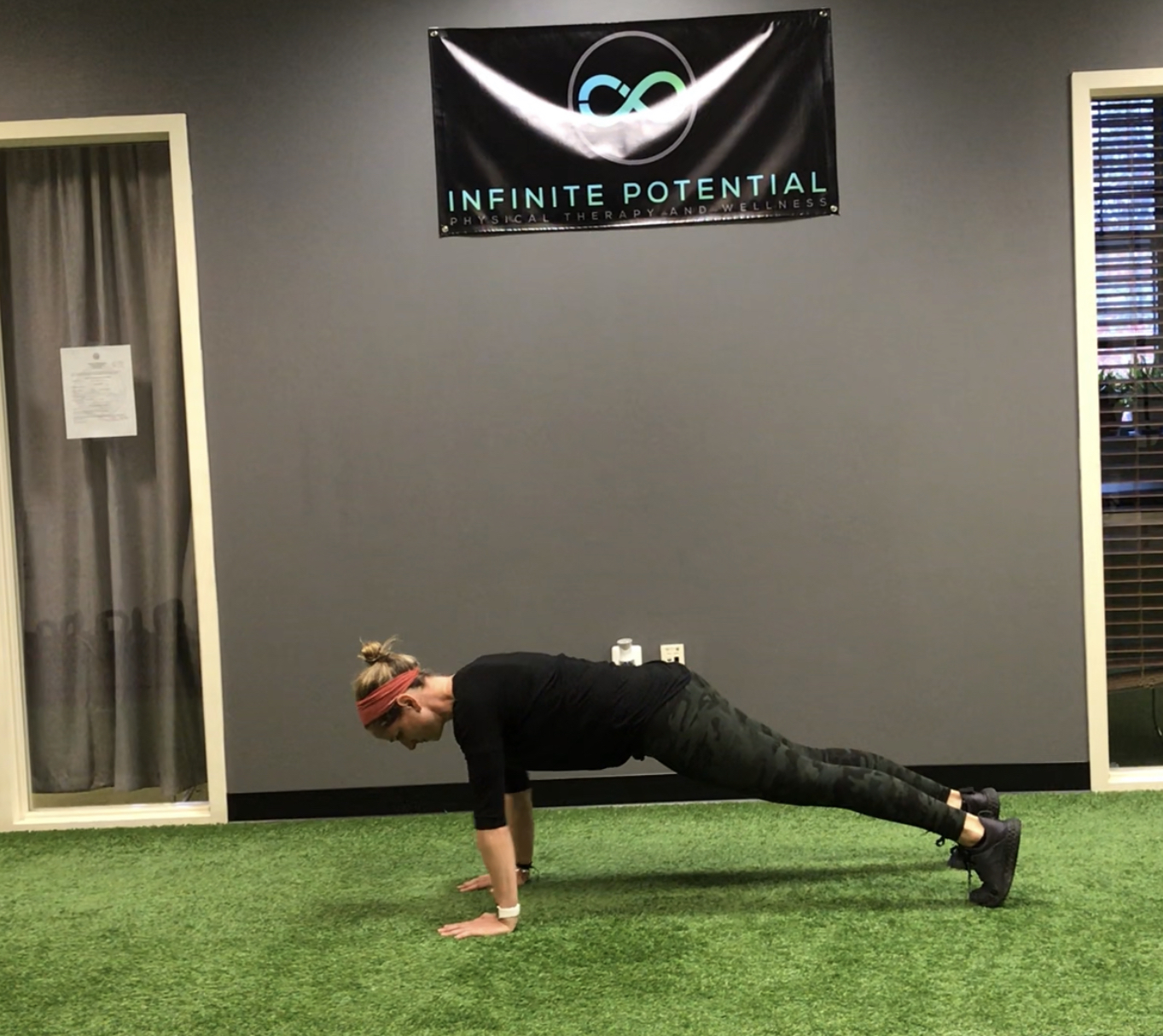
First of all you need to be comfortable in a plank position, so get this position down and aim to hold for 20-30 seconds. Plank from the hands first and then forearms (which is a little more difficult).
Push up descent
Push up to a box (incline)
Next up you can try a push up to a box. Step away from the box and get into a plank position with hands on the box. Slowly lower yourself down maintaining the straight body plank position until your chest makes contact with the box. From here, squeeze and engage the core muscles and push back up to the plank position. Repeat 8-10 reps for 3 sets
Once you have mastered the push-up decline and the push up incline to a box you can move forward to the next steps.
Push up from the knees
Starting on your knees with your hands directly below your shoulders bend the elbows maintaining a straight body position, lowering slowly until your chest touches the floor. Contract your core and press your body back up.
repeat 5-8 reps for 3 sets
When you feel comfortable doing this from the knees you can try your first full push-up!
This time from a high plank position lower yourself to the floor, keeping your elbows tucked in to your side. Contract your core muscles by pulling your belly button to your spine and will pressure through your palms press yourself back up to the high plank position maintaining the straight body position throughout.

by Pippa Teague, Strength Coach | Oct 10, 2019 | Abdominals, Conditioning, Exercise advice, Injury Prevention, knee pain, Ladies, lifts, Personal training, Recovery, strength training, Uncategorized, working with injury, youthtraining
Lunges are a great unilateral movement to work not only the muscles involved but also work balance and stability.
They can be done with little space required
-difficulty can be added by including weight- kettlebell or dumbbells
Here are some lunge variations:
The reverse lunge
- start with the feet hip width apart and facing forwards
- with your back remaining straight take one foot backwards, allowing both knees to bend as the back knee touches the ground lightly
- push off the back foot keeping the front foot firmly planted
- drive through the heel and return the leg beside the other
Repeat on the other side
this works the glutes, quads and hamstrings and is also a great way to improve knee stability
Alt reverse lunge
Lateral Lunge
We often forget to move laterally. Lateral movement is great for stabilizing the hips and works your inner thigh and glutes.
- start with your feet together
- Step out wide to the side, transferring the weight over to the side you just stepped with, keeping both feet planted on the ground and facing forwards
- sit back into a squat position and go as low as you feel you are able to
- drive through your foot and return to the starting position
Repeat on the other side
Lateral lunges w/ kb
Static (split squat) Lunges
During this movement the feet remain in the same position (static)
This movement is great for those of us who are not so good with balance when moving and is the least challenging of all the lunges. Static lunges help build balance and strength from a stationary position.
Muscles worked are your thighs and glutes
- Start in a split stance- hip width apart with one leg in front of the other
- Lift onto the toes of your back foot and lower that knee down to the ground allowing the front knee to bend also to a 90 degree angle parallel to the ground
- Press through the heel of your front foot and straighten the legs back up.
- Keep your torso upright. Most of your weight should be felt through the front leg
Repeat 8-10 reps and then switch to the other leg
Split Squat w/ kb
Alternating jump lunges
Similar to the reverse lunge but with an element of power and plyometric transition with a jump from one lunge position to the other by switching feet in the air
This exercise challnges the same muscles as the regular reverse lunge but also adds a cardiovascular effect by increasing the heart rate and helps burn more calories.
tips to help your jumping lunge
- master the basic lunges first-reverse lunges and walking lunge
- aim for soft landings, avoid landing hard on your knee
- chest and torso stays upright
- be light on your feet and try to spring through the ball of your feet to gain some air time
- you can increase the difficulty by increasing reps, jumping higher and spending less time on the ground
Alt jump lunges
Try some lunges today and let us know how you get on!
Happy lunging !
by Pippa Teague, Strength Coach | Sep 30, 2019 | Conditioning, Exercise advice, Injury Prevention, Personal training, Recovery, Running, strength training, Uncategorized, youthtraining
by Pippa Teague
Infinite Potential Strength Coach
I would like to start off by giving the research credits to Barbell Medicine and their 3 part series has been summarized below.
Previously a lot of peoples beliefs surrounding youth and resistance training involved some of the following quotes and I still hear some of these coming up today:
“Resistance training stunts growth”
“Kids shouldn’t lift weights-it will damage their growth plates”
Well…both of these statements have been proven to be wrong and we have slowly shifted from that mindset.
Childhood is the time where we need to be focusing on building bone mass and structure by weight bearing activities!
It is ok for kids to weight train and resistance train-in fact, its GOOD for them!
Studies have shown these three important factors to resistance training as a youth
- Resistance training should be essential for aspiring athletes
- Participation early in life correlates to later life
- Those who don’t resistance train are at a higher risk of negative consequences
Developing those skills early in life is very important if we want to remain healthy and fit as we get older.
Today 10 year olds are participating in the same amount of exercise as 60 year olds!
We are failing at getting our youth to exercise the amount that has been recommended – 5-17 year olds should engage in 60 mins of moderate to vigorous activity/day! Only 40% are actually achieving this!
Here is a breakdown of some age ranges and examples of how to include resistance training int their exercise.
Ages 6-8 – FUNdamentals, game oriented exercise, coordination, balance, agility
Ages 10-13 (males ) 9-11 (females) – learning to train, plyometric and free weights with a variety of training
Adolescence 14-18 (males) 12-18 (females) training to train, sport specific plus other training, heavy and slow resistance training
Adulthood Ages 18+ – training to compete, sport specialty, resistance training still an integral part
One study found that strength training reduced injuries three fold over the course of 1 soccer season! It also improved cutting speed and jumping !
Another study looked at females in repetitive sport e.g. running, and found that those youth athletes were 3 times more likely to have a lower bone mineral density than females who did the repetitive sport but also were resistance training.
Resistance training is important not just for youth athletes but for growing children.
Longer programs elicit larger effects and it is important for youth athletes to maintain resistance training alongside their sport for optimal results!
Citation: ‘resistance training for youth part I and part II’
www.barbellmedicine.com
