by Pippa Teague, Strength Coach | May 1, 2019 | Conditioning, Exercise advice, Jumprope, strength training, Uncategorized
By Pippa Teague NASM CPT, WS
Infinite Potential Personal Trainer, Orangetheory coach, Professional Figure Skating Coach
I love double unders and jump rope in general but I know dubs don’t come easy to everyone and there are some tricks and tips that can help!
In general, jump rope is a great conditioning tool. As a competitive figure skater I would use it frequently to warm up in the rink and before competitions. It is light and easy to bring to smaller spaces and gets that heart rate up fast!
Being effiecent in jump rope and getting those dubs will help to improve the following:
-Speed
-Coordination
-Endurance
-Body control
-Strength
-Power
-Reaction speed
Here is my guide to achieving your first double under.
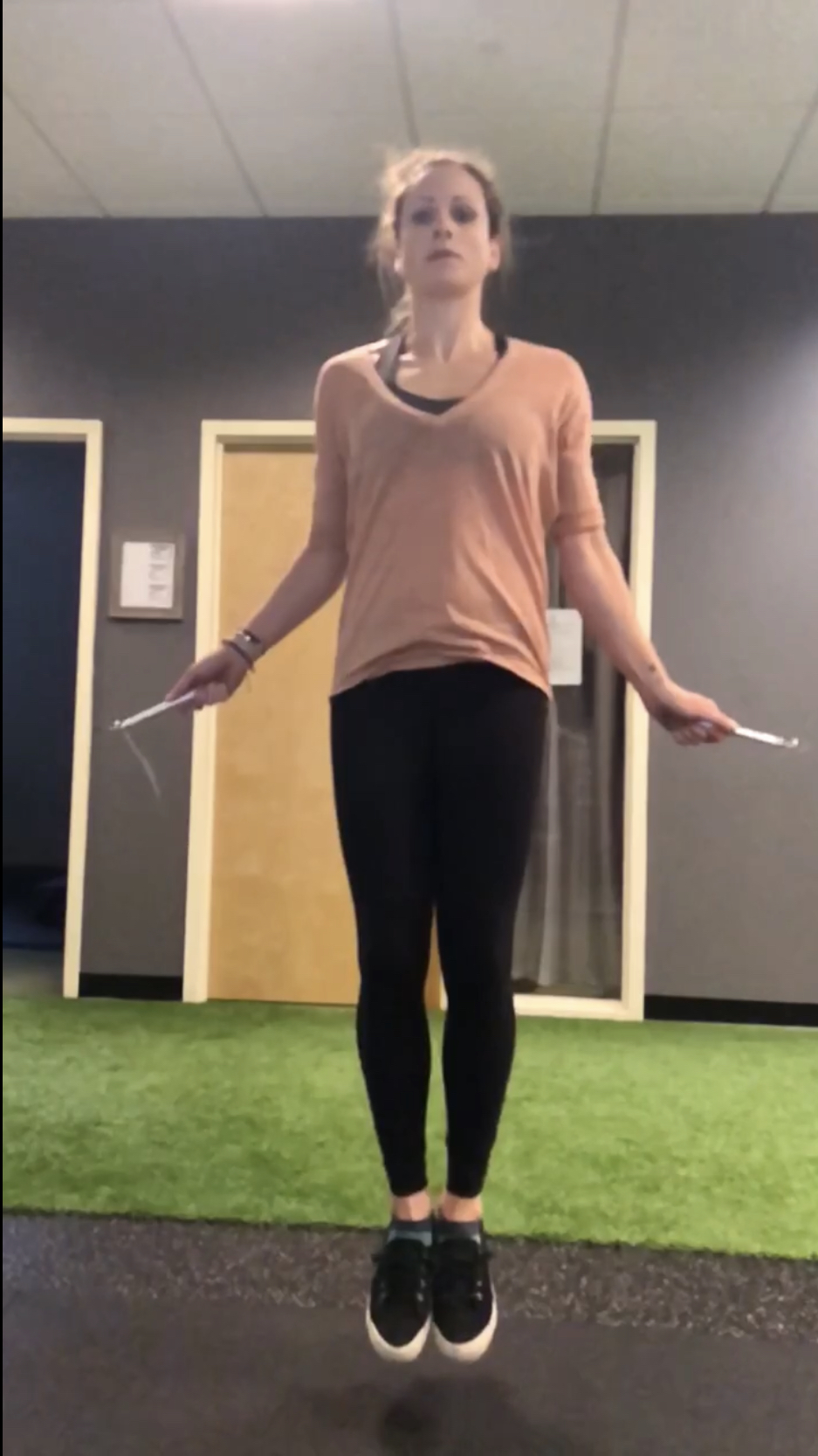
First make sure you are efficient with your single unders. Be able to quickly manage about 20 in a row unbroken. A big mistake I see very often is trying to make large circles with the arms in order to bring the rope through. Try to keep your wrists and arms close to your side. A trick to help is to squeeze a rolled up towel under each arm. As you jump the wrists actually flick down. So think about your thumb turning a tight circle towards the ground as you jump upwards. Timing should be even and smooth. Focus on one point in front of you.
Single unders
Double under timing.
Penguin taps:
Without the rope jump up and tap your legs twice. This is how fast you need to be doing the flick motion with your wrists. The jump itself should not change, you want to jump higher for the double under but legs should look the same. Often times people will bend the knees up in a tuck fashion. Try to avoid this. Toes should still leave the ground last and legs stay straight.
Once you feel like you have the singles down you should start trying a couple of doubles mixed in. Use the timing of the singles to help flow you into a double so it might be something like single-single-single -double-single
When you can manage this, try to get two in a row. The hardest part is the timing and jumping straight into the next one.
Double unders
Good luck and tag me in your double under journey !
by Pippa Teague
Infinite Potential Personal Trainer, Orangetheory coach, Professional figure skating coach
NASM CPT, WS

by Pippa Teague, Strength Coach | Apr 30, 2019 | Exercise advice, Pushups, strength training, Uncategorized
By Jenny Gusella, ACE, CFSC, Personal Trainer and Orangetheroy Fitness Coach
Push-ups are a staple of any workout program from youth to adulthood. You don’t need any equipment, you can do them anywhere, and they are easy to modify them to make them simpler as well as more advanced. However, according to anecdotal evidence I’ve gathered from my clients, push-ups are among the more dreaded of the exercises we do. Reasons range from “I’ve just never been able to do them” to “I feel so weak, I can’t even do one” to “Can’t I just do them from my knees?”
Usually, in life, when a situation isn’t going the way we want, we make an effort to fix it. We aim to improve our situation so we can move on and be happier. If you are someone who dreads push-ups, we can fix your situation, and, if you progress properly, it will feel empowering, not defeating.
Why fix it? First of all, it’s one of the best bang-for-your-buck exercises out there, working your chest, arms, core and even your legs all at once – if you have it in your arsenal, you open up opportunity for greater strength gains. Second of all, push-ups are revealing themselves to be a great indicator of cardiovascular health. A recent study published in the JAMA Network open found that men who could do more push-ups were less likely to experience cardiovascular issues, with those who could do 40 or more seeing the greatest risk reduction. That’s not to say if you just get good at push-ups your heart will become healthy, but practicing some push-ups and seeing where you need improvement may inspire you to pick up a more complete fitness routine (including push-ups, of course!) which will ultimately lead to a healthier heart.
Now, let’s meet you where you’re at to determine how to tackle these push-ups! Find which statement below applies to you, start there, then work your way down as you get more proficient. When you practice push-ups, try to aim for 3 sets of around 8-12 reps.
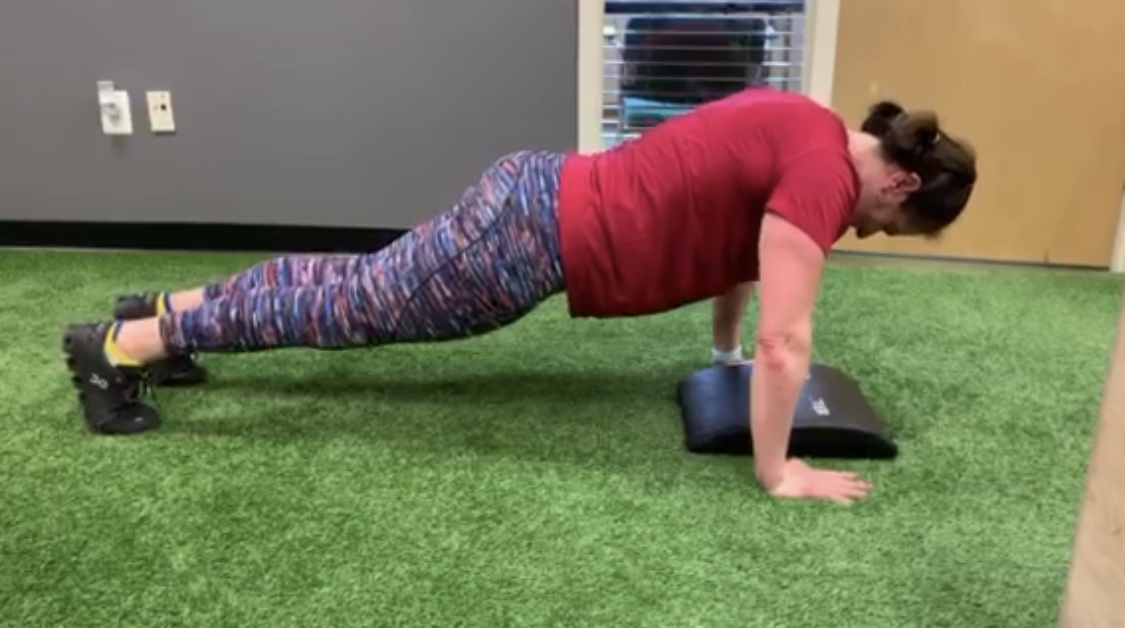
1. “I cannot hold the top of a push-up” If you can’t hold a high plank (from your hands) then you will not yet be able to perform a push-up, so let’s start there. Try holding a plank for 10 seconds. Make sure your wrists are right under your shoulders, your back is flat enough to hold a mug of coffee on top, and your butt isn’t way up in the air. Increase your plank hold by 5 seconds every few days. By the time you can hold a plank for 30 straight seconds, you’re ready to move on.
2. “I cannot do 1 full push-up” Let’s start by elevating your hands. Find something like a bureau, set yourself up in a plank position with your hands on the edge, and perform a push-up with your chest coming all the way to touch the bureau. Was that easy? Then find a lower piece of furniture, maybe your dining room table, or a coffee table. The lower your hands are, the more difficult the push-up will be. Once you find an elevation that’s challenging for about 8-10 reps (but you can complete it) then find a lower piece of furniture!
3. “I can do a couple but my form really falls apart” Let’s go back to basics. A perfect push-up should start as a perfect plank, then when you lower down, your chest and your hips lower at the exact same rate, and your elbows stay tucked in at least 45 degrees to your body. Keep your eyes looking a few inches in front of you so your head doesn’t drop. Your chest should be able to touch a small pad on the ground below you. Practice doing as many perfect ones as you can, and then do the rest of your push-ups back at step 2 with your hands elevated.
4. “I’m happy with how many push-ups I can do” That’s great! Some fun ways to make them more challenging could be: slow down the tempo, lower to the count of “3…2…1”. Elevate your feet, make sure to stay in that perfect plank. When you push up, jump your hands up into the air. Or try doing push-ups on just 1 foot.
Last step: add some fun music to your routine! Might I suggest “Push It” by Salt-n-
by Pippa Teague, Strength Coach | Apr 23, 2019 | Abdominals, Shoulders, strength training, Uncategorized
Guest Editorial
By Kerry Moynihan
Fit for life after 50
Certified Personal Trainer
Am I the only one amused by the often inventive and entertaining names used for exercises in the fitness world? Deadlifts, Skull Crushers and Crunching, to name just a few, create bone-chilling imagery as you’re just trying to get that pain-free one hour workout in. Or Inchworms, Bird Dogs and Flutter Kicks which have us daydreaming of Earth’s renewal on a lovely May morning rather than working that core to its max.
Regardless of name or the imagery created, only one man can lay claim to having a fabulously effective exercise named just for him…..no bone-chilling moniker, nothing Spring Day about it. It’s The Arnold Press.
Seven time Mr. Olympia, Arnold Schwarzenegger, created the Arnold Press during his illustrious bodybuilding career in the early 1970’s. He can still lay claim as one of the most successful and influential figures in bodybuilding and is credited with inventing this press which targets the anterior, lateral and posterior deltoids (three shoulder muscles). Think: Summer Shoulders.
As with any exercise, form first.
To start: Seated position. Back straight. Feet planted on the floor. Keep core tight and braced throughout.
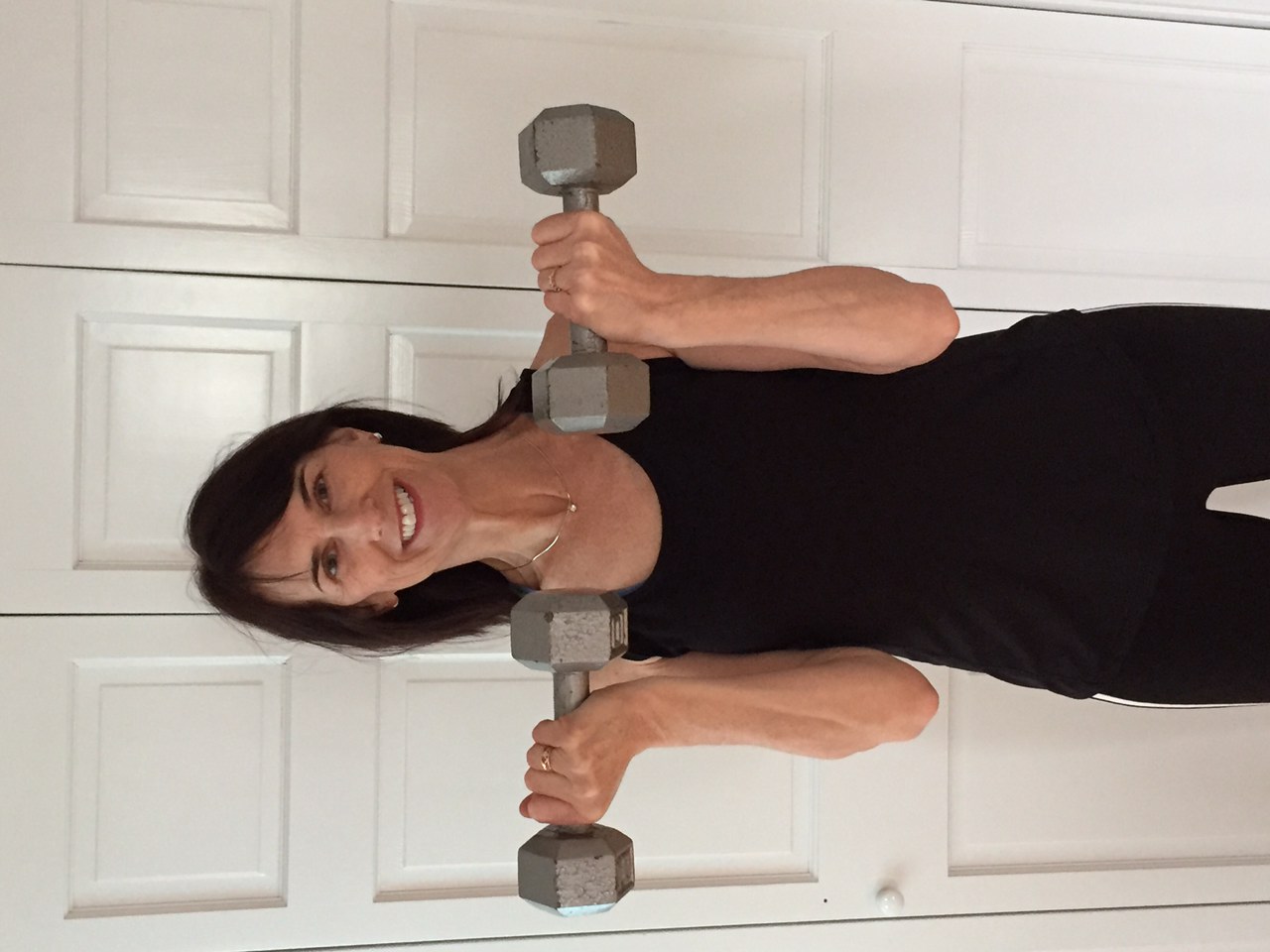
Grasp a dumbbell in each hand. Start with a very manageable weight to get the motion of the exercise.
Curl the weights up to the shoulders. Hold the dumbbells at shoulder level with palms facing the body.
In a controlled manner, slowly press the dumbbells simultaneously upwards and rotate your hands to a forward position until you have fully extended your arms upward. Slowly (with control) lower the weight down by reversing the exercise and repeat the movement.
The true work of the Arnold Press is the downward motion of the weight returning to the starting position.
Not guaranteeing a Mr. or Ms. Olympia title, but when you master the proper mechanics of the Arnold Press, it truly is a great addition to your upper body workout.
Kerry Moynihan
ACE Certified Personal Trainer
by Pippa Teague, Strength Coach | Apr 8, 2019 | Ladies, strength training
by Anna Burns, PT, DPT
Infinite Potential Physical Therapist
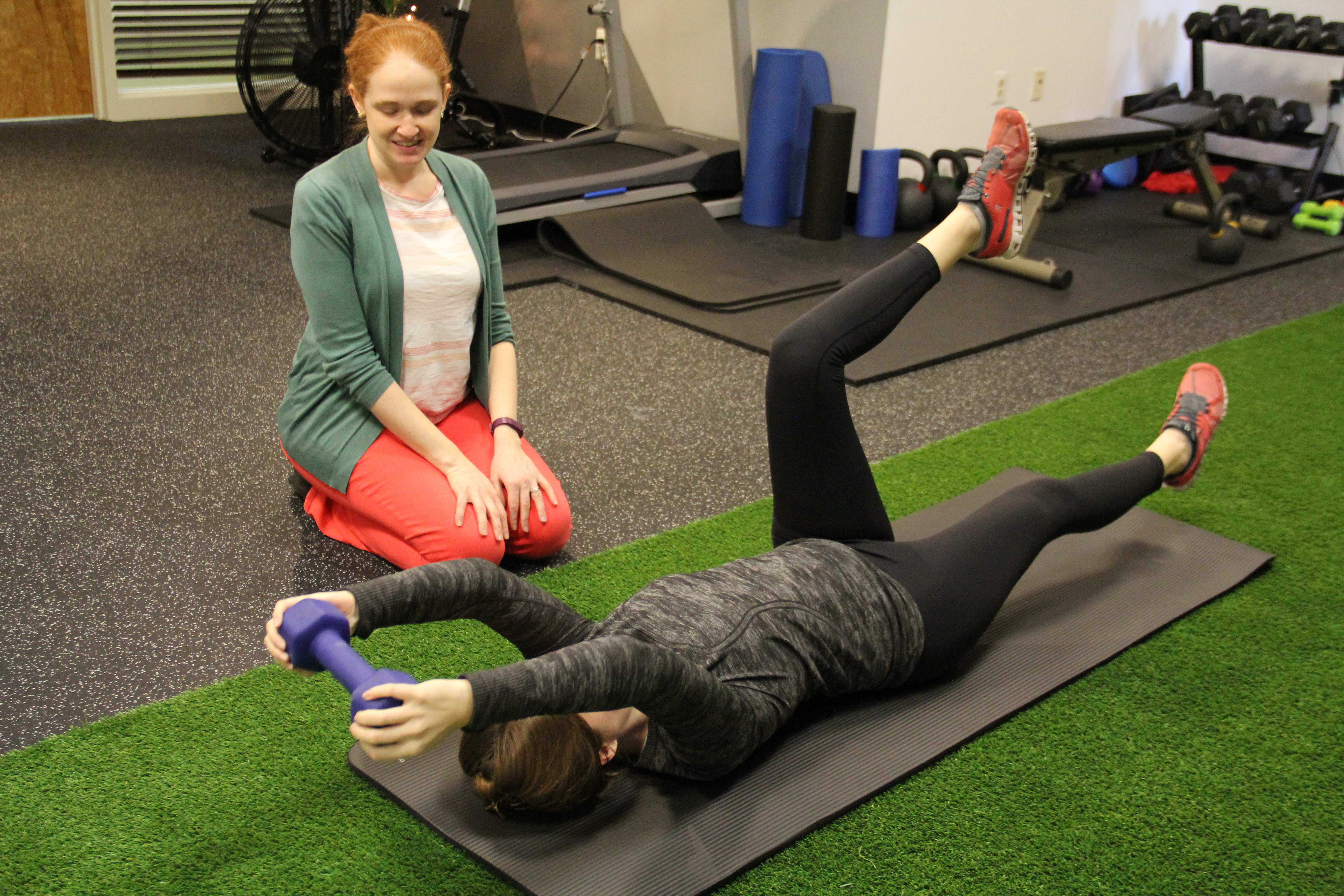
There are SO many things to consider when pregnant, and physical activity is one of them. In the old days, women were advised to “take it easy” while pregnant. However now, the CDC recommends that pregnant women get at least 150 minutes of moderate-intensity aerobic activity every week. Ideally, a pregnant woman should be able to do any exercise she had been doing prior to pregnancy with a few modifications.
Here are a few things to avoid during exercise while pregnant:
- Laying on your back for more than 3 minutes after 20 weeks
- Exercising in a hot, humid environment, whether it’s outside or in a heated studio
- Performing inversion poses or any position where the hips are above the shoulders (handstands, bridges, etc.)
- Exercises that put pressure on the abdomen during mid-to-late pregnancy, have a risk of falling, or contact sports
- Over-stretching muscles
If you lift weights, here are a few guidelines and suggested modifications:
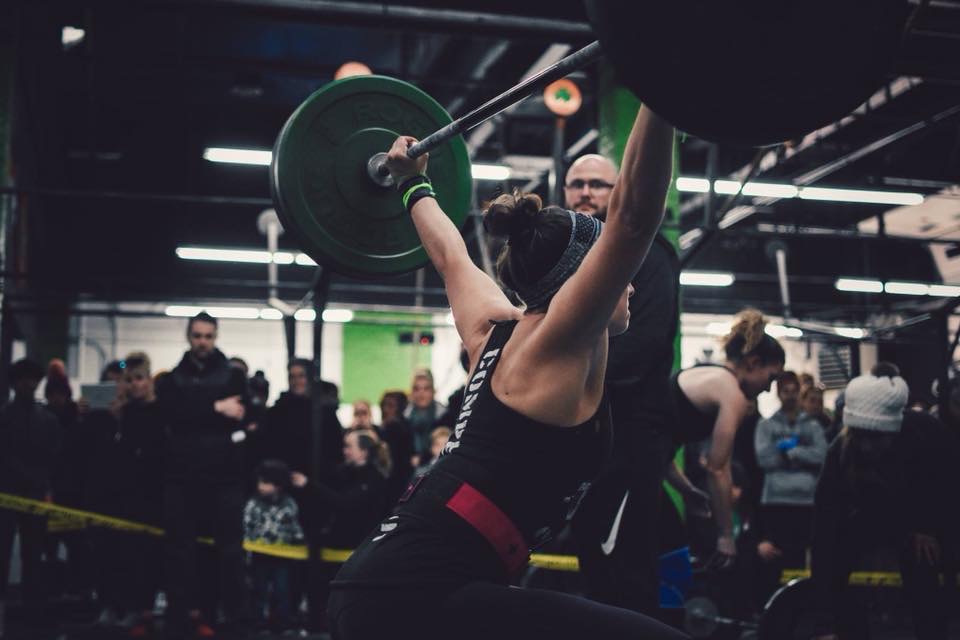
- Decrease your lifting load to 60-75% of your pre-pregnancy “one rep max.”
- Modify asymmetrical movements such as a split snatch or a split jerk if they cause pain in your pelvis.
- If your belly gets in the way with lifting from the floor, lift from blocks instead.
- Switch out front squats for back squats, as the front squats increase your intra-abdominal pressure (which is already increased by the presence of the baby).
Regardless of the type of exercise you participate in, watch for symptoms that signal you should STOP exercising and contact your healthcare provider immediately:
- Bleeding or leaking fluid from the vagina
- Feeling dizzy or faint
- Shortness of breath before starting exercise
- Chest pain
- Headache
- Muscle weakness
- Calf pain or swelling
- Regular, painful contractions of the uterus
You should always talk to your obstetrician or midwife before starting an exercise routine. Don’t let pregnancy leave you sitting around eating bonbons! The more active you can stay, the better you and your baby will feel, both during pregnancy and after delivery!
__________

by Dr. Loni Rodriguez | Dec 17, 2018 | Exercise advice, Injury Prevention, lifts, Running, running help, squats, strength training
Why should runners strength train? PART II

Again, this post was inspired by Chris Johnson, my GO-TO for all things running!
For more information about Chris and some of the amazing content he has to offer, visit his website at Chris Johnson PT.
In the last post, we covered some of the benefits of strength training and the specific importance of this practice for runners. In this second piece, I will cover some of the most important and effective exercises that a runner’s strength training routine should include.
Dynamic Warm Up
This is often neglected by runners because it is easy just to get out and run. We want to allow adequate perfusion of blood to the necessary tissues and prepare the nervous system for the run itself. There is also likely too much time spent on unnecessary stretching. This stretching has little to no effect on injury prevention or preparing for the run.
Here are two recommended exercises that can be included in a dynamic warm up:
Hugging knee to chest
Quad stretch with overhead reach
The March
It is important for a runner to demonstrate solid single leg balance. Marching provides training for single leg balance that simulates running. It also allows for training of shortened stride length which can help reduce the risk of running related injuries.
Here are two recommended marching exercises:
Baseline marching with or without weights
Prisoner March
Lateral Toe Tap
This exercise is important to train the glute muscles. The glutes play a large role at reducing running related injuries, as they are large contributors to the activity of running itself. This exercise directly targets those glutes, challenges single leg balance and simulates running as it is an upright activity.
Here are two recommended lateral toe tap exercises:
Lateral toe taps with band
Single leg stance hip abduction
Step up (7-8” step)
This exercise challenges single leg stance just like the demands of life. It is important to focus on control, coordination, and timing with this one. It is NOT an exercise that should be challenging on the muscles but more on balance, quality, and form.
Here are two recommended step up exercises:
Standard step up
Fluid step up
The Bridge
This exercises is one of the most basic yet it is very important. It is also performed without equipment. It works on glutes, hamstrings, calves, low back, and abdominals
It is great for preventing knee pain in runners.
Here are two recommended bridge exercises:
Standard bridge
Bridge march
The Plank
This is NOT just a core exercise. It challenges the lateral hip musculature which is very important for runners. It is recommended to not jump too quickly into unstable surface work as you want to master these first.
Here are two recommended plank exercises:
Standard plank arms bent with or without knee taps
Standard plank arms straight with or without knee taps
Calf Raise
Calves can not be overlooked in training for the lower body as they are the powerhouse for distance running. Calf exercises can create tissue resiliency and build capacity to tolerate the demands of the sport and resistance to injury.
Here are two recommended calf exercises:
Isometric double leg calf raise
Isometric single leg calf raise
Squat
The squat is the most fundamental strength training exercise that is involved in everyday life. It has the ability to create full body resistance to running-related injuries.
Here are two recommended squat exercises:
Air squat
Goblet Squat
Loaded Carry
Life demands that we carry stuff. So why not train it? Loaded carries play a primary role in working with runners of all ages and abilities as it is important to get acquainted with being tall and upright.
Here is a recommended carry exercise:
Farmers carry march
Deadlift
This exercise, along with the squat is one of the most important functional exercises that every human should perfect. It is also extremely important for injury prevention. The correct form is crucial and introductory exercises for this movement are important to perfect.
Here are a few deadlift exercises to introduce you to to the movement:
Hip hinge with PVC
KB Deadlift
WANT MORE?!?!?!?!?
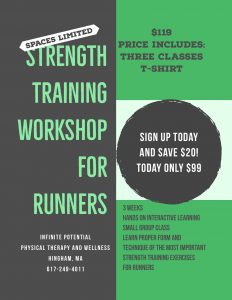
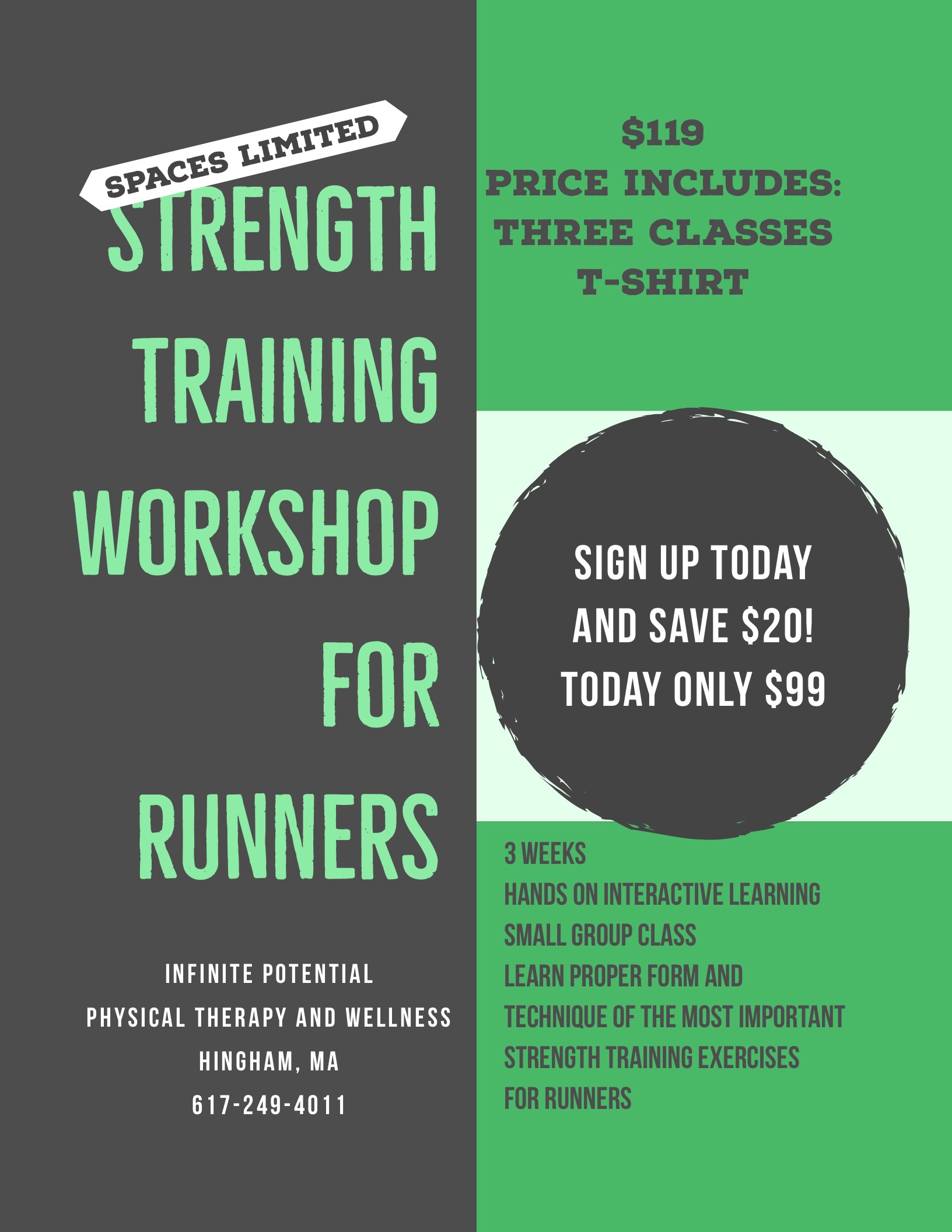
Interested in live group training that covers this content?
We will be hosting a 3-part series workshop held on 3 consecutive Wednesday’s in January from 6:30-7:30pm
JANUARY 9th, 16th, and 23rd.
This workshop will be located at our brand new office on 1 Derby Street in Hingham. Space is limited so please sign up ASAP!
Email Loni through loni@infinitepotentialptw.com or call 617-249-4011 x 700 for ANY and all questions!
Sign up through this link– choose the 6:30pm class on January 9th. Follow the prompts to complete registration.
 @
by Dr. Loni Rodriguez | Dec 11, 2018 | Exercise advice, Injury Prevention, Running, running help, strength training
Why should runners strength train? PART I
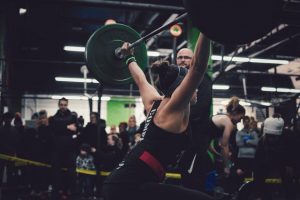
The following is a very brief overview of Chris Johnson’s book, Running on Resistance. For more information about Chris and some of the amazing content he has to offer, visit his website at Chris Johnson PT.
Strength training is an integral part of any regular exercise routine. Here are some major benefits of this fundamental practice:
- Builds cardiovascular health
- Improves body image
- Improves flexibility
- Improves full body resiliency and resistance to injury
For runners, not only are you focused on the above, but for more competitive runners, there is a focus on performance. There is an element of excitement when we improve our mile time or come back for a run feeling refreshed.
Here are some of the running specific benefits that strength training can provide:
- Improve capacity
- Increase running economy
- Increase speed
- Delay fatigue onset
Body weight exercises are a great entry into resistance training, yet additional resistance with the use of weighted equipment will provide the necessary stimulus to gain strength. However, to reduce the risk of injury from strength training, a general periodization program should be followed. There are various programs out there and have been proven to be effective. The major areas of interest when choosing a program are exercise selection, recommendations for load, repetition count, and rest periods. Each of these should be well understood and planned before initiating a program.
Here are some general recommendations
- Exercises need to be individualized to the person’s goals and exercise history
- Initially, 2-3 sets of 8-12 reps of bodyweight movement. Progressed then to weighted routine as form and comfort improves
- Single leg exercises need little to no rest
- Two-legged exercises require a rest of 1-2 minutes recommended
- Frequency is most effective at about two days per week for 12 weeks on days of lower volume running or drill/tempo days
Stay tuned for Part II, where I will review the most important and effective exercises for runners to add into their regular routine.
WANT MORE?!?!?!?!?
Interested in live group training that covers this content?
We will be hosting a 3-part series workshop held on 3 consecutive Wednesday’s in January from 6:30-7:30pm
JANUARY 9th, 16th, and 23rd.
This workshop will be located at our brand new office on 1 Derby Street in Hingham. Space is limited so please sign up ASAP!
Email Loni through loni@infinitepotentialptw.com or call 617-249-4011 x 700 for ANY and all questions!
Sign up through this link– choose the 6:30pm class on January 9th. Follow the prompts to complete registration.
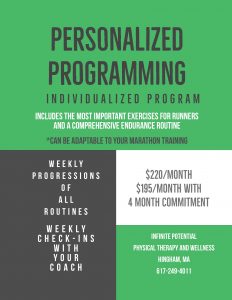
Are you interested in personalized programming?
It is a great way to safely and effectively implement this strength training program that was touched upon in the workshop.
HINT >>>> Most of it will be addressed in more detail in the 3-part series in January!
However, for a more personalized approach, the remote programming is a great way to be sure that you are doing EVERYTHING you need to do to improve your running performance and reduce your injury risk.
Email Loni through loni@infinitepotentialptw.com or call 617-249-4011 x 700 for ANY and all questions!