by Dr. Loni Rodriguez | Jan 23, 2020 | Exercise advice
We’ve all been there, particularly in Resolution January. The neighborhood gym is PACKED, your favorite weights are in someone else’s grip…what’s one to do?! Go ahead and pick up that unwieldy and mysterious kettle bell in the corner. You’ll be glad you did.
Kettle bells didn’t originate as dust collectors at the gym. Ancient Greeks (think Olympics) used spherical stones for competitive weight competition and strength training. The traditional kettle bell shape as we know it today was first seen in Russia in the 18th century and had very practical applications. Russian farmers used them as counter weights for grain & produce measurement at country markets.
Fast forward to today: Their application is vast and wide. Just ask a cross-fitter. It’s a staple in Cross-Fit gyms worldwide. From top to toe, a full workout can be accomplished using kettle bells. Here are some favorites:
Farmer’s Carry: Grab two challenging even weight kettle bells. Place one in each hand, palms facing hips. Shoulders back, long tall spine (think Giselle on the catwalk), core engaged – now walk. This underutilized exercise improves grip strength, burns calories, increases heart rate, builds muscle and increases strength. It’s an all-over body workout.
Kettle Bell Swing: Stand tall while gripping one kettle bell with both hands. Your arms are long and relaxed in front of you. Your legs are hip width apart. Hinge forward with your upper body while your derrière moves back. Simultaneously, your knees soften and your weight shifts into your heels. Next, drive through your heels. Explode through your hips to send the kettle bell upward from your legs to a position directly in front of your chest – maintaining straight arms. To achieve this finished position you have to contract your core and squeeze your glutes while in this standing position. As the KB begins to descend again, repeat the hip hinge, derrière back, soft knee, weight in heels activity. This is a phenomenal exercise for the posterior chain: hips, glutes, hamstrings, lats. Plus the cardio boost is a nice extra benefit.
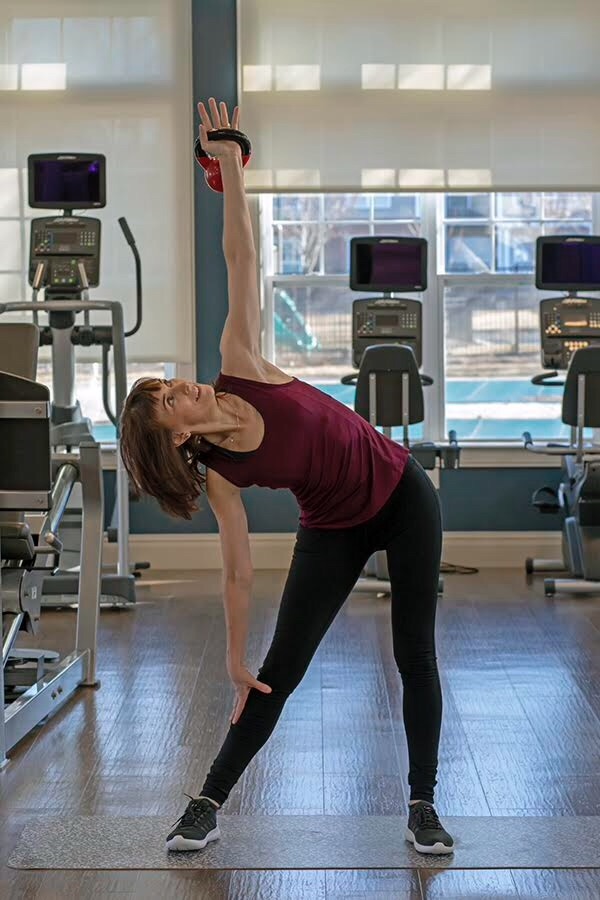
Kettle Bell Windmill: Let’s begin on the left. Grab a manageable weight kettle bell in your left hand. Stand with feet hip width apart. Turn both feet approximately 45 degrees to the right. Bring the weight to your left shoulder and press the weight up overhead (ball facing down). Engage your lats to keep the kettle bell hoisted. Your right arm is relaxed by your side. This is the starting position. Next, keeping your left arm raised and your eyes on your left hand, push your left hip back (hinge) to the side, your derrière pushed slightly back. As you hinge, your right arm slides down your right leg towards the right foot. The left arm remains pointed at the ceiling. Stop. Raise back to standing. That’s one rep. Go slowly. Repeat on the right side. This is a great one to do for deep core work and obliques. It also helps with shoulder, hip and spine mobility.
Here are but three examples of kettle bell applications and we’ve hit virtually every body segment. So branch out. Give them a try. Walk past the weight rack and grab yourself a kettle bell to spice up that 2020 workout.
By Kerry Moynihan
Personal Trainer
@fit4lifeafter50

by Dr. Loni Rodriguez | Dec 23, 2019 | Injury Prevention
Are you thinking about starting something new in January? Setting some workout goals or planning to participate in a challenge at your gym?
We all love to start the New Year off right with things like new workout routines, gym challenges, or general lifestyle changes. Maybe this year your goal is to run a 5k or compete in your first CrossFit competition, or maybe it is to complete the OrangeTheory Fitness ™ “Transformation Challenge”. This is all well and good, but you must make sure what you are doing is not drastic, is realistic, and is gradual. I can not tell you how many times I have seen someone in March or April who is coming to see me for pain that came on after participating in some form of new workout regimen or routine. I am the last person to tell someone NOT to participate in something, but you have to know yourself, your body, and how to take care of it during this time!
Here are some tips that will help reduce your injury risk as you venture into your new routine.
1. PROCEED GRADUALLY
If your new plan involves a workout routine that your body is not used to then you have to proceed into that new routine as gradually as possible. Maybe that means adding a few extra gym days, or increasing your running mileage. Maybe you are planning to work with a personal trainer in addition to your regular routine in order to get stronger and fit in a new way. The best advice I can give you is make sure that you are not increasing your overall workout intensity by more than 10% per week. That means how HARD you are working should not change much from week to week.
How do you figure that out? You have to understand your baseline and then the level of intensity you are partaking in.
Here are some examples…
Let’s take days of the week. If you normally workout 2 days per week and the challenge asks for 3, then that is about a 50% increase. I am not saying to not go to the gym that 3rd day, but plan accordingly by making one of those days a bit less intense. This will decrease your overall intensity level.
How about a new workout routine… you went from doing yoga and Pilates to starting OrangeTheory Fitness ™ 2 days per week. That is a 200% increase in your intensity level. I am by no means saying that you should not start a new routine, but your intensity level has to stay low and gradually increase as you adapt to the new training program.
Just remember, that most injuries come from doing too much after doing too little for too long.
2. USE YOUR DAYS OFF TO BENEFIT YOU
It is super important for your body to have days that you aren’t in the gym. If you have a plan to go that extra day, then you need to make sure your week has an extra day in it that you are resting. A day full of errands, taking the dog for a 2 mile walk, and a full clean of the house is not a complete rest day. Does taking a full rest day sound foreign to you? That is fine, try to at least do half as much as you normally do on one of the days during the week.
3. GET YOUR RECOVERY IN
This is one of THE most important things to think about keeping as a priority during this time. I am not talking about getting on a foam roller more often, stretching more or getting massages, etc. I am specifically referring to SLEEP, HYDRATION, and CLEAN FOOD consumption. This is something that can be tracked and modified easily throughout your week.
3. LISTEN TO YOUR BODY
If you have read my content before, you know well that I am someone who promotes pushing yourself and not shying away from pain all the time. However, there are many circumstances that warrant you to slow it down, lessen the load, decrease the intensity in the short term. If pain starts to sideline you, GO TALK TO SOMEONE. It is not just going to go away if you stop doing that said painful activity. Most pains will go away on their own, but as soon as you start back up again they come back most of the time.
4. TRY A NEW NON-TRADITIONAL GYM WORKOUT
This is a great time of year to do something new that is not an intense workout. Try getting outside on local trails, trying indoor rock climbing, take up gentle yoga or meditation class. These are GREAT things to do on off-days at the gym that do not tax your body.
These are just some things to think about as you proceed into the New Year. They can obviously be applied to many situations at other times of the year, but most people start something new in January and I wanted to give a few guidelines to follow.
The first and third tips are the most important to keep in mind! If you have questions about your new routine, post comments below or reach out to us personally. We are happy to help!
Wishing you all a safe, healthy and Happy New Year!

by Dr. Loni Rodriguez | Dec 19, 2019 | Exercise advice
Do you know anyone who has suffered
an ACL tear? This is one of the most common knee injuries and takes a long time
to come back from. It’s the kind of injury that can keep an athlete out for a
whole year and requires surgery and a lengthy rehab. When I see someone with
this injury, I tell them that it will take time, but they definitely can make a
full recovery and get back to playing their sport. The process takes hard work
and commitment, but the outcomes are very good.
There are lots of important parts of
rehab from an ACL injury, but I want to highlight certain things that make sure
an athlete can safely get back on the field.
- Long term commitment– When coming back from this injury, the athlete has to understand that you can’t rush the process. The ACL takes a long time to heal and research has shown that it takes a minimum of 9 months to become strong enough to safely play sports. Even more importantly, the athlete has to develop the muscle power and strength needed to run, jump, and cut on a field.
- Strength training– When rehabbing from an ACL injury, the muscles in our legs lose a lot of strength and need to be trained to be strong again. Early on this strengthening is necessary to allow the person to regain normal walking mechanics, the ability to go up the stairs, and to get in and out of a car. As time passes and you get stronger, the training becomes even more specific to your sport so that your muscles can support the ACL as much as possible.
- Landing mechanics– One of the risk factors for ACL injury is landing mechanics. When landing we want to make sure the athlete has control of their knee and are able to maintain stability. As the athlete gets stronger and is closer to returning to play, it is important to make sure landing mechanics are practiced in all different ways. This means working on jumping/landing on two legs, on one leg, landing from different heights, and making the practice specific to their sport.
- Mentality– This is an area that doesn’t always get as much attention as it deserves. Returning to the sport that an athlete got hurt playing can be really difficult and scary. It is so important that we take the time to help each person feel confident in their ability to move. Developing the right mentality takes time, but we know that it is vital for the athlete to return to 100%.
- Consistency– When you know that it’s going to take at least 9 months to get back to playing, it is easy to get discouraged. It’s okay to have a day occasionally, when you don’t feel like doing your exercises. However, you have to stay committed to working hard each day and continue to push yourself to get stronger. When rehabbing from this injury it is important to keep working all the way until you’re back on the field. Going to PT for 5 months before trying to do the rest on your own isn’t the best strategy for making a 100% recovery. Train to get back on the field and then keep training so you can stay there.
These are just some of the different parts of working with athletes recovering from an ACL injury and as always, the most important part of rehab is working with someone you trust.
If you or someone you know is rehabbing from an ACL injury, let us know about your experience!

by Pippa Teague, Strength Coach | Dec 3, 2019 | Exercise advice
As a personal trainer and group fitness coach I am often asked the question “when am I going to see the results”. Well, this is a tough one to answer as everyone is on a different fitness journey and everyone is different. We each have different lifestyles, jobs, body types, genetics, and age. It can be very easy to compare yourself to others who started at the same time or friends the same age. This is normal and everyone does it but truth is- we just need to enjoy the ride and not put so much pressure ourselves to see fast results.
Below is some advice to help you on your fitness journey:
Stay consistent
Be consistent with whatever it is you are doing. Classes two to three times a week, maybe you see a personal trainer, take a walk on the weekend, play tennis. Whatever your fitness regime is stick with it!
Crazy fad fitness and diets don’t work! Get involved with something you can incorporate into your lifestyle forever or at least a long time. It needs to be part of your routine, like brushing your teeth at night. Trying quick fads never stick!
Eat clean or as close to it as you can
Going to the gym everyday but still eating way too much or junk processed foods won’t get you anywhere. Sure -you will get stronger and be more fit but you won’t physically see all the results of your hard work if your nutrition is not on track. That’s not to say you need to be super crazy with it but try to get good clean food into your body- meat and veggies and not too much over processed carbs! Maybe you actually need to increase the amount you are eating, maybe you aren’t fueling your body enough! Restricting and under eating can be just as bad!
Allow yourself some cheats and don’t feel bad about it but try to eat clean 80% of the time.
Keep your eyes on the prize!
Remember the reason you started on this journey. What is your why? Stay focused and motivated. Having a fit and healthy life will improve many aspects – improved strength to do daily tasks, ability to run around with children or grandchildren, improved mental health, heart health, and sooo many more.
Training should be fun
Don’t overdo your training program. Make sure you are training smart and effective. You don’t want to have to drag yourself to the gym and you also don’t want to end up over training and feeling fatigued. Your body needs recovery time, over training will add additional unnecessary stress.
Bottom line is being confident in what you are doing and trying to achieve and not stressing out about seeing fast results!
By PippaTeague
Infinite Potential Strength Coach and Personal Trainer
by Pippa Teague, Strength Coach | Nov 11, 2019 | Abdominals, Conditioning, Exercise advice, Personal training, Pushups, Recovery, Running, Shoulders, stool, strength training, Telehealth, Uncategorized, youthtraining
The push up is a very effective body weight movement and one that requires practice to master!
Here is my advice on how to get a push up!
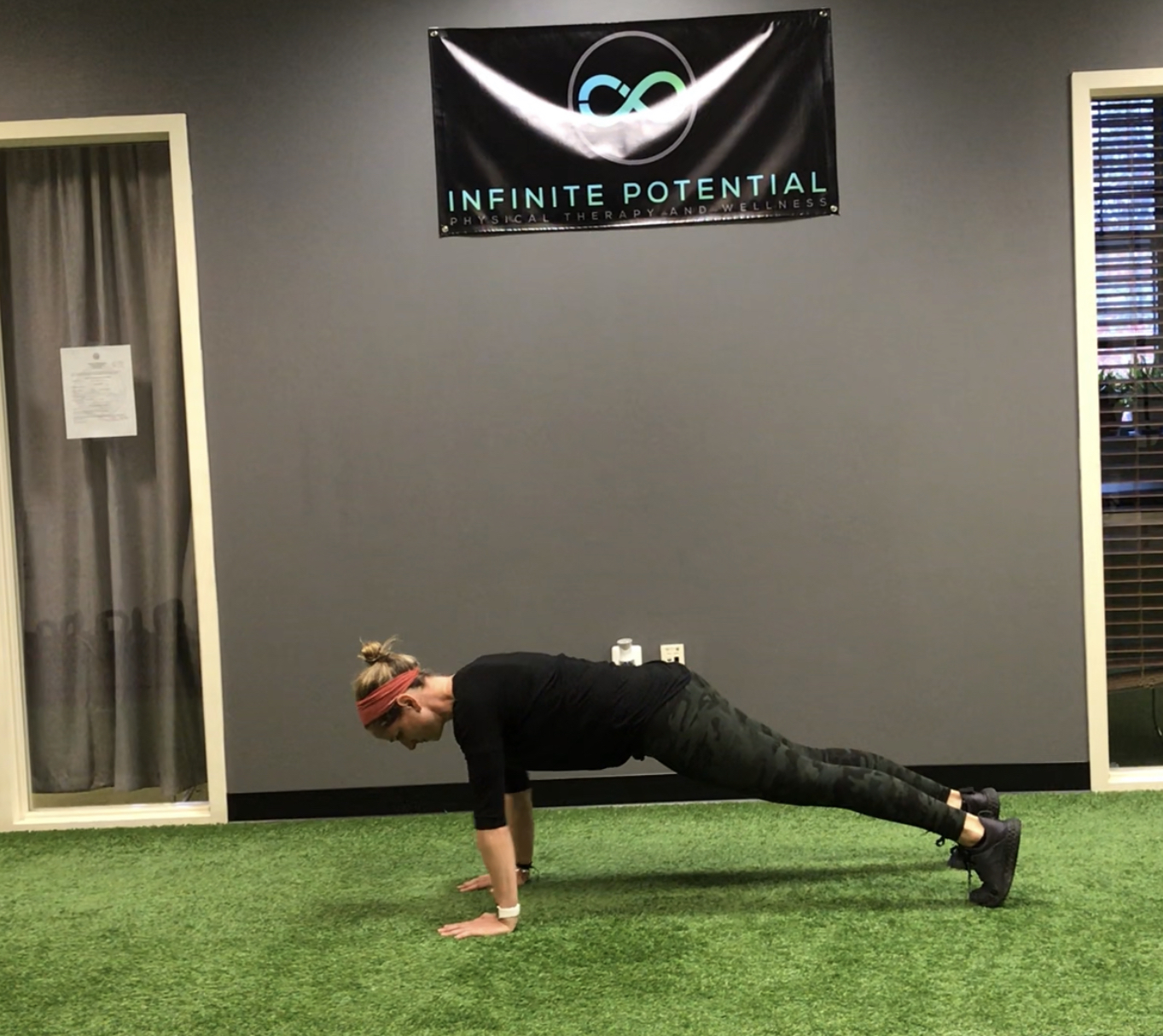
First of all you need to be comfortable in a plank position, so get this position down and aim to hold for 20-30 seconds. Plank from the hands first and then forearms (which is a little more difficult).
Push up descent
Push up to a box (incline)
Next up you can try a push up to a box. Step away from the box and get into a plank position with hands on the box. Slowly lower yourself down maintaining the straight body plank position until your chest makes contact with the box. From here, squeeze and engage the core muscles and push back up to the plank position. Repeat 8-10 reps for 3 sets
Once you have mastered the push-up decline and the push up incline to a box you can move forward to the next steps.
Push up from the knees
Starting on your knees with your hands directly below your shoulders bend the elbows maintaining a straight body position, lowering slowly until your chest touches the floor. Contract your core and press your body back up.
repeat 5-8 reps for 3 sets
When you feel comfortable doing this from the knees you can try your first full push-up!
This time from a high plank position lower yourself to the floor, keeping your elbows tucked in to your side. Contract your core muscles by pulling your belly button to your spine and will pressure through your palms press yourself back up to the high plank position maintaining the straight body position throughout.
by Dr. Loni Rodriguez | Oct 28, 2019 | Exercise advice
Kerry Moynihan
Personal Trainer
Two-time Breast Cancer Survivor
October always gives me pause. With its proliferation of pink it’s a reminder that this month marks breast cancer fundraising and awareness season.
I was caught in the breast cancer cross hairs in 2003 and again in 2013, so I’m a major supporter of all efforts to eradicate this dreaded disease. Until that day, patients and survivors, alike, must take their own health into their own hands and do what they can to live healthy, full lives.
During treatment simply moving from the bed to the couch may feel overwhelming. But studies show physical activity and maintaining muscle mass, encourages patients to take better care of themselves, allows them to engage in enjoyable activities during treatment, and helps with quicker treatment recovery time.
The American Cancer Society recommends all patients, in treatment or post, follow the U.S. Surgeon General’s physical activity guidelines stating that adults should get AT LEAST 150 minutes of cardio each week and strength train twice for ALL muscle groups for AT LEAST 20 minutes per sweat sesh.
As with all exercise, consistency is key so choosing an enjoyable exercise outlet is important in keeping you in the game. And depending on physical limitations, finding the right workout is vital. It’s always a good idea to check-in with your physician and consult with a certified personal trainer to tailor-make an effective and enjoyable individualized program based on treatment and post-op needs.
Aside from its physical benefits, exercise is a mental outlet for stress and anxiety and a cancer diagnosis is without a doubt stressful. While we workout, endorphins (chemicals produced by the body) naturally relieve our stress, boost our mood, and increase our overall well being.
When thriving through a cancer diagnosis, I have found it’s important to use ALL of the tools in the tool chest: exercise being a vital one. It soothes body and soul reminding us that we are strong, capable and alive.
