by Pippa Teague, Strength Coach | May 28, 2019 | Exercise advice, Ladies, nutrition, Uncategorized
By: Kerry Moynihan
Certified Personal Trainer
@Fit4lifeafter50
Life is a winding road and for we women, menopause is a rest stop on the journey.
Those of us “of that certain age”, grasp the realities of menopause: lower estrogen levels, slower metabolic rate (the rate at which our body converts stored energy to working energy), declining muscle mass and bone density. This life stage requires some lifestyle adjustments. We need to meet the changing needs of our bodies in order to age with the good health and continued mobility we all desire. The question becomes, How?
Two words, EXERCISE and NUTRITION.
The reality is that the rate at which we expend energy during exercise declines at this point in our lives. What worked at age 30 won’t necessarily be our golden ticket at 55. Bottom line, increased time and intensity of exercise is important to lower our risk of osteoporosis, metabolic syndrome and heart and lung issues.
STRENGTH TRAINING or weight resistance training is key in developing the muscle that protects our bones by increasing its mass and improving our metabolism. Shoot for gym time two to three times a week and incorporate dumbbells, kettle bells, and resistance bands, as an example.
AEROBIC exercise keeps us heart and lung healthy and burns extra calories. Pick your poison: swimming, rowing, cycling, dancing…….
Our goal should be 30 minutes of the exercise of our choice most, if not all, days of the week. An added tip….take the stairs and bypass that elevator. Just keep moving!!
Mix it up. Do different and unique activities to keep the interest factor elevated. And grab a partner. Exercising is so much more enjoyable with a friend and frankly science backs the fact that it’s a mood booster, too. Make it fun. Final note, consult your physician if you have any concerns about starting a new program.
Let’s talk NUTRITION. My “full bag of Doritos for a snack” days are sadly over. But frankly, I’d rather feel great with better choices than salt overload knowing that I’m taxing my body. So the key word here is CHOICES. Choose whole grains, natural fruits and vegetables, lean proteins, and healthy snacks like frozen grapes or blueberries, which are delicious. Processed foods are not fabulous, so bypass that supermarket aisle. And time your dinner meal so that it isn’t too close to bedtime. Personally, I find my food tracker phone app helpful in tracking my daily protein goals. Lastly, portion control is important. That chicken breast should be the size of your palm, not the super sized forearm portion at your favorite local diner.
Hot flashes aside, Folks, this stage in life is pretty great. It’s in our power to be happy, healthy and active.
by Pippa Teague, Strength Coach | May 22, 2019 | Breathing, Conditioning, Flexibility, Foam rolling, Injury Prevention, strength training, Stretching, Uncategorized
Pippa Teague, Strength Coach
Infinite Potential Physical Therapy
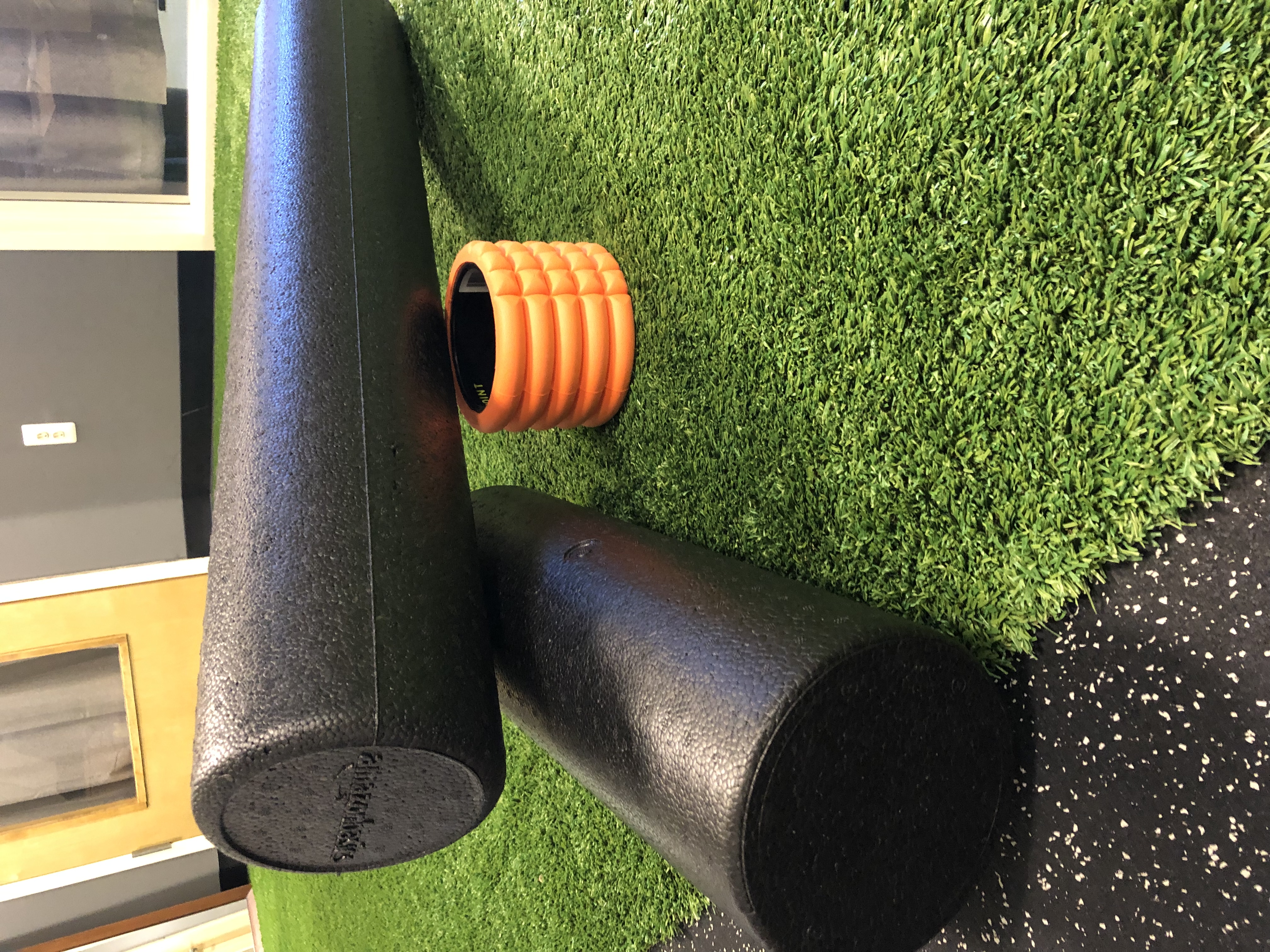
So.. what the heck IS foam rolling exactly? Well, it is rolling parts of your body (muscles) on a foam roller giving yourself your own “massage” or some might say “self myofacial release”.
It is frequently used to promote recovery, flexibility and athletic performance. However, as everyone began to become obsessed with it over the past few years, we have learned more about what it DOES NOT do verses what is DOES do. It has NOT been proven to provide long term effects on recovery, perform, OR flexibility. Short term effects on flexibility? Sure. Long term (what we really want)..? Not so much.
The widely accepted theory is that foam rolling / lacrosse balling / super nova-ing is a way to “release” fascia (soft tissue surrounding all organs, muscles, bones and nerve fibers), adhesions, muscular restrictions, etc. This restriction, adhesion or tightness of this fascia causes decreased joint range of motion and blood flow.
Here is the real deal.. to actually CHANGE the tissue that is underneath your skin (aka fascia) you need a SIGNIFICANTLY higher force than a human exerting it on themselves would need to be used! So let’s get one thing straight.. you ARE NOT releasing anything..
So why are we getting those short-term improvements in flexibility, pain relief, etc..?
The theory is that foam rolling CAN stimulating the nervous system to relax which in addition will improve pain tolerance. Similar to other things like stretching, deep breathing and meditation..
Our Advice? USE IT IF YOU LIKE IT AND UNDERSTAND THAT IT PROVIDES SHORT TERM EFFECTS ONLY.
Apply during your warm up (no more than 2-3 mins)
5-10 passes over each muscle group
We know that more does not mean improved outcomes…
So.. in short. Foam rolling or self mobilization can give you short term gains in flexibility, decrease muscle soreness and pain. KEY WORD IS SHORT TERM! What can it do long term? …..? Unsure.
If you foam roll and you feel like it helps you in your workouts and promotes recovery, then keep it up! If you foam roll and are in agony and doesn’t seem to help you then giving it a miss might not be a bad idea!
Learn how your body reacts and do what feels good!

by Pippa Teague, Strength Coach | May 14, 2019 | Back Pain, Injury, Injury Prevention, knee pain, Ladies, lifts, Neck Pain, Running, running help, strength training, Uncategorized, working with injury
By Loni Rodriguez,
Physical Therapist
Do you know what fires me up more than anything? It’s hearing a story from a client that begins with… “I felt like the doctor did not understand where I was coming from.”
You may not know this story, but I dealt with hip and low back pain for just over 2 years when I was going through graduate school. It came on gradually while running one day on the treadmill. It was sharp, came on strong and would not let go. It gradually persisted and ultimately led me to have to stop running all together. It derailed me and created a borderline depression around the fact that I was unable to exercise like I had wanted to. I went from running almost every day to dealing with persistent hip pain that I would feel first thing in the morning and be with me until the minute I went to bed. I would wake up wondering if it would just go away…
How I was going to be able to go out with friends? Sit at a baseball game? Go shopping? Play football with friends on the beach? It consumed me.
I went to a plethora of doctors and physical therapists, had injections, saw specialists and was convinced that my hip required surgery because one MRI found a cartilage tear. I was constantly searching for answers to the cause of my symptoms and coming up short time and time again. Fast forward 7 years, symptoms have improved dramatically and I no longer deal with persistent pain. I feel stronger and more resilient than ever… so what can I contribute it to? That is a question I do not have the answer to… yet, but is not the point of my story. I am not going to tell you I have the magic answer to solve all persistent pain like this… But I am damn sure I know what would have helped me along the way.
Looking back on this, I realized one common piece that I was missing. I didn’t have a healthcare provider that told me that I was going to get through this and they were going to guide me… that is all I wanted, someone to tell me they would lead me on a path to feeling better and more confident in my hip.
At 21 I had one person – a doctor, surgeon and low back pain specialist tell me that I was going to be dealing with pain for the rest of my life. I remember crying in my car after the session, not because I thought he was right, but because I knew he was wrong. I was more upset because I knew he was going to be giving that same screwed up advice to all the other poor souls in the waiting room. I knew that I had a better understanding of pain and did not want to take that answer as my fate.
I wanted someone to listen to my entire story and not seem like the details were obsolete. I remember creating a pain log to show one of my providers and they didn’t even look at it. Finally, overtime I gradually improved and found my way of returning to exercise – running, lifting weights, competing in CrossFit and running races without even thinking about my hip or low back. This took time and hard work, but I made it.
This is not how an experience with a medical professional should be. You should 110% be involved in your own plan and be guided in that direction.
Have you ever had an experience with this? Have you ever been a fly on the wall in this situation with a family member? How many times have you or someone you know had to accompany a family member at a doctors appointment because you do not remember what they said.
I would love to hear YOUR story…
It does not have to be like this! Seek other advice from someone who listens.
Thank you for taking the time to read and have an awesome rest of the week!

by Pippa Teague, Strength Coach | May 6, 2019 | Abdominals, Breathing, Diaphragm, Stressrelief, Uncategorized
By Anna Burns, PT, DPT
Infinite Potential Physical Therapist
One of the simplest things you can do for your core, your pain, and your stress level is to breathe. When working out or concentrating, it’s always the first thing to go. Our diaphragm is directly connected with our nervous system. When our nervous system is on high alert with pain, stress, anxiety, or fear, engaging our diaphragm can switch the nervous system from “fight or flight” to “rest and digest,” decreasing pain and stress levels. It’s one of our best tools to manage pain.
We have adopted a couple of different ways of breathing that “get around” the diaphragm. One is breathing with the upper chest; this breath is “emergency” breathing, a very shallow pattern that we perform when we are stressed or scared. Click HERE for an example of Emergency Breathing
Another way is “belly breathing,” in which we distend our bellies outward on purpose. While the belly rising is normal with inhalation, it should not be consciously distended. Click HERE for an example of Belly Breathing
Optimal breath engages our diaphragm, a large muscle that sits under our lungs and over our stomach. By breathing into this area that touches all aspects of the rib cage, the diaphragm contracts to expand the surface area for oxygen intake in our lungs. When we exhale completely, the diaphragm relaxes to push out the stale air. To activate your diaphragm, breathe in through your nose (CLICK HERE FOR VIDEO). Visualize a balloon in that area expanding as you inhale. Exhale slowly through your mouth, deflating the balloon, as far as you can until you have no air left. Pause a second, and then inhale again through your nose. Try not to bulge out your belly on purpose or move your back. In fact, I love practicing this laying on my back. So take a mindful moment (or several!) throughout your day to breathe. As one of our clients likes to say, “Breathing is NOT optional!”
by Pippa Teague, Strength Coach | May 1, 2019 | Conditioning, Exercise advice, Jumprope, strength training, Uncategorized
By Pippa Teague NASM CPT, WS
Infinite Potential Personal Trainer, Orangetheory coach, Professional Figure Skating Coach
I love double unders and jump rope in general but I know dubs don’t come easy to everyone and there are some tricks and tips that can help!
In general, jump rope is a great conditioning tool. As a competitive figure skater I would use it frequently to warm up in the rink and before competitions. It is light and easy to bring to smaller spaces and gets that heart rate up fast!
Being effiecent in jump rope and getting those dubs will help to improve the following:
-Speed
-Coordination
-Endurance
-Body control
-Strength
-Power
-Reaction speed
Here is my guide to achieving your first double under.
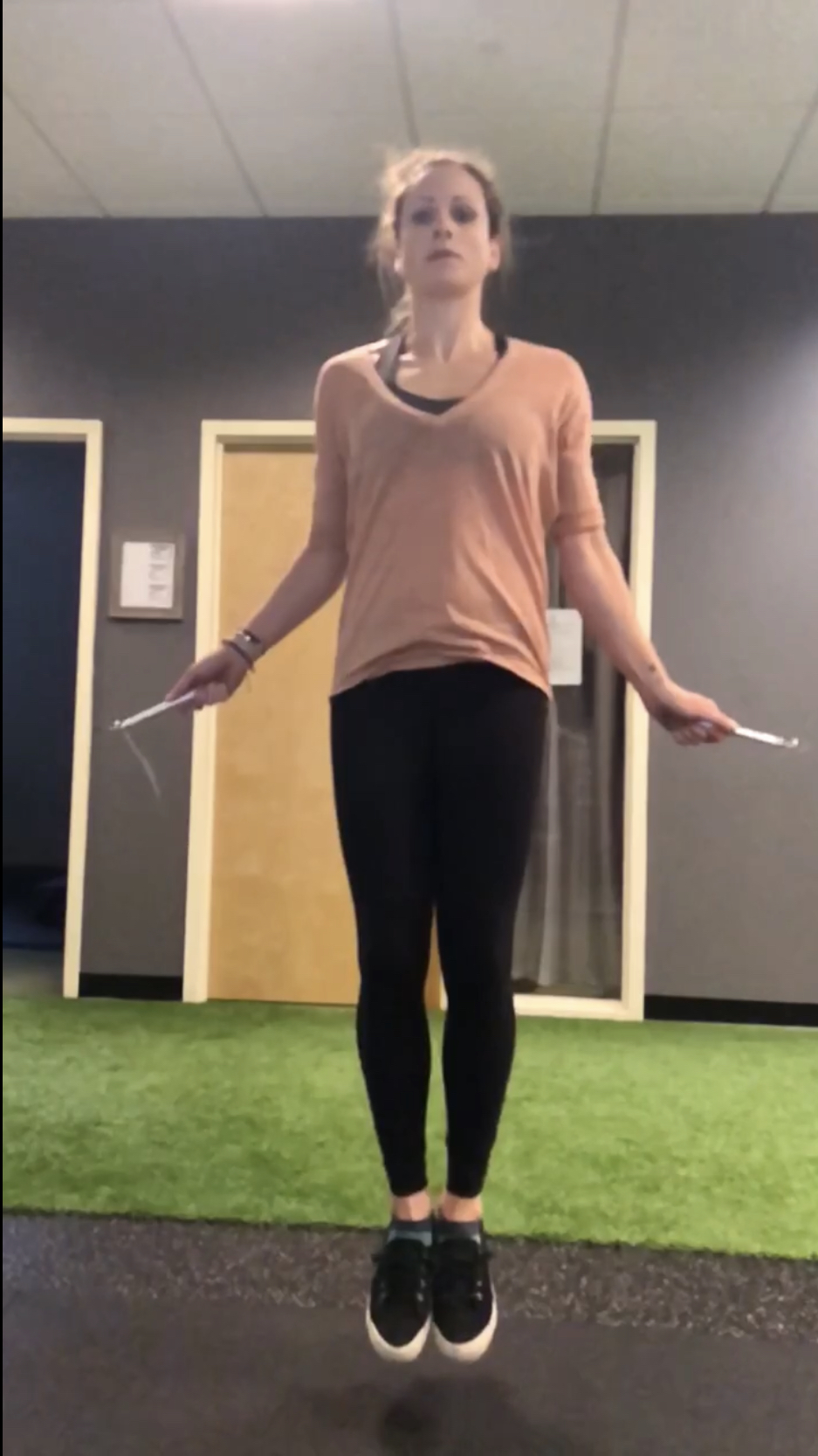
First make sure you are efficient with your single unders. Be able to quickly manage about 20 in a row unbroken. A big mistake I see very often is trying to make large circles with the arms in order to bring the rope through. Try to keep your wrists and arms close to your side. A trick to help is to squeeze a rolled up towel under each arm. As you jump the wrists actually flick down. So think about your thumb turning a tight circle towards the ground as you jump upwards. Timing should be even and smooth. Focus on one point in front of you.
Single unders
Double under timing.
Penguin taps:
Without the rope jump up and tap your legs twice. This is how fast you need to be doing the flick motion with your wrists. The jump itself should not change, you want to jump higher for the double under but legs should look the same. Often times people will bend the knees up in a tuck fashion. Try to avoid this. Toes should still leave the ground last and legs stay straight.
Once you feel like you have the singles down you should start trying a couple of doubles mixed in. Use the timing of the singles to help flow you into a double so it might be something like single-single-single -double-single
When you can manage this, try to get two in a row. The hardest part is the timing and jumping straight into the next one.
Double unders
Good luck and tag me in your double under journey !
by Pippa Teague
Infinite Potential Personal Trainer, Orangetheory coach, Professional figure skating coach
NASM CPT, WS
