
by Dr. Loni Rodriguez | Jan 2, 2020 | Posture
Perfecting Posture
Desk sitting, phone surfing, computer typing – it’s the nature of modern day living. As a result, our proper posture has taken a punch in the gut. Neck pain, shoulder hunching are an inevitable result so being mindful of body position is key.
How to build awesome posture?
POSTURE EXERCISES:
- Chin tuck: Strengthens muscles at the front of the neck. Place two fingers at the bottom of your chin. GENTLY tuck your chin in and retract a your head back keeping your chin gently tucked the whole time. Hold this position for 3-5 seconds- relax your neck – repeat two to three sets of 10 reps.
- Shoulder Blade Squeeze: Strengthens low and mid-back muscles. Position yourself in a chair with feet and knees slightly wider than hips. Gaze forward. Spine is neutral, hands rested at your sides. Bring arms back and externally rotate them so your thumbs are pointed backwards. Hold position for 5-10 seconds- release – repeat two to three sets of 10 reps.
- Cat/cow: Relieves tension in torso, shoulders, neck. Go onto your hands and knees with weight balanced evenly. Inhale, look up while dropping your abdomen towards the ground as you extend your spine. Exhale, arch your spine towards the ceiling and tuck your chin into your chest. Continue slowly for one minute.
- Plank: A classic. Helps relieve pain and stiffness throughout the body. Strengthens shoulders, glutes, hamstrings, core, back. Go onto your hands and knees. Straighten your legs behind you. Engage abs, arm, leg muscles. Lengthen your spine, shoulders packed into back away from ears. Hold position for one minute.
Perfecting our posture helps us develop all over strength, flexibility and balance – combating the realities of a modern day technological world.
By Kerry Moynihan
Certified Personal Trainer
@fit4lifeafter50

by Dr. Loni Rodriguez | Dec 23, 2019 | Injury Prevention
Are you thinking about starting something new in January? Setting some workout goals or planning to participate in a challenge at your gym?
We all love to start the New Year off right with things like new workout routines, gym challenges, or general lifestyle changes. Maybe this year your goal is to run a 5k or compete in your first CrossFit competition, or maybe it is to complete the OrangeTheory Fitness ™ “Transformation Challenge”. This is all well and good, but you must make sure what you are doing is not drastic, is realistic, and is gradual. I can not tell you how many times I have seen someone in March or April who is coming to see me for pain that came on after participating in some form of new workout regimen or routine. I am the last person to tell someone NOT to participate in something, but you have to know yourself, your body, and how to take care of it during this time!
Here are some tips that will help reduce your injury risk as you venture into your new routine.
1. PROCEED GRADUALLY
If your new plan involves a workout routine that your body is not used to then you have to proceed into that new routine as gradually as possible. Maybe that means adding a few extra gym days, or increasing your running mileage. Maybe you are planning to work with a personal trainer in addition to your regular routine in order to get stronger and fit in a new way. The best advice I can give you is make sure that you are not increasing your overall workout intensity by more than 10% per week. That means how HARD you are working should not change much from week to week.
How do you figure that out? You have to understand your baseline and then the level of intensity you are partaking in.
Here are some examples…
Let’s take days of the week. If you normally workout 2 days per week and the challenge asks for 3, then that is about a 50% increase. I am not saying to not go to the gym that 3rd day, but plan accordingly by making one of those days a bit less intense. This will decrease your overall intensity level.
How about a new workout routine… you went from doing yoga and Pilates to starting OrangeTheory Fitness ™ 2 days per week. That is a 200% increase in your intensity level. I am by no means saying that you should not start a new routine, but your intensity level has to stay low and gradually increase as you adapt to the new training program.
Just remember, that most injuries come from doing too much after doing too little for too long.
2. USE YOUR DAYS OFF TO BENEFIT YOU
It is super important for your body to have days that you aren’t in the gym. If you have a plan to go that extra day, then you need to make sure your week has an extra day in it that you are resting. A day full of errands, taking the dog for a 2 mile walk, and a full clean of the house is not a complete rest day. Does taking a full rest day sound foreign to you? That is fine, try to at least do half as much as you normally do on one of the days during the week.
3. GET YOUR RECOVERY IN
This is one of THE most important things to think about keeping as a priority during this time. I am not talking about getting on a foam roller more often, stretching more or getting massages, etc. I am specifically referring to SLEEP, HYDRATION, and CLEAN FOOD consumption. This is something that can be tracked and modified easily throughout your week.
3. LISTEN TO YOUR BODY
If you have read my content before, you know well that I am someone who promotes pushing yourself and not shying away from pain all the time. However, there are many circumstances that warrant you to slow it down, lessen the load, decrease the intensity in the short term. If pain starts to sideline you, GO TALK TO SOMEONE. It is not just going to go away if you stop doing that said painful activity. Most pains will go away on their own, but as soon as you start back up again they come back most of the time.
4. TRY A NEW NON-TRADITIONAL GYM WORKOUT
This is a great time of year to do something new that is not an intense workout. Try getting outside on local trails, trying indoor rock climbing, take up gentle yoga or meditation class. These are GREAT things to do on off-days at the gym that do not tax your body.
These are just some things to think about as you proceed into the New Year. They can obviously be applied to many situations at other times of the year, but most people start something new in January and I wanted to give a few guidelines to follow.
The first and third tips are the most important to keep in mind! If you have questions about your new routine, post comments below or reach out to us personally. We are happy to help!
Wishing you all a safe, healthy and Happy New Year!

by Dr. Loni Rodriguez | Dec 19, 2019 | Exercise advice
Do you know anyone who has suffered
an ACL tear? This is one of the most common knee injuries and takes a long time
to come back from. It’s the kind of injury that can keep an athlete out for a
whole year and requires surgery and a lengthy rehab. When I see someone with
this injury, I tell them that it will take time, but they definitely can make a
full recovery and get back to playing their sport. The process takes hard work
and commitment, but the outcomes are very good.
There are lots of important parts of
rehab from an ACL injury, but I want to highlight certain things that make sure
an athlete can safely get back on the field.
- Long term commitment– When coming back from this injury, the athlete has to understand that you can’t rush the process. The ACL takes a long time to heal and research has shown that it takes a minimum of 9 months to become strong enough to safely play sports. Even more importantly, the athlete has to develop the muscle power and strength needed to run, jump, and cut on a field.
- Strength training– When rehabbing from an ACL injury, the muscles in our legs lose a lot of strength and need to be trained to be strong again. Early on this strengthening is necessary to allow the person to regain normal walking mechanics, the ability to go up the stairs, and to get in and out of a car. As time passes and you get stronger, the training becomes even more specific to your sport so that your muscles can support the ACL as much as possible.
- Landing mechanics– One of the risk factors for ACL injury is landing mechanics. When landing we want to make sure the athlete has control of their knee and are able to maintain stability. As the athlete gets stronger and is closer to returning to play, it is important to make sure landing mechanics are practiced in all different ways. This means working on jumping/landing on two legs, on one leg, landing from different heights, and making the practice specific to their sport.
- Mentality– This is an area that doesn’t always get as much attention as it deserves. Returning to the sport that an athlete got hurt playing can be really difficult and scary. It is so important that we take the time to help each person feel confident in their ability to move. Developing the right mentality takes time, but we know that it is vital for the athlete to return to 100%.
- Consistency– When you know that it’s going to take at least 9 months to get back to playing, it is easy to get discouraged. It’s okay to have a day occasionally, when you don’t feel like doing your exercises. However, you have to stay committed to working hard each day and continue to push yourself to get stronger. When rehabbing from this injury it is important to keep working all the way until you’re back on the field. Going to PT for 5 months before trying to do the rest on your own isn’t the best strategy for making a 100% recovery. Train to get back on the field and then keep training so you can stay there.
These are just some of the different parts of working with athletes recovering from an ACL injury and as always, the most important part of rehab is working with someone you trust.
If you or someone you know is rehabbing from an ACL injury, let us know about your experience!

by Dr. Loni Rodriguez | Dec 12, 2019 | healthcare
Yes, cute dog just to catch you eye 🙂
Knowledge is Power… Especially In Healthcare.
I am going to assume that some of you are self-employed but I know that many of you work for companies who provide you with a health insurance benefit. Well, even if your company supplies it, it is still INCREDIBLY confusing to choose the “right” plan. You read and search and all the words are big and confusing and it is very difficult to decipher in order to make a decision on which plan to choose. All you want is someone to talk you through it to understand the “investment” you are about to make…
This was me yesterday. It is open enrollment time and the last plan I choose was horrible so I was on the hunt. I am obviously in the healthcare field so I understand some of the verbiage, but even for me it was foreign. So… I called the customer service line in hopes for help.
20 minutes later after a dropped call, 2 different agents, and a wait time I had my man on the phone.
Man: “Hello, thank you for calling XYZ insurance, how can I assist you today?”
Me: “Well, I am trying to compare plans from various providers and I would like to understand a few of the words used in the benefits description of each plan and…”
(Interruption)
Man: “Well, I am sorry ma’am but I only work for XYZ Insurance and I can not answer anything about other plans.”
Me: “I am just looking to understand some of the common words I see, like deductible, and…”
(Interruption)
Man: “We are not able to discuss any other plans benefits except the XYZ insurance plans.”
(Getting angry now)
Me: “Listen. Can you just tell me what out-of-pocket max means if i have a deductible and coinsurance… and what is coinsurance?”
He finally answered me and it turns out that I understood all the verbiage. I just wanted clarification! I wanted him to educate me on HIS expertise to allow me to pick the plan that was best for me and my needs, not sell me a plan or talk about other insurance providers. Not only was it was unbelievable that he was interrupting me and not listening, but that he kept explaining that he could not help me. Once he finally listened, he realized that he could in fact help and did.
The point of this discussion is not to discuss the rising costs of healthcare but to discuss customer service. Since I opened my practice and have emphasized refining the customer experience, I can really see when my experience with another service is crap. This was one of those times. If the man on the phone took his hard hat off and realized that I just wanted to be educated and a bit more informed, I would have been very pleased.
Don’t settle for crappy service… Get yourself educated in every way possible… Knowledge is power!
Interested in knowing a bit more about the confusing health plan words? Here is a quick reference list!
Deductible: What you pay before your plan starts to kick in. Some preventative services are covered and do not apply to your deductible which would include things like yearly visits with your doctor. If you have a co-payment, you do not pay your copayment if you have a deductible, you are just paying your deductible until it is met. This would mean that you are paying for the procedures in full until you hit the deductible Sometimes, you then have a copayment AFTER the deductible has been met.
Coinsurance: A percentage that you still pay AFTER your deductible is met. If you have a 20% coinsurance and a $2,000 deductible, then you are paying your 2k outright and then 20% of all medical costs after the 2k has been met.
Out-of-pocket max: This is the max amount of money you will spend on healthcare in the year if you use your benefits with a participating provider. This includes your deductible, co-payments, AND co-insurance.
Overall, health insurance is not fun and not fair but we live in a world where many healthcare procedures are incredibly expensive when paying without insurance. Did you know that most procedures done in a hospital are more expensive vs at your primary care office? Also, many primary care docs have to refer you for tests done at hospitals and if you do not have hospital-based coverage, you may be hit with a HUGE bill! I’m talking HUGE!
My overall advice… ALWAYS ask the providers billing department what your cost is going to be BEFORE a procedure is done and give your health insurance a call before you do anything.
Ask questions and get informed!

by Pippa Teague, Strength Coach | Dec 3, 2019 | Exercise advice
As a personal trainer and group fitness coach I am often asked the question “when am I going to see the results”. Well, this is a tough one to answer as everyone is on a different fitness journey and everyone is different. We each have different lifestyles, jobs, body types, genetics, and age. It can be very easy to compare yourself to others who started at the same time or friends the same age. This is normal and everyone does it but truth is- we just need to enjoy the ride and not put so much pressure ourselves to see fast results.
Below is some advice to help you on your fitness journey:
Stay consistent
Be consistent with whatever it is you are doing. Classes two to three times a week, maybe you see a personal trainer, take a walk on the weekend, play tennis. Whatever your fitness regime is stick with it!
Crazy fad fitness and diets don’t work! Get involved with something you can incorporate into your lifestyle forever or at least a long time. It needs to be part of your routine, like brushing your teeth at night. Trying quick fads never stick!
Eat clean or as close to it as you can
Going to the gym everyday but still eating way too much or junk processed foods won’t get you anywhere. Sure -you will get stronger and be more fit but you won’t physically see all the results of your hard work if your nutrition is not on track. That’s not to say you need to be super crazy with it but try to get good clean food into your body- meat and veggies and not too much over processed carbs! Maybe you actually need to increase the amount you are eating, maybe you aren’t fueling your body enough! Restricting and under eating can be just as bad!
Allow yourself some cheats and don’t feel bad about it but try to eat clean 80% of the time.
Keep your eyes on the prize!
Remember the reason you started on this journey. What is your why? Stay focused and motivated. Having a fit and healthy life will improve many aspects – improved strength to do daily tasks, ability to run around with children or grandchildren, improved mental health, heart health, and sooo many more.
Training should be fun
Don’t overdo your training program. Make sure you are training smart and effective. You don’t want to have to drag yourself to the gym and you also don’t want to end up over training and feeling fatigued. Your body needs recovery time, over training will add additional unnecessary stress.
Bottom line is being confident in what you are doing and trying to achieve and not stressing out about seeing fast results!
By PippaTeague
Infinite Potential Strength Coach and Personal Trainer
by Dr. Loni Rodriguez | Dec 2, 2019 | Injury Prevention
Exercise and injuries…
How many of you have “taken time off from the gym because of an injury?” I personally know most of you reading this, most should raise your hand. Go ahead, raise it.
OR… Does this sound more like you?
How about you just go to the gym but stop doing the thing that hurts and just ignore it, hoping that the pain will just go away and you will once be able to wean back into it
Okay… speaking from experience, taking time off and begin injured is really not fun. It is also really not fun to have to modify your workouts, right?
WHY? Let me take you through a few scenarios…
It reroutes your routine First off, your normal routine gets all messed up because for most of us, the gym is part of your daily or at least weekly routine. This impacts not only the rest of your day but also your social life. If you aren’t going to the gym, then you aren’t seeing your friends. On the other hand, let’s say you are going but you are modifying – still not as satisfying as hitting it hard, no limtiations.
You’re sluggish You feel sluggish, you begin to lose your energy level and start to feel out-of-shape. You begin to feel like the endurance and strength you have build will all be lost.
Fear You begin to be a little concerned that your pain is not going to go away. You know that it is still there because you tested it a few times on a run and yup, it is still there.
Concern Okay, now it is really not getting better… but it is not really getting worse? You are not sure where to turn or who to talk to.
So… I have been injured, I get that you don’t always want to ask for help. Time will go by and most things get better with time. You are spot on… However, there are a few things that can really speed up the process when you are injured.
Here are 4 tips that can really help speed up the process of healing while being injured:
- KEEP GOING TO THE GYM
- KNOW HOW TO MODIFY
- KNOW HOW TO WEAN BACK
KEEP GOING TO THE GYM.
Most people I know still do this and there are HUGE benefits!
- Continuing to go to the gym helps maintain your fitness and work on other areas of weakness that you may have been neglecting.
- Keeps you in a regular routine. This one is HUGE! You MUST have a routine to keep yourself sane. There are many times that you HAVE to take a break from some activity or movement for a short period of time, but you MUST know how and when to modify.
KNOW HOW TO MODIFY.
Many people use pain as a stop sign, it hurts so STOP. Well sure, sometimes we need to do that but it is also important to still use that body part or region of the body during other activities!
Here are some examples of how to work through let’s say, a knee injury…
Knee pain with running?
Try the elliptical The elliptical is a great option to substitute as well as fast walking. Keeping yourself on the treadmill or road is very important. If you are a runner and love that runners high but can not run right now, throw on a weight vest and get after a 45 min walk at a fast clip – you will be surprised at how much your heart rate will skyrocket.
Get stronger Strength training for the lower body is a main-stay for knee rehab and time off from running is a great time to begin to emphasize it. Strength work will no only help rehab the knee while it heals, but it will also dramatically improve your running performance once you are back on the road… a WIN WIN!
Knee pain with squatting?
Modifying the weight, the speed, and OR the range of motion can be the best way to modify when it comes to pain with squatting.
- Weight If it does not feel great to squat with weight, make it a little lighter and increase the reps to still get something out of the workout
- Speed Slowing a movement down can be a serious challenge… If you are having knee pain with squats, try squatting SLOW – 3 second count on the way down, 3 second hold at the bottom, and a 3 second count on the way up. It will get real spicy, real fast! It is a great way to get. Good training effect without heavy weights
- Range of motion Maybe partial squats are where it’s at for you right now, because deep squatting is painful. Well guess what, that is FINE! Partial squats have many benefits and if you are still training the squat but just changing it up a bit for a while, you are doing GREAT!
KNOW HOW TO WEAN BACK
This is the hardest part for anyone… Patience is key and understanding the steps you need to take is very important.
- Give it time So… You have been feeling really good, you do a test “run” to see how your hip is feeling and it feels great! I would not suggest trying to run again, tomorrow, farther, faster. Stay at the same level of intensity for at least 10 days and do not repeat the activity more than 2-3 times within those 10 days. At that point, you can progress, but only if you feel 100% confident.
- Continue your rehab So… You are rehabbing yourself or working with someone and have been strengthening things up. Great! Keep doing it and make sure the routine aligns with your goals and is progressive! Your rehab / strength work needs to get harder and progress.
Everyone’s rehab from and injury is different. Every client we see is a human, there are life things that have to be taken into account, different goals, lifestyles and routines. All of that plays a HUGE role in HOW to wean back from an injury. I am hoping that this gives a little insight on how you may be able to apply this to your own injuries or pain you have been dealing with.
Questions? Let us know or find yourself a solid rehab team to get you back on your feet.
by Dr. Loni Rodriguez | Nov 25, 2019 | Personal training
By: Kerry Moynihan, Certified Personal Trainer
Fit4LifeAfter50.com
It’s that holiday gift giving time of year. Be a super Santa in your fitness fan’s life by placing something special under the tree. Here are some at home equipment ideas for your Christmas shopping list:
- TRX HOME2 SYSTEM: $169.95
Suspension trainers allow you to use your own body weight to build muscle and strength. The TRX system (Total Resistance eXercise) is at the top of the market. Your at-home system can be suspended in the door frame for a convenient and mobile workout.
- AB DOLLY: $79.99
The Ab Dolly roller system builds core galore. Exercises range from upper body rollouts to lower body knee pulls – allowing you to target all major muscle groups. It isn’t nicknamed “Satan’s Skateboard” for no reason. Ab Dolly exercises are challenging and effective.
- RESISTANCE BANDS: $10.00
These loopy latex bands are effective, stretchy, portable and perfect for stocking stuffing. They can be used for a range of exercises from glute & hip activation to shoulder, arm and back work. If your fitness fan is a traveler, these are the pick – easily packable.
- FOAM ROLLER: $14.99
Foam rollers aid with muscle stiffness and loosen muscular knots. Perfect gift for those plagued by post-exercise soreness. Rolling improves range of motion and helps with muscle fatigue. This is sure to be a fan favorite.
- EXERCISE BALL/YOGA BALL: $19.88
This uber durable elastic ball comes with a pump to blow it up to approximately 30 inches. It’s major benefit is that due to its instability, it recruits more muscle, allowing for super efficient, effective and challenging exercises like: push-ups, wall squats, crunches, roll-outs, to name just a few. Plus, the color options make this a festive and fun gift.
- BOMBAS PERFORMANCE SOCKS: $15.00 +
Like working out on a cloud! Bombas use the softest of yarns to create comfortable, cozy, anti-microbial and moisture-wicking socks. Added to that, the Bombas company believes in a “one purchased – one donated” philosophy. So far over 25 million clothing items have been donated to homeless shelters and organizations thanks to Bombas customers and the Company’s sense of community. That’s a seasonal win/win.
Wishing you a wonderful season of family, friends, fun and fitness! 🎁

by Dr. Loni Rodriguez | Nov 21, 2019 | Injury Prevention
Dr. Loni here, coming to you with some info on why we get hurt!
There are many causes for injuries, WAY too many to list and name. Why is that? We are all different human beings with different inner workings, work schedules, ability levels, past histories of injury, medical conditions, motivation levels, fears, sleep qualities, nutrition habits, and the list goes on…
So what is the number one predictor for injury? Hands down, the research tell us that the number one predictor of injury is previous injury.
This, however is not something that we can modify. We can’t take back time. So, what CAN we modify? Well, give this next statement a read…
Most injuries occur from doing too much after doing too little for too long.
So… why do we get hurt?
Injuries and pain have a TON of contributing factors, too many to name and too specific to each person to narrow down to an all inclusive list.
One of the best ways to look at an injury or develop a prevention strategy is to think through these key points:
- Are you dealing with current injury or pain? Did YOU put YOUR body through more than it used to at a faster speed than it could adapt to?
- Are you thinking about Injury prevention: Can you find out what your goal is and create an exercise routine around that goal? Will it allow your body to SLOWLY adapt and become resilient to the activities you want to put it through?
Think a bit less about how to FIX what is going as the first line of defense on using specific fixing methods for pain relief, movement correction, etc.
Think more about the relevant causes, make some short-term modifications, maybe add some fixing methods in along the way to help you get by, and put a plan in place to SLOWLY allow your body to adapt to what you want it to do.
Did you learn something here? Let us know! Do you know someone who would benefit from reading this? Pass it along.
Until next time…

by Dr. Loni Rodriguez | Nov 14, 2019 | working with injury
The picture above is with my grandma who turned 82 this month! Happy Birthday Grandma!
There are times when clients will let me know of their woes before the session. Usually by email… It is as if they are trying to prep me so I am ready for them to lay it on me.
I am going to share a story of a client of mine who has come SO far, but is still having some issues with leg and back pain.
A line in the email received before the session was… ”Well, I think I have lost my motivation for all of this. We will have to talk tomorrow…”
At first, that makes me sad because it is my job to keep her motivated. It is my job to be the voice of reason, to help her see the light at the end of the tunnel and to be her guide. I thought that there was a possibility that I had failed her. No, I can not help everyone (even though I would like to think so)… But I know darn well that there is still hope for this one.
Going into the session, I had no idea what to think, I had no idea what she was going to come in with or where the session would end up.
Well… in walked (patient who will be named Jane for the purposes of confidentiality).
Jane: “You know Loni… I don’t know if I will ever get over this”
Loni: “Why do you say that?”
Jane: “Well, I workout 4-5 days per week. I lift heavy things, I squat, I run, I lunge and do sit ups. Why does my back and leg still hurt after a full 8 hour day of housework?”
Loni: “Tell me about how you would feel last year if you were to do 8 hours of housework?”
Jane: “Oh, there is no question that there would be NO WAY I would be able to do 8 hours of housework. My leg wouldn’t have been able to handle that.”
Loni: (Silent smile)
Jane: “I have progressed haven’t I?”
Loni: “Yes ma’am!“
This is a great example of understanding that being pain-free or symptom free is not always the best end goal. Of course, that is what we want and can keep working towards. But in reality, the best goals are the small, incremental ones and really based upon FUNCTION. Those goals should also be frequently revisited. Why? Because it allows you to see that progress! It lets you look back and reflect on where you started and where you are. It can significantly brighten your outlook.
The person in this story came to me barely able to do 2 sets of 5 bodyweight squats without having significant pain.
Her Monday’s now look like 5 sets of 5 back squats using 75 pounds.
I could not be more proud of her and I feel very privileged to be part of her journey.
Next time you are feeling down about where you are in the present, take a peak at where you started.
Thanks for reading, keep on keepin’ on…
by Pippa Teague, Strength Coach | Nov 11, 2019 | Abdominals, Conditioning, Exercise advice, Personal training, Pushups, Recovery, Running, Shoulders, stool, strength training, Telehealth, Uncategorized, youthtraining
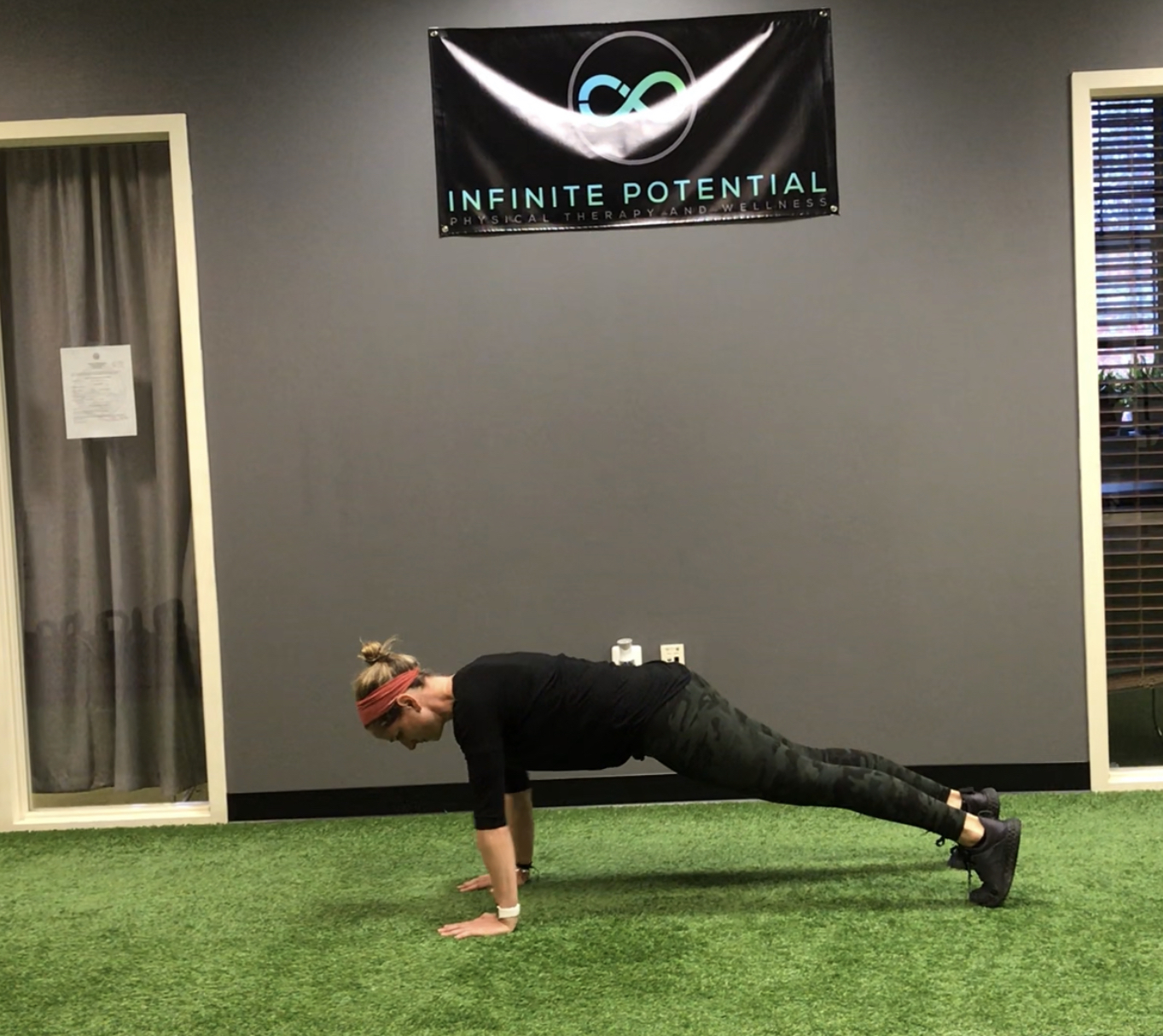
The push up is a very effective body weight movement and one that requires practice to master!
Here is my advice on how to get a push up!
First of all you need to be comfortable in a plank position, so get this position down and aim to hold for 20-30 seconds. Plank from the hands first and then forearms (which is a little more difficult).
Push up descent
Push up to a box (incline)
Next up you can try a push up to a box. Step away from the box and get into a plank position with hands on the box. Slowly lower yourself down maintaining the straight body plank position until your chest makes contact with the box. From here, squeeze and engage the core muscles and push back up to the plank position. Repeat 8-10 reps for 3 sets
Once you have mastered the push-up decline and the push up incline to a box you can move forward to the next steps.
Push up from the knees
Starting on your knees with your hands directly below your shoulders bend the elbows maintaining a straight body position, lowering slowly until your chest touches the floor. Contract your core and press your body back up.
repeat 5-8 reps for 3 sets
When you feel comfortable doing this from the knees you can try your first full push-up!
This time from a high plank position lower yourself to the floor, keeping your elbows tucked in to your side. Contract your core muscles by pulling your belly button to your spine and will pressure through your palms press yourself back up to the high plank position maintaining the straight body position throughout.
