by Pippa Teague, Strength Coach | Sep 30, 2019 | Conditioning, Exercise advice, Injury Prevention, Personal training, Recovery, Running, strength training, Uncategorized, youthtraining
by Pippa Teague
Infinite Potential Strength Coach
I would like to start off by giving the research credits to Barbell Medicine and their 3 part series has been summarized below.
Previously a lot of peoples beliefs surrounding youth and resistance training involved some of the following quotes and I still hear some of these coming up today:
“Resistance training stunts growth”
“Kids shouldn’t lift weights-it will damage their growth plates”
Well…both of these statements have been proven to be wrong and we have slowly shifted from that mindset.
Childhood is the time where we need to be focusing on building bone mass and structure by weight bearing activities!
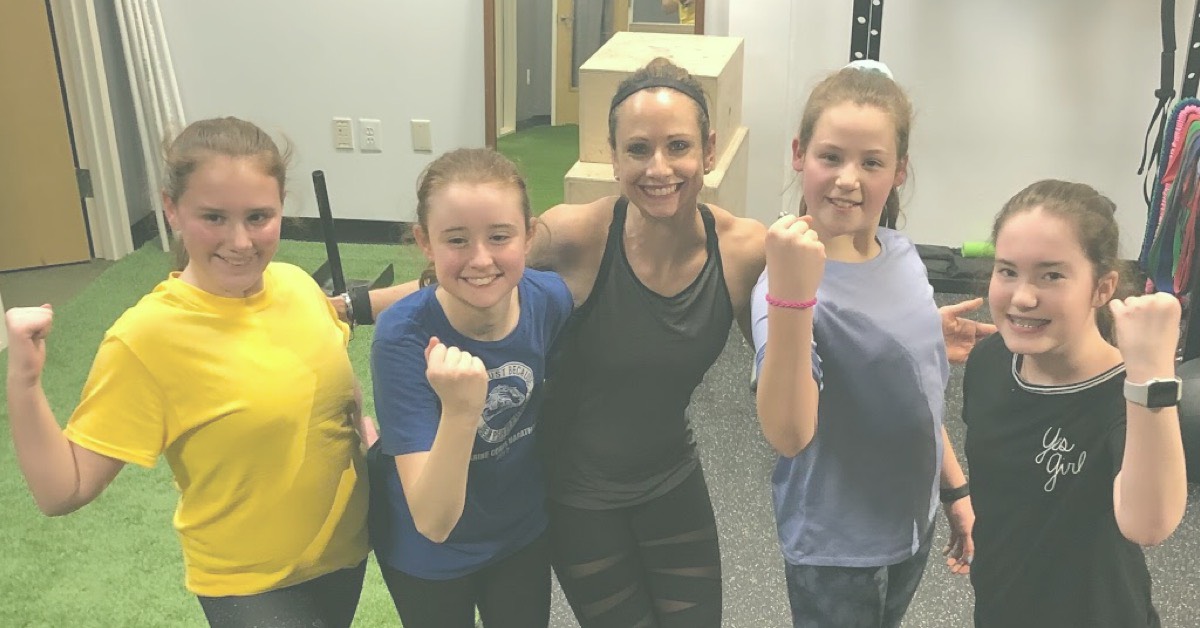
It is ok for kids to weight train and resistance train-in fact, its GOOD for them!
Studies have shown these three important factors to resistance training as a youth
- Resistance training should be essential for aspiring athletes
- Participation early in life correlates to later life
- Those who don’t resistance train are at a higher risk of negative consequences
Developing those skills early in life is very important if we want to remain healthy and fit as we get older.
Today 10 year olds are participating in the same amount of exercise as 60 year olds!
We are failing at getting our youth to exercise the amount that has been recommended – 5-17 year olds should engage in 60 mins of moderate to vigorous activity/day! Only 40% are actually achieving this!
Here is a breakdown of some age ranges and examples of how to include resistance training int their exercise.
Ages 6-8 – FUNdamentals, game oriented exercise, coordination, balance, agility
Ages 10-13 (males ) 9-11 (females) – learning to train, plyometric and free weights with a variety of training
Adolescence 14-18 (males) 12-18 (females) training to train, sport specific plus other training, heavy and slow resistance training
Adulthood Ages 18+ – training to compete, sport specialty, resistance training still an integral part
One study found that strength training reduced injuries three fold over the course of 1 soccer season! It also improved cutting speed and jumping !
Another study looked at females in repetitive sport e.g. running, and found that those youth athletes were 3 times more likely to have a lower bone mineral density than females who did the repetitive sport but also were resistance training.
Resistance training is important not just for youth athletes but for growing children.
Longer programs elicit larger effects and it is important for youth athletes to maintain resistance training alongside their sport for optimal results!
Citation: ‘resistance training for youth part I and part II’
www.barbellmedicine.com

by Pippa Teague, Strength Coach | Sep 19, 2019 | Conditioning, Exercise advice, Injury Prevention, lifts, Personal training, Running, squats, strength training, Uncategorized
By Jenny Gusella
These days there are endless workout options, from spinning to barre to HIIT to personal training, bootcamps, home DVDs and more. There’s also tons of information and scientific research floating around about the benefits of one workout versus the next. With your head spinning from information overload, you finally decide to seek an expert opinion, so you ask a trainer like me, “OK. Tell me the truth. What is the best workout?”
The best workout is the one that you will actually do. Whether it’s because it’s the quickest, or you love the instructor, or your friends go to that gym, or your favorite coffee shop is next door, or because you genuinely love the workout, there is no reason too small if that reason is enough to get you to complete the workout.
The human body is much more simple than we think. Eat food, move around, sleep, repeat tomorrow. Of course, in between those things is an entire life – a career, familial responsibilities, not to mention social pressures, self-doubt, etc. All of those things complicate the basics, but you have the power to uncomplicate fitness. Are you stressed that you don’t have an hour to spare to workout? Simple solution: do a 45 minute workout. Are you dreading doing that 3 mile run you promised yourself you’d do? Simple solution: Don’t do the run. Do some squats, lunges and pushups, or go for a bike ride, or walk your dog.
Yes. I just said, “don’t do the run.” Running in particular is a topic that comes up so often in this line of work. So many of us dread running, and yet force ourselves to do it anyways, as if it’s some sort of requirement. I am here to tell you: YOU DO NOT NEED TO RUN IF YOU DON’T WANT TO. Ever. (Unless you’re being chased.) I am also here to tell you that you do not need to be “a runner” to go on some runs. If you like it, do it, if you don’t, do something else. It truly is that simple. Think about Forrest Gump. Why did he start? “I just felt like running.” Why did he stop? “I’m pretty tired. I think I’ll go home now.”
The next time you find yourself in a workout rut and are about to ditch the gym, ask yourself if there’s maybe another physical activity you’d rather do instead, and try to direct yourself down that route. Don’t worry if your workout doesn’t “scorch the most calories” or “target 90% of your muscles” – just move!

by Pippa Teague, Strength Coach | Sep 9, 2019 | Breathing, Conditioning, Injury, Injury Prevention, Recovery, Running, strength training, Stressrelief, Stretching, Uncategorized, working with injury
The definition of adversity via Webster’s Dictionary:
“Difficulties, misfortune, ill luck, back luck, trouble, difficulty, hardship, distress, disaster, misadvantage, suffering, affliction, sorrow, misery, heartbreak, heartache, wretchedness, tribulation, woe, pain, trauma, torment, torture.” The list goes on.
Adversity can be defined as any of the above. Everyone goes through some sort of adversity. It’s not about what type you deal with, but about how you respond to it.
Do you ever feel alone when you’re dealing with something like this? I am sure of it, we all do. But guess what, you aren’t alone. The feeling of being alone EASILY gets more believable in a world where social media is constantly in our faces. Old friends, co-workers, gym buddies, cousins, acquaintances, celebrities… they all look SO happy on the screen of your phone. But guess what, they probably have shit going on. Don’t forget that.
So… How do you overcome adversity? You can’t just make it go away, you can’t just run and hide and let someone else deal with it, you can’t just forget about it because it absolutely will resurface at some point.
Adversity can be overcome by the way you react to it.
This can be applied to matters BIG and SMALL.
Small example…
Someone is going 40 MPH in the passing lane and you are LATE for work?
Option A: Tailgate them like a MASShole, honk and give them the finger?
OR
Option B: Remain calm and let them realize they are being slow where they will eventually speed up or switch lanes.
Big example…
Someone does something extremely unjust, unreasonable and unfair?
Option A: scream and yell, accuse and verbally abuse?
OR
Option B: Remain calm with them. Do you best to not let your emotions drive your words. Take your feelings to a conversation with a friend where you can say what you want and get some advice.
Take home… We all deal with shit on any given day. The sun still rises in the morning no matter what was dealt the day before. Get up, shake the dust off and keep moving. Use adversity to learn, grow and become stronger. Get your reps in, practice makes perfect so keep working on overcoming those small hardships because when the big ones roll around, you will be ready.

by Pippa Teague, Strength Coach | Sep 4, 2019 | Back Pain, Injury Prevention, Recovery, Uncategorized, working with injury
By Loni Rodriguez, PT
We know that many people do. It is actually one of the leading causes of disability world-wide. Did you know that at any given time, about 540 million people are experiencing low back pain? This is one of the most COMMON areas of pain! It also has dramatically increased healthcare costs and how many people use their healthcare dollars to treat it. Back pain is costing YOU more money than it needs to.
I want you to understand the fears that surround low back pain and help you understand it. It is important to talk about this stuff! Helping you understand these fears is vital to creating a positive outcome for both short term and long term pain.
I have put together the most common fears that surround this topic. It is important to understand that these fears are real, many people have similar beliefs, and the way that these fears are handled is very important. If you have some of these thoughts or beliefs, please be open to the explanations, ask questions, and make your own assumptions based on what you read.
There are also many other medical and fitness professionals out there who have different viewpoints. Please understand that this is my viewpoint backed by the most recent understanding of what science knows about low back pain. I learn the up-to-date stuff because I just want to be a bit less wrong, versus being right. The hope is that I can help you learn HOW to view low back pain and not WHAT to view about it.
Additionally, this is NOT supposed to be a guide to help your exact situation. Please seek the help of a trusted professional to deal with your individual case of low back pain. It can be used as a guide to help you understand back pain a bit more versus directing your treatment.
- Definition… What is low back pain? We can define low back pain as a symptom and not a condition. A symptom is well known to come and go, a condition feels like it is there to stay.
- Vulnerability… You may view your lower back as being vulnerable and needing protection. When back pain is experienced, you may view it as though your back has lost that protection. Many people experience lower back pain after trivial events and view the pain as damage, now needing protection. The feeling of vulnerability is real! You feel this way because first off, the back pain happened after something so simple as bending over to move a dog bowl. Second, you now think there is damage. Your back is not vulnerable and you do not need to worry that it will fail on you, even if you feel that has happened in the past. If you have been diagnosed with degeneration or arthritis, you do not have to feel fragile and that vulnerability will slowly fade as you become more and more confident. Your back is built to last, treat it with what it was born to take.
- Protection… You may feel that you have to protect your back if you have had a painful experience, leaving you feeling fragile. Back pain has been thought to be a result of lost protection. Now we know, however, that protection is not the key. Whether it means avoiding certain things because you do not want to have back pain, or keeping yourself out of certain activities because you fear your back pain will worsen. Both scenarios could actually be prolonging the issue. You get the permission to move! We want to add movement into your normal routine, little by little. It is like building up a retirement account, adding money in little by little builds to a solid chunk of change. Adding confidence to your low back over time creates long-lasting resiliency.
- Uniqueness… You may view back pain as being very special in nature, very different or unique from other forms of pain experiences in regards to how it impacts you. Back pain seems incredibly complex because it’s severe and you don’t know much about your back or its structures. Low back pain is viewed differently than other types of pain, but it shouldn’t be. It is commonly seen as special and its own entity, however it needs to be viewed under a different light. Back pain is just like pain in any other area of the body and it is not a warning sign for the spine. It does not mean you must stop doing the activity and it sure as hell does not mean that you are damaging anything.
- Damage… Pain means damage, damage needs healing, best to rest? Pain is commonly viewed as damage in the lower back, or anywhere in general. We now know that there can be a ton of pain and no damage, or a ton of damage and no pain. The correlation is just not there. Pain and damage do not go hand in hand and we do not need to be worried that increasing pain means further damage.
- MRI scans… MRI to the rescue? Many people seek to get MRI scans done to help direct treatment, identify worsening conditions, or rule out anything serious. We must rethink our views on medical testing (MRI’s, X-ray’s). Many of the findings are normal and just a part of the aging process and can be considered the grey hair of the spine. Most conditions such as arthritis, degeneration, or disc herniations do not cause pain. If MRI’s were the only ways to identify gray hair, would you want and MRI? So why would you want one? The most important reason to get an MRI would be to rule out the very serious conditions such as fractures, infections, cancer or tumors. Those conditions are extremely rare and found in about 3% of cases of low back pain. There are also very specific questions that could lead us to believe that one of those cases could be an issue. If those answers don’t fit, then the likelihood of you having any those conditions is extremely low. Not many doctors follow this protocol because they aren’t trusting in the new direction of medicine and reimbursement is pretty high for MRI’s and X-rays.
- You and your back need to be friends… You need a positive relationship with your lower back. It can feel like your back pain rules your life, and you have become a different person as it consumes you. Before you know it, you begin to notice that your back pain has made you a real bear. Your spouse, kids, and co-workers know when you are in a fight with your spine. Well, the reality is that it does not have to be like that and you have to trust that your back won’t fight back if you begin to make it do its job.
- Back pain, personified… A mind of its own. Your back pain does not have to rule you or your life. Personification of low back pain is common and understandable, but it does not truly have a mind of its own. You don’t have to walk on eggshells around it or tread lightly. Poke the bear with activities that slightly make it angry. Over time, you will notice that the amount of activity you can handle will sky rocket and you will once again be in control.
- Understand the uncertainty… It is hard to tell what someone’s outcome will be, but we know that it will get better. The outcome of low back pain is commonly unknown. The healing process is hard to see, especially because you aren’t really sure what is damaged or what needs to heal. The truth is that in most cases, nothing needs to heal and we always fall back on the fact that pain does not mean there is damage. Trying to search for the root cause will be a never ending battle and it is always multifactorial in nature. There is a ton of misinformation out there and you have to remember that. In general, you must understand that most cases of low back pain get better. If you are someone who has had back pain for years, there is TONS of hope. There are likely some underlying factors that have yet to be revealed.
Thank you for reading. This topic weighs heavily in my passion to pave the road of pain relief for many suffering from both short-term and long-term pain. I am determined to help you understand more about what is going on inside your body and empower you, versus scare you. You must remember that all cases of low back pain are different and treatment and education is extremely individualized. If you are suffering from low back pain and have yet to seek medical attention, please DO NOT use this editorial as a treatment guide. Please ask for help or find a trusted professional to guide you in the best direction.
That’s all folks…

by Pippa Teague, Strength Coach | Aug 12, 2019 | Conditioning, Exercise advice, Injury Prevention, Personal training, Recovery, strength training, Uncategorized
Pippa Teague
NASM CPT
Infinite Potential Personal Trainer
What is recovery?
Basically the ability to shorten the time needed in between workouts so you can see more improvement faster!
Sore muscles are good! Something that doesn’t seem right? Not good. Sore muscles actually mean you have done your job during your workout and the muscles are growing / becoming stronger. If your muscles are painful to touch you probably overdid it a little and might want to wait until it’s more along the sore muscle range before working out again.
Here are a few things that will aid in recovery after your workout.
- Active recovery – get moving. Light weights or bodyweight, bike, minimal raised heart rate
- Stretching– if it makes you feel better and/or you have lost some range of movement
- Nutrition– this one is a very important part of recovery. Replacing carbs after a workout and making sure you are taking in enough protein is key
- Hydration – consuming enough water post workout to speed up muscle repair and prepare you for your next workout
- Sleep– also very important. Less than 7 hours hurts recovery, more than 7 is good but more than 9 hours sleep helps the most in recovery
- Massage and meditation – helps to decrease stress which delays recovery
The two biggest pieces to recovery I believe are nutrition, hydration and sleep.
Nutrition
–Protein
Protein is very important. It helps repair and rebuild muscle after activity. Consuming the right amount provides building blocks to get that underway. It is recommended that you should consume 0.15-0.25 g of protein /lb of body weight.
-Carbs
Consuming carbs post workout replenishes your glycogen stores. 0.5-0.7g/lb of body weight is recommended up to 30 minutes post workout.
–Fat
Fat should be limited right after your workout as it slows down the absorption of the other nutrients you may be taking in but consuming it won’t reduce the benefits.
Here is a list of some examples of some good post workout food
Protein
- Protein shake
- chicken
- egg whites
- Greek yogurt
- salmon
- tuna
Carbs
- potatoes
- green veggies
- Oatmeal
- pasta
- rice
- Chocolate milk
- fruits
Fats
Hydration
Hydration is also very important for recovery. Not just before the workout and during but after is almost more important!
Hydrating after working out provides the following benefits for ultimate recovery
- muscle repair
when we work out muscles actually get broken down and repaired (which is what builds the strength ). For this repair water is vital in speeding this process up as our muscles are made up of 75% water!
2. Digestion
water helps with digestion by breaking down the food and absorbing the nutrients that our muscles need right after a workout- salts electrolytes (to name a few).
Sleep
Getting at least 8 hours of sleep is vital in your recovery after a workout. When you sleep growth hormones are released helping repair muscles, build bones and burn fat. Make sleep a priority in your training, go to bed at the same time every night and wake up the same time in the morning, take naps in the day if you miss out on sleep. Try to increase sleep on the run up to an event or competition.
Try to add some of these recovery suggestions to your next week of workouts and see how you feel !
by Pippa Teague, Strength Coach | Jun 20, 2019 | Conditioning, Exercise advice, Injury Prevention, strength training, Uncategorized
Pippa Teague
IPPTW strength coach, NASM CPT
I’ve been working with kids now for over 15 years, mostly as a figure skating coach but most recently as a personal trainer/ strength coach for both specific sport performance gains and also general health gains.
I love seeing how the improvements translate from off the ice to on the ice.
For young athletes who want to excel in their chosen sport, some form of strength and conditioning is essential and specific needs can be met with a personal trainer to zone in on areas that they are struggling or need to improve on.
As well as improving specific sports performance implementing some form of strength and conditioning at a young age will help the following:
- Builds healthy, strong bones and muscles (which in turn will prevent injuries down the line).
- Encourages a healthy lifestyle and educates them to continue to live this way into their adulthood
- Better nutrition and exercise decreases the chance of having to deal with obesity and diabetes in later years
- Reduces stress and releases endorphins (the happy hormone)
- Gives them a sense of achievement and confidence decreasing depression
Strength and conditioning doesn’t have to be going to the gym and lifting weights unless you have sport specific needs or goals. Getting kids to workout out can be as easy as going for a bike ride, exploring a hiking trail, visiting a local rock climbing place, playing back yard games, swimming etc and the list goes on.
The more they enjoy what they are doing and the people they do it with they will “work” hard!
Working with kids definitely keeps me on my toes but it’s definitely my favorite clientele to work with
