![5 Misconceptions Surrounding Low Back Pain]()
by Pippa Teague, Strength Coach | Jun 10, 2019 | Back Pain, Exercise advice, Injury, Injury Prevention, lifts, squats, strength training, Uncategorized, working with injury

By Loni Rodriguez DPT
Low back pain is an extremely common condition that many people are faced with on a daily basis and the incidence is climbing. From 1996 to 2006, the number of people who experienced low back pain increased from 3.9% to 10.2%. Recent research has also shown that up to 33% of individuals who have experienced low back pain experience it again within one year.
How can this be?
There have been significant advancements in medical technology including improved surgical procedures, imaging techniques, and medications. With these advancements, however, the incidence of low back pain continues to increase.
What are we doing wrong?!
One main underlying issue is the misconceptions surrounding the topic of low back pain. These misconceptions can lead to poor treatment outcomes, fear of movement, incorrect diagnoses, and worsening symptoms. The discussion today will help debunk some of these misconceptions and will better educate YOU on this low back pain epidemic.
Misconception #1: My back hurts, I should rest.
I don’t recommend anyone take complete rest from their activity. In every case of low back pain, there are specific activity modification recommendations that can be made. I will never tell someone to completely rest!
These modifications are specific to each person – it is recommended that you seek medical advice to find out what the right path is when you are dealing with pain.
Not convinced? Let’s hear Roy’s Story
Misconception #2: I should not lift weights because it is bad for my back.
One of the most effective ways to treat low back pain is strength training. Strength training creates full body resiliency. The most beneficial weight training exercises involved in low back pain rehabilitation programming include squatting, deadlifting, carrying, pressing, and pulling. All of these exercises help strengthen the muscles throughout the entire body including the lower back, which help to decrease pain and improve activity tolerance. Just like the previous recommendation, if you have low back pain do not think that jumping into these exercises without supervision is a good idea. Seek advice from a trusted professional!
Misconception #3: My back pain is from the chair I sit in at work.
Most of the time, back pain and the type of chair you sit in do not correlate. In some cases, the amount of time sitting and the lack of time spent up and moving are bigger contributors to symptoms. As stated before, movement is medicine, especially in the case of low back pain – when in doubt, just get up and move as frequently as you can.
Misconception #4: My back is stiff, I probably should be stretching more.
A stiff back does not always mean that it has to be stretched. A lot to times, stiffness is a perception of being tight and it is your body’s way of telling you that it needs some attention. Low back stiffness can be helped with frequent, active movement, versus stationary, passive stretching. This type of stretching does serve a purpose, but is not the most effective way of helping your stiff back. Here is a quick video to a great routine that you can perform on your own to “loosen” your lower back!
Misconception #5: I know where my pain is coming from, I have a disc herniation.
Disc herniations are not proven to be the cause of back pain. In most cases, disc herniations are not causing the symptoms. Especially when the pain has been going on for a while. This condition can be considered part of the normal aging process! The percentage of people with disc herniations increases with age and most of the people with herniations do not have pain! Please quit blaming your pain on a condition that can be considered the gray hair of the spine.
If you would like more information on back pain, or any pain for that matter, please visit www.infinitepotentialptw.com. On this website there is a plethora of free information and content, as well as a forum to ask questions.
References
Delitto et al. “Clinical Practice Guidelines linked to the international classification of functioning, disability, and health from the orthopedic section of the American Physical Therapy Association”. J Orthop Phys Ther. 2012;42(4):A1-A57
by Pippa Teague, Strength Coach | May 22, 2019 | Breathing, Conditioning, Flexibility, Foam rolling, Injury Prevention, strength training, Stretching, Uncategorized
Pippa Teague, Strength Coach
Infinite Potential Physical Therapy
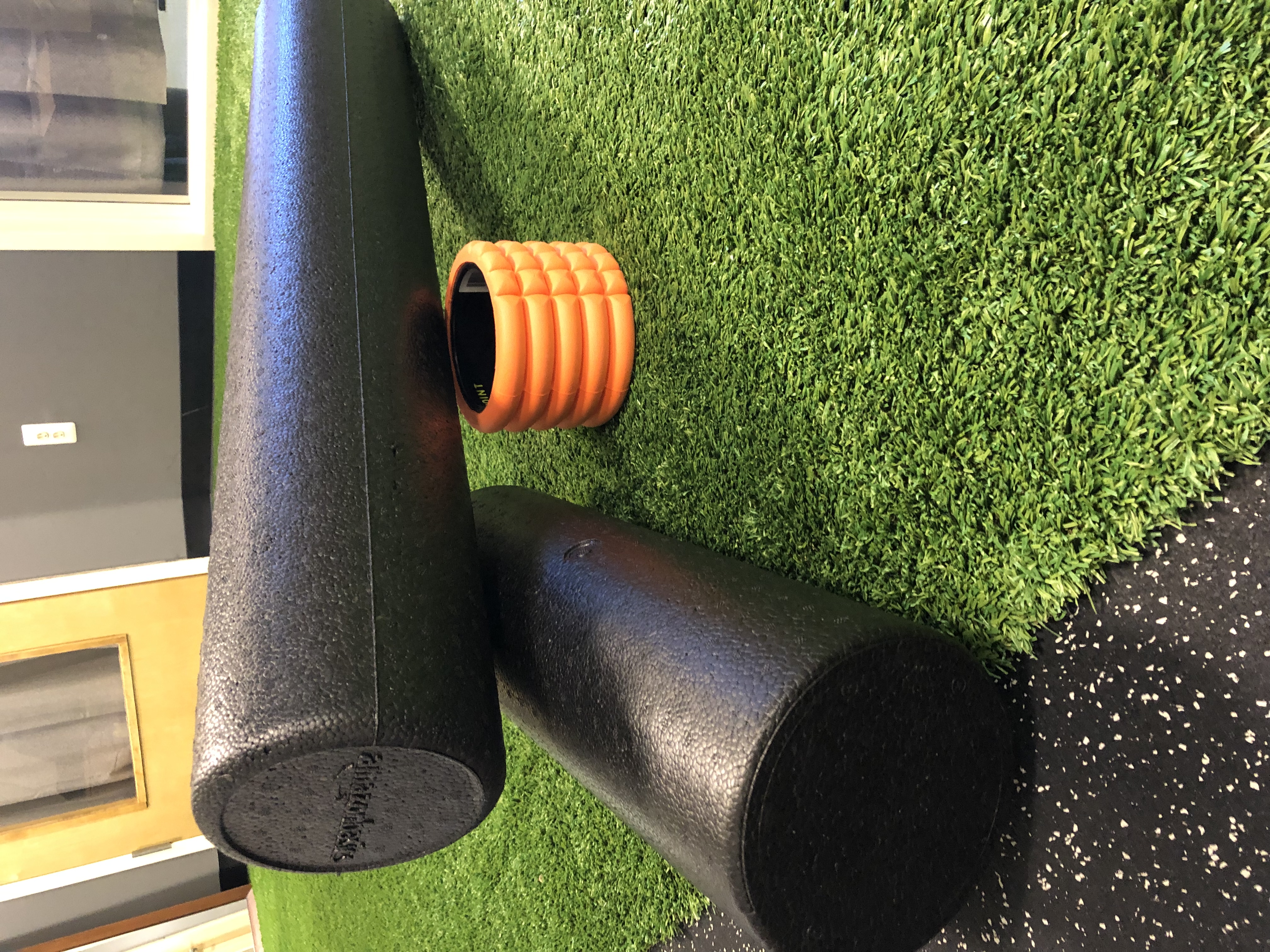
So.. what the heck IS foam rolling exactly? Well, it is rolling parts of your body (muscles) on a foam roller giving yourself your own “massage” or some might say “self myofacial release”.
It is frequently used to promote recovery, flexibility and athletic performance. However, as everyone began to become obsessed with it over the past few years, we have learned more about what it DOES NOT do verses what is DOES do. It has NOT been proven to provide long term effects on recovery, perform, OR flexibility. Short term effects on flexibility? Sure. Long term (what we really want)..? Not so much.
The widely accepted theory is that foam rolling / lacrosse balling / super nova-ing is a way to “release” fascia (soft tissue surrounding all organs, muscles, bones and nerve fibers), adhesions, muscular restrictions, etc. This restriction, adhesion or tightness of this fascia causes decreased joint range of motion and blood flow.
Here is the real deal.. to actually CHANGE the tissue that is underneath your skin (aka fascia) you need a SIGNIFICANTLY higher force than a human exerting it on themselves would need to be used! So let’s get one thing straight.. you ARE NOT releasing anything..
So why are we getting those short-term improvements in flexibility, pain relief, etc..?
The theory is that foam rolling CAN stimulating the nervous system to relax which in addition will improve pain tolerance. Similar to other things like stretching, deep breathing and meditation..
Our Advice? USE IT IF YOU LIKE IT AND UNDERSTAND THAT IT PROVIDES SHORT TERM EFFECTS ONLY.
Apply during your warm up (no more than 2-3 mins)
5-10 passes over each muscle group
We know that more does not mean improved outcomes…
So.. in short. Foam rolling or self mobilization can give you short term gains in flexibility, decrease muscle soreness and pain. KEY WORD IS SHORT TERM! What can it do long term? …..? Unsure.
If you foam roll and you feel like it helps you in your workouts and promotes recovery, then keep it up! If you foam roll and are in agony and doesn’t seem to help you then giving it a miss might not be a bad idea!
Learn how your body reacts and do what feels good!

by Pippa Teague, Strength Coach | May 14, 2019 | Back Pain, Injury, Injury Prevention, knee pain, Ladies, lifts, Neck Pain, Running, running help, strength training, Uncategorized, working with injury
By Loni Rodriguez,
Physical Therapist
Do you know what fires me up more than anything? It’s hearing a story from a client that begins with… “I felt like the doctor did not understand where I was coming from.”
You may not know this story, but I dealt with hip and low back pain for just over 2 years when I was going through graduate school. It came on gradually while running one day on the treadmill. It was sharp, came on strong and would not let go. It gradually persisted and ultimately led me to have to stop running all together. It derailed me and created a borderline depression around the fact that I was unable to exercise like I had wanted to. I went from running almost every day to dealing with persistent hip pain that I would feel first thing in the morning and be with me until the minute I went to bed. I would wake up wondering if it would just go away…
How I was going to be able to go out with friends? Sit at a baseball game? Go shopping? Play football with friends on the beach? It consumed me.
I went to a plethora of doctors and physical therapists, had injections, saw specialists and was convinced that my hip required surgery because one MRI found a cartilage tear. I was constantly searching for answers to the cause of my symptoms and coming up short time and time again. Fast forward 7 years, symptoms have improved dramatically and I no longer deal with persistent pain. I feel stronger and more resilient than ever… so what can I contribute it to? That is a question I do not have the answer to… yet, but is not the point of my story. I am not going to tell you I have the magic answer to solve all persistent pain like this… But I am damn sure I know what would have helped me along the way.
Looking back on this, I realized one common piece that I was missing. I didn’t have a healthcare provider that told me that I was going to get through this and they were going to guide me… that is all I wanted, someone to tell me they would lead me on a path to feeling better and more confident in my hip.
At 21 I had one person – a doctor, surgeon and low back pain specialist tell me that I was going to be dealing with pain for the rest of my life. I remember crying in my car after the session, not because I thought he was right, but because I knew he was wrong. I was more upset because I knew he was going to be giving that same screwed up advice to all the other poor souls in the waiting room. I knew that I had a better understanding of pain and did not want to take that answer as my fate.
I wanted someone to listen to my entire story and not seem like the details were obsolete. I remember creating a pain log to show one of my providers and they didn’t even look at it. Finally, overtime I gradually improved and found my way of returning to exercise – running, lifting weights, competing in CrossFit and running races without even thinking about my hip or low back. This took time and hard work, but I made it.
This is not how an experience with a medical professional should be. You should 110% be involved in your own plan and be guided in that direction.
Have you ever had an experience with this? Have you ever been a fly on the wall in this situation with a family member? How many times have you or someone you know had to accompany a family member at a doctors appointment because you do not remember what they said.
I would love to hear YOUR story…
It does not have to be like this! Seek other advice from someone who listens.
Thank you for taking the time to read and have an awesome rest of the week!
by Dr. Loni Rodriguez | Dec 17, 2018 | Exercise advice, Injury Prevention, lifts, Running, running help, squats, strength training
Why should runners strength train? PART II

Again, this post was inspired by Chris Johnson, my GO-TO for all things running!
For more information about Chris and some of the amazing content he has to offer, visit his website at Chris Johnson PT.
In the last post, we covered some of the benefits of strength training and the specific importance of this practice for runners. In this second piece, I will cover some of the most important and effective exercises that a runner’s strength training routine should include.
Dynamic Warm Up
This is often neglected by runners because it is easy just to get out and run. We want to allow adequate perfusion of blood to the necessary tissues and prepare the nervous system for the run itself. There is also likely too much time spent on unnecessary stretching. This stretching has little to no effect on injury prevention or preparing for the run.
Here are two recommended exercises that can be included in a dynamic warm up:
Hugging knee to chest
Quad stretch with overhead reach
The March
It is important for a runner to demonstrate solid single leg balance. Marching provides training for single leg balance that simulates running. It also allows for training of shortened stride length which can help reduce the risk of running related injuries.
Here are two recommended marching exercises:
Baseline marching with or without weights
Prisoner March
Lateral Toe Tap
This exercise is important to train the glute muscles. The glutes play a large role at reducing running related injuries, as they are large contributors to the activity of running itself. This exercise directly targets those glutes, challenges single leg balance and simulates running as it is an upright activity.
Here are two recommended lateral toe tap exercises:
Lateral toe taps with band
Single leg stance hip abduction
Step up (7-8” step)
This exercise challenges single leg stance just like the demands of life. It is important to focus on control, coordination, and timing with this one. It is NOT an exercise that should be challenging on the muscles but more on balance, quality, and form.
Here are two recommended step up exercises:
Standard step up
Fluid step up
The Bridge
This exercises is one of the most basic yet it is very important. It is also performed without equipment. It works on glutes, hamstrings, calves, low back, and abdominals
It is great for preventing knee pain in runners.
Here are two recommended bridge exercises:
Standard bridge
Bridge march
The Plank
This is NOT just a core exercise. It challenges the lateral hip musculature which is very important for runners. It is recommended to not jump too quickly into unstable surface work as you want to master these first.
Here are two recommended plank exercises:
Standard plank arms bent with or without knee taps
Standard plank arms straight with or without knee taps
Calf Raise
Calves can not be overlooked in training for the lower body as they are the powerhouse for distance running. Calf exercises can create tissue resiliency and build capacity to tolerate the demands of the sport and resistance to injury.
Here are two recommended calf exercises:
Isometric double leg calf raise
Isometric single leg calf raise
Squat
The squat is the most fundamental strength training exercise that is involved in everyday life. It has the ability to create full body resistance to running-related injuries.
Here are two recommended squat exercises:
Air squat
Goblet Squat
Loaded Carry
Life demands that we carry stuff. So why not train it? Loaded carries play a primary role in working with runners of all ages and abilities as it is important to get acquainted with being tall and upright.
Here is a recommended carry exercise:
Farmers carry march
Deadlift
This exercise, along with the squat is one of the most important functional exercises that every human should perfect. It is also extremely important for injury prevention. The correct form is crucial and introductory exercises for this movement are important to perfect.
Here are a few deadlift exercises to introduce you to to the movement:
Hip hinge with PVC
KB Deadlift
WANT MORE?!?!?!?!?
Interested in live group training that covers this content?
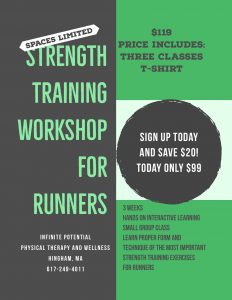
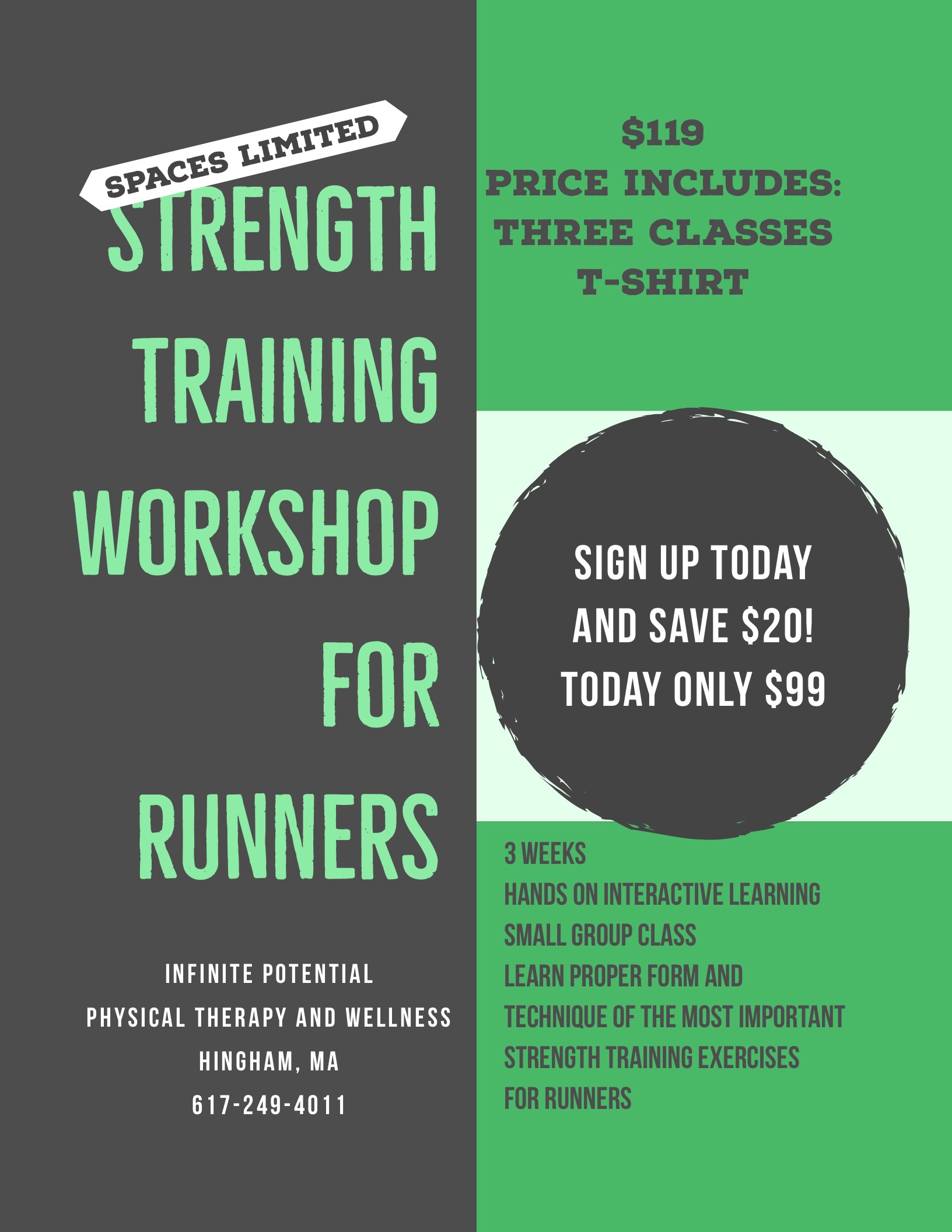
We will be hosting a 3-part series workshop held on 3 consecutive Wednesday’s in January from 6:30-7:30pm
JANUARY 9th, 16th, and 23rd.
This workshop will be located at our brand new office on 1 Derby Street in Hingham. Space is limited so please sign up ASAP!
Email Loni through loni@infinitepotentialptw.com or call 617-249-4011 x 700 for ANY and all questions!
Sign up through this link– choose the 6:30pm class on January 9th. Follow the prompts to complete registration.
 @
by Dr. Loni Rodriguez | Dec 11, 2018 | Exercise advice, Injury Prevention, Running, running help, strength training
Why should runners strength train? PART I
The following is a very brief overview of Chris Johnson’s book, Running on Resistance. For more information about Chris and some of the amazing content he has to offer, visit his website at Chris Johnson PT.
Strength training is an integral part of any regular exercise routine. Here are some major benefits of this fundamental practice:
- Builds cardiovascular health
- Improves body image
- Improves flexibility
- Improves full body resiliency and resistance to injury
For runners, not only are you focused on the above, but for more competitive runners, there is a focus on performance. There is an element of excitement when we improve our mile time or come back for a run feeling refreshed.
Here are some of the running specific benefits that strength training can provide:
- Improve capacity
- Increase running economy
- Increase speed
- Delay fatigue onset
Body weight exercises are a great entry into resistance training, yet additional resistance with the use of weighted equipment will provide the necessary stimulus to gain strength. However, to reduce the risk of injury from strength training, a general periodization program should be followed. There are various programs out there and have been proven to be effective. The major areas of interest when choosing a program are exercise selection, recommendations for load, repetition count, and rest periods. Each of these should be well understood and planned before initiating a program.
Here are some general recommendations
- Exercises need to be individualized to the person’s goals and exercise history
- Initially, 2-3 sets of 8-12 reps of bodyweight movement. Progressed then to weighted routine as form and comfort improves
- Single leg exercises need little to no rest
- Two-legged exercises require a rest of 1-2 minutes recommended
- Frequency is most effective at about two days per week for 12 weeks on days of lower volume running or drill/tempo days
Stay tuned for Part II, where I will review the most important and effective exercises for runners to add into their regular routine.
WANT MORE?!?!?!?!?
Interested in live group training that covers this content?
We will be hosting a 3-part series workshop held on 3 consecutive Wednesday’s in January from 6:30-7:30pm
JANUARY 9th, 16th, and 23rd.
This workshop will be located at our brand new office on 1 Derby Street in Hingham. Space is limited so please sign up ASAP!
Email Loni through loni@infinitepotentialptw.com or call 617-249-4011 x 700 for ANY and all questions!
Sign up through this link– choose the 6:30pm class on January 9th. Follow the prompts to complete registration.
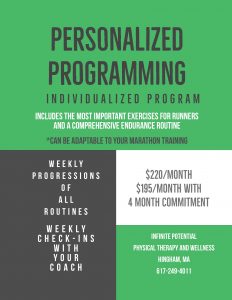
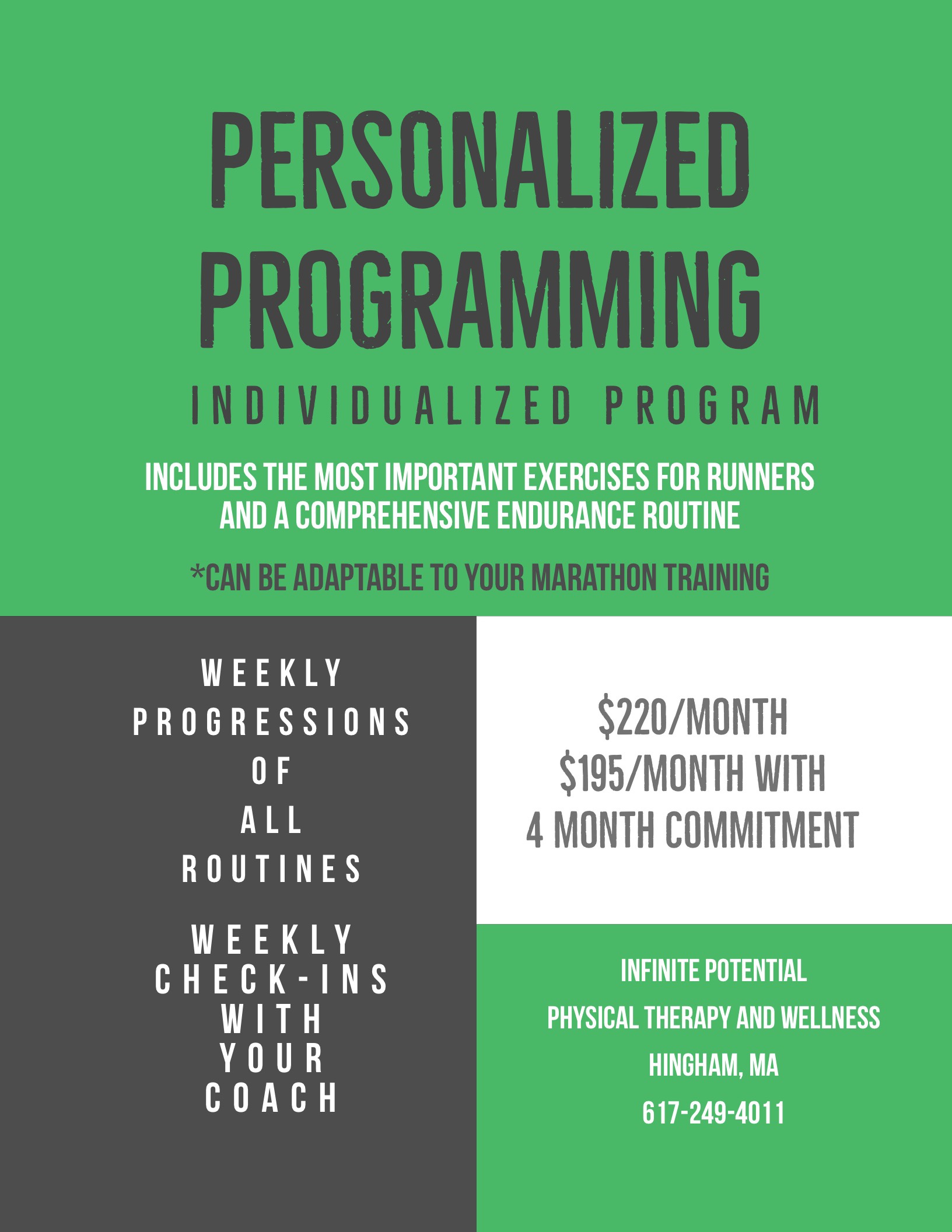
Are you interested in personalized programming?
It is a great way to safely and effectively implement this strength training program that was touched upon in the workshop.
HINT >>>> Most of it will be addressed in more detail in the 3-part series in January!
However, for a more personalized approach, the remote programming is a great way to be sure that you are doing EVERYTHING you need to do to improve your running performance and reduce your injury risk.
Email Loni through loni@infinitepotentialptw.com or call 617-249-4011 x 700 for ANY and all questions!

by Dr. Loni Rodriguez | Nov 19, 2018 | Back Pain, Exercise advice, Injury, Injury Prevention, knee pain, lifts, squats, working with injury
What to do when you are having pain during a workout?
Have you ever just left the gym or class when pain starts to occur? How annoying is that?! First off, you didn’t get a workout in, second, you might have hurt yourself… I hope not, and third, what do you do now? Should you go back to the gym tomorrow? Take a week off?
I really would like this post to come across the right way. I am by no means, telling you it is okay to push through any significant pain while exercising. What I would like to do is to provide a guideline of what to do when pain comes on during a workout.
Before I get into the guideline, there is one major exception:
*If you actually feel like you had an injury, as in, there was an EVENT that caused your pain, please stop exercising and seek medical attention*
Eg.
- if you fall off the treadmill, and feel a pop or snap in a joint followed by severe pain
- if you hit your head
- if something occurs and you notice immediate swelling and pain
…you get the point
What this guideline is NOT…
- A way to treat your pain
- A way to continue to exercise multiple sessions in a row without seeing guidance from a medical provider
- A way to avoid formally dealing with your injury
Point being… please seek medical advice to really help your issue!
In the meantime, I want you to be able to have some understanding of how to allow training to continue despite some pain vs taking time off.
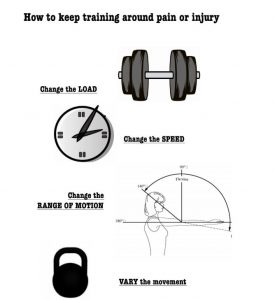
First… reduce the weight
- Try using a lighter weight, but continue the movement as prescribed.
- If the reps continue to be painful…
Next… slow it down
- Keep the weight and try using performing the movement slowly.
- If the reps continue to be painful…
Next… change the range of motion
- Keep the weight, return to a normal speed and limit how far you go into the movement being performed.
Finally… vary the movement
- There are various ways to perform different exercises.
- You can continue to get the same training effect while performing the movement in a slightly different way.
Here are a few examples of how you can vary the workout if you are experiencing pain during specific movements:
Knee pain with squatting?
- Reduce the load
- Alter the tempo – 3 seconds down, 3 seconds up
- Reduce the range of motion – Squat to a box or a bench
- Change the movement – go from front squats or goblet squats to a back squat
Back pain with deadlifting?
- Reduce the load
- Alter the tempo – try a quick lift from the floor and a slow lower
- Reduce the range of motion – Lift from an elevated surface (blocks or plates)
- Change the movement – go from a barbell to a hex bar or kettlebell
Use this to help keep yourself training, but PLEASE… also seek medical advice. There are many other things to be done in order to get you back to being pain-free during workouts… most of the time, it’s more exercise! Not rest.
